Tokyo National Museum: 120,000 Objects and 89 National Treasures in Ueno Park
Most visitors to Tokyo spend their museum time at the teamLab digital art spectacles or the Ghibli Museum. Both are fun. Neither tells you anything about Japan. The Tokyo National Museum (TNM) does. It holds approximately 120,000 Cultural Properties, including 89 National Treasures and 649 Important Cultural Properties. That is roughly 10% of all National Treasures designated by the Japanese government. If you want to understand Japanese visual culture from the Jomon period (10,000 BCE) through the Edo era, this is the only place that covers the full timeline with the depth to do it justice.
Founded in 1872 as the Ministry of Education Museum, TNM is Japan's oldest national museum. Executive Director Makoto Fujiwara has overseen the institution since 2025, managing a collection that rotates roughly 3,000 items on display at any given time, with each object shown for only four to eight weeks before being replaced. That rotation policy means repeat visits yield entirely different works, which is both a strength and a frustration: you cannot guarantee you will see a specific piece unless you check the current exhibition schedule before going.
What to See If You Only Have Two Hours
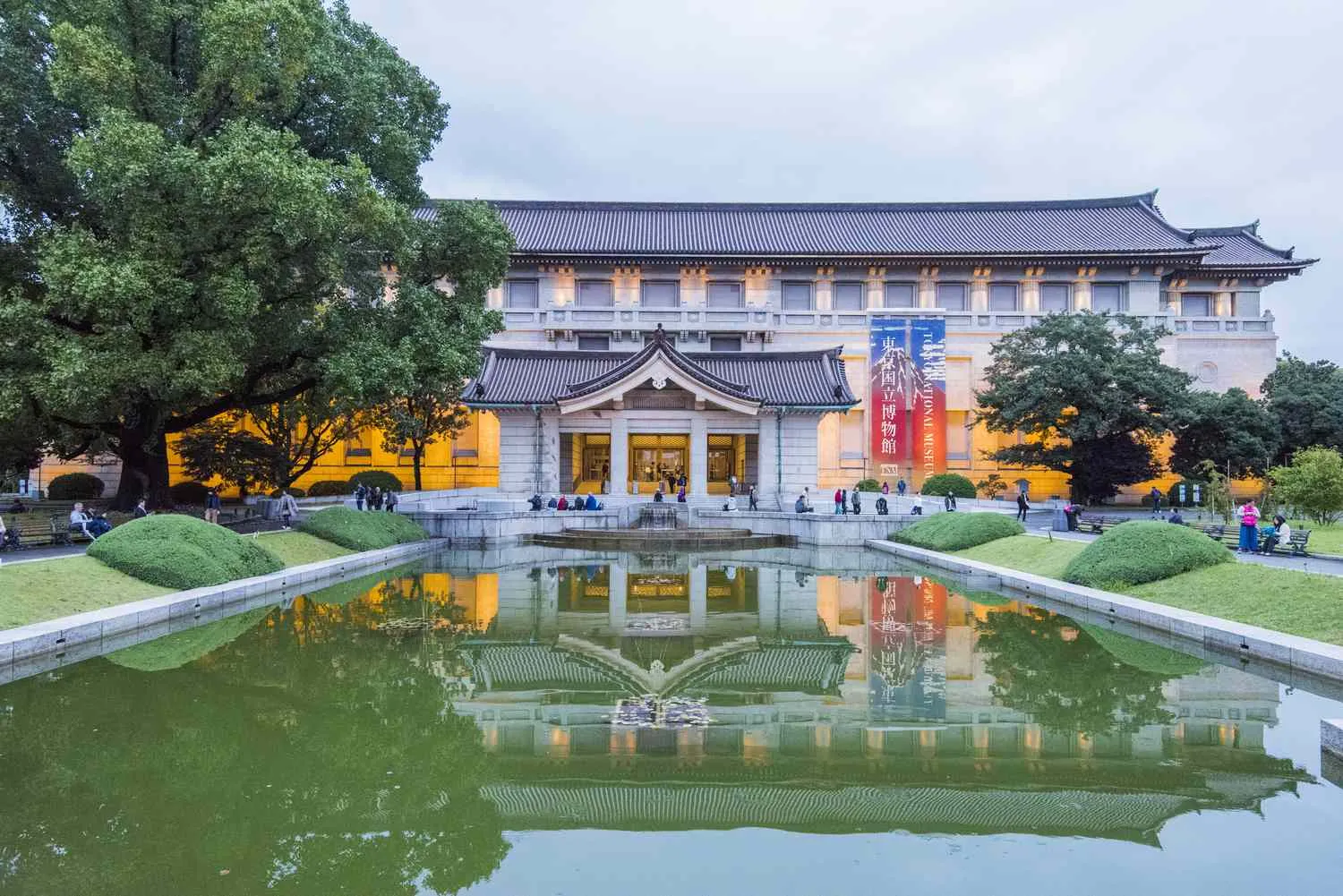
Start with the Honkan (Japanese Gallery), the main building designed by Watanabe Jin in the Imperial Crown Style, which blends Western structural engineering with a Japanese roofline. The second floor walks you chronologically through Japanese art: Jomon cord-marked pottery (some of the oldest ceramics in human history), Buddhist sculptures from the Asuka and Nara periods, Heian-era calligraphy, Muromachi ink landscapes, Momoyama decorative screens, and Edo-period ukiyo-e woodblock prints. If you skip everything else, do not skip this building.
The painting collection includes works by virtually every major Japanese painter. Sesshu Toyo's ink landscapes represent the peak of Japanese suiboku-ga. Hasegawa Tohaku's Pine Trees screens achieve an atmospheric depth that rivals any Chinese Song dynasty master. Ogata Korin's bold, stylized designs defined the Rinpa school. And the ukiyo-e holdings include works by Katsushika Hokusai and Utagawa Hiroshige, though the museum rotates these frequently, so check ahead if you want to see specific prints.
Next, head to the Toyokan (Asian Gallery), designed by Taniguchi Yoshio (who also designed the MoMA renovation in New York). This building contextualizes Japanese art within the broader Asian tradition, with Chinese paintings, Korean celadon, Southeast Asian sculpture, and Central Asian artifacts along the Silk Road. The Chinese and Korean galleries are particularly strong and help explain how Japanese aesthetic traditions developed through centuries of cross-cultural exchange.
If time permits, visit the Gallery of Horyuji Treasures, which holds 319 objects donated by the Imperial Family from Horyu-ji temple in Nara. These 7th-century Buddhist treasures are displayed in a building designed by Taniguchi Yoshio with lighting so precise that the gold leaf on bronze statues seems to glow from within. Most visitors skip this building because it is at the edge of the complex. That is a mistake.
The Sculpture and Sword Collections
The Buddhist sculpture collection traces the development of Japanese religious art from the 6th century onward. The Kamakura-period works by Unkei and Kaikei are the standout. These sculptures combine physical realism, spiritual intensity, and technical virtuosity in a way that places them among the great sculptural traditions in world art. Unkei's wooden figures in particular have a warmth and humanity that challenges any assumption that medieval religious sculpture is stiff or formulaic.
The sword and armor collection is one of the finest in existence. Japanese swords are classified as art objects under Japanese law, not weapons, and the TNM's collection demonstrates why. The forging techniques, the hamon (temper line) patterns, and the mounting craftsmanship elevate these objects to the level of sculpture. If you have any interest in metalwork or craft traditions, the sword gallery on the first floor of the Honkan is worth 30 minutes on its own.
How It Compares
Against other Japanese national museums, TNM is the most comprehensive for ancient and medieval Japanese art. The Kyoto National Museum has stronger holdings in specific areas of Japanese antiquities, and the Nara National Museum specializes in Buddhist art, but neither matches TNM's breadth. The National Museum of Modern Art, Tokyo picks up where TNM's collection effectively ends, covering modern and contemporary Japanese art.
Internationally, TNM is comparable to the British Museum in its role as a national repository of cultural heritage, though TNM's focus is narrower (Japan and Asia versus global). It is smaller and more focused than the Metropolitan Museum of Art or the Louvre, but for Japanese art specifically, no museum anywhere matches its depth.
Insider Tips
Go on Friday or Saturday. The museum stays open until 8 PM on those days, and the evening hours are noticeably less crowded. Weekday mornings are also manageable, but weekend afternoons get packed, especially during special exhibitions.
Check gallery closures before you go. The museum regularly closes individual rooms for exhibition rotation and environmental maintenance. In 2026, several Honkan galleries are scheduled for closure on a rotating basis (Room B through June, Room 4 from October, Rooms 17-20 and the Toyokan from late November). Check the TNM website for the current closure schedule.
The restaurants are under renovation. The museum restaurants in the Toyokan and the Gallery of Horyuji Treasures are closed for renovation and scheduled to reopen in stages from summer to autumn 2026. In the meantime, food trucks operate in the front yard, and there are plenty of restaurants in Ueno Park outside the museum gates.
Do not confuse TNM with the National Museum of Western Art. Ueno Park contains four major museums. The National Museum of Western Art (designed by Le Corbusier, a UNESCO World Heritage Site) is right next door and focuses entirely on European art. The National Museum of Nature and Science and the Tokyo Metropolitan Art Museum are also in the park. If you have a full day, you can visit two or three of these, but do not try to do all four.
Free admission days. TNM offers free entry to the permanent collection on May 19 (International Museum Day), September 21 (Respect for the Aged Day), and November 3 (Culture Day). Special exhibitions still require separate tickets.
Practical Information
Admission: ¥1,000 for adults, ¥500 for university students, free for visitors under 18 and over 70 (bring ID). Special exhibitions require separate tickets priced individually. Persons with disabilities and one accompanying person enter free.
Hours: 9:30 AM to 5:00 PM. Open until 8:00 PM on Fridays and Saturdays. Closed on Mondays (if Monday is a holiday, the museum opens and closes the following Tuesday instead). Last admission 30 minutes before closing.
Getting there: 10 minutes from JR Ueno Station (Park Exit) or JR Uguisudani Station. Tokyo Metro Ueno Station and Keisei Ueno Station are about 15 minutes on foot.
Book tickets: tnm.jp
Final Verdict: Who Is This Actually For?
Anyone who wants to understand Japanese art and culture beyond the surface level. TNM is not a museum you can absorb in an hour. It rewards slow looking and repeat visits, and the rotating display policy means you will see different objects each time. If you are only in Tokyo for a few days and must choose between TNM and a contemporary art destination, your choice depends on what you want from the trip. But if you care about Japanese history, craft traditions, or Buddhist art, skipping TNM would be like visiting Paris and skipping the Louvre. It is the foundational institution, and it earns that status through the quality of what it holds.