MALI Lima: 2026 Is the Year of Women Artists at Peru's Premier Museum
In 2026, the Museo de Arte de Lima (MALI) has dedicated its entire exhibition program to women artists. Four major shows, running simultaneously, examine the contribution of women to Peruvian and Latin American art: Julia Codesido, recognized as Peru's first professional female painter; Sandra Gamarra Heshiki, in a panoramic retrospective co-organized with MASP in Sao Paulo; Astrid Jahnsen, a Peruvian photographer based in Madrid; and Olinda Silvano (Reshinjabe), a Shipibo-Konibo artist and activist whose work redefines the kené tradition within contemporary Peruvian art.
This is not a token gesture. It is a sustained, institution-wide commitment that positions MALI as one of the most forward-thinking museums in Latin America. The program has drawn attention from across the region and makes 2026 an exceptional time to visit.
What MALI Is
The Museo de Arte de Lima is Peru's most important art museum, holding over 17,000 works that span 3,000 years of Peruvian artistic production. The collection runs from pre-Columbian ceramics and textiles through colonial painting and republican-era portraits to contemporary installation and video art. No other museum in the country tells this full story.
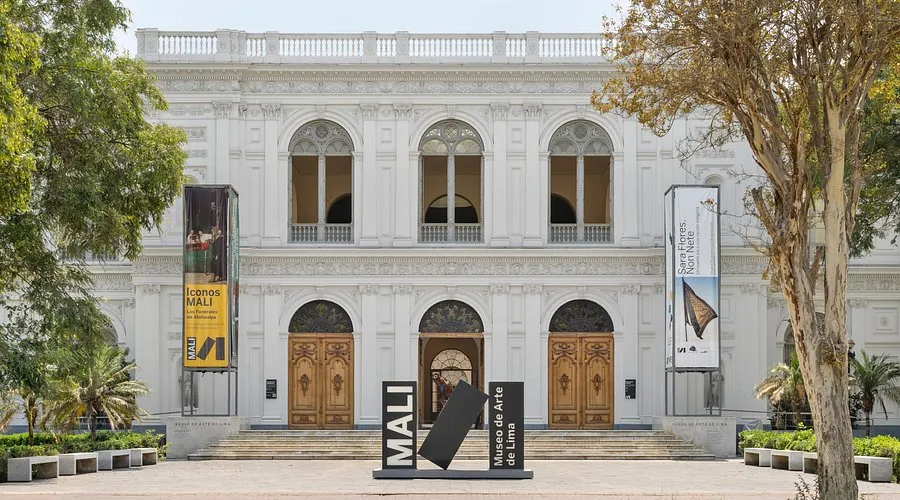
MALI is housed in the Palacio de la Exposicion, a neoclassical and Art Nouveau building constructed in 1872 for Lima's International Exhibition. The building, designed by Italian architect Antonio Leonardi, features wrought-iron architecture that reflects the cosmopolitan ambitions of 19th century Lima. A major renovation in the early 2000s modernized the galleries while preserving the historic character of the original structure. The museum sits in the Parque de la Exposicion, a historic park in central Lima that provides a green setting in the middle of the city.
Sharon Lerner, who has held curatorial roles at MALI since 2012 and serves as Curator of Contemporary Art, has been a driving force behind the museum's contemporary program. She has led major exhibitions connecting local contexts with international platforms, including projects with the Getty Foundation's PST: LA/LA initiative and ARCO Madrid. The 2026 women artists program reflects her curatorial vision.
The 2026 Women Artists Program
Julia Codesido (June 17 through November 1, 2026)
Curated by Luis Eduardo Wuffarden and Ricardo Kusunoki, this exhibition explores the career of Julia Codesido, widely recognized as Peru's first professional female painter. Born in Lima in 1883, Codesido was an influential teacher, a pioneering collector of Peruvian folk art, and an ethnographic researcher. The show examines her dialogue with modernist avant-garde movements, Peruvian folk art, and the cultural transformations that shaped more than five decades of her production.
Codesido was linked to the Indigenist movement of Jose Sabogal but transcended its orthodoxy through her early contact with international modernism. Among her contemporaries, she stood out as an original, free, and audacious figure, capable of reconciling a vision anchored in Peruvian identity with formal explorations that kept her relevant throughout the 20th century. The exhibition is supported by the Fundacion Julia Codesido y Estenos and sponsored by Bank of America.
Sandra Gamarra Heshiki
The first panoramic retrospective of Sandra Gamarra Heshiki, co-organized with MASP and curated by Florencia Portocarrero and Sharon Lerner. The exhibition is structured around the concept of "replica" as a response to dominant narratives, an appropriation of artistic traditions, and a rereading of the artist's own trajectory. The project unfolds simultaneously in two Latin American institutions, creating a dialogue between different contexts.
Astrid Jahnsen: Doscientos Gramos (Two Hundred Grams)
The first exhibition in Lima by Peruvian photographer Astrid Jahnssen, based in Madrid. The show takes as its starting point an 1903 claim by astronomer Camille Flammarion that "the female brain was 200 grams lighter than the male." Jahnsen investigates the scarce and diffuse representation of women in 20th century encyclopedias, producing a photographic series that recovers the presence of historically omitted women.
Olinda Silvano (Reshinjabe): Mi Kene Brilla al Mundo
An individual exhibition of Reshinjabe, the Shipibo-Konibo name of Olinda Silvano Inuma. The show traces the path of an artist, activist, and Indigenous leader whose work redefines the kené within contemporary Peruvian art. Curated by historian Maria Eugenia Yllia, the exhibition brings together early pieces with recent productions, showing the expansion of her practice into new supports and platforms, including digital spaces from which the artist builds a public voice of wide reach.
The Permanent Collection: 3,000 Years of Peruvian Art
Beyond the temporary exhibitions, MALI's permanent collection is the most comprehensive survey of Peruvian art anywhere.
Pre-Columbian Art
The pre-Columbian galleries are the museum's foundation. Andean textiles from the Paracas, Nazca, Wari, and Inca cultures represent one of the most remarkable artistic achievements of any pre-Columbian civilization. Some Paracas textiles, dating to approximately 200 BC, contain over 190 different hues of naturally dyed fiber, a chromatic sophistication not matched in Europe until the 19th century.
Moche portrait vessels are the other highlight: ceramic vessels modeled as individual human faces with a naturalism and psychological presence that rivals portraiture from any ancient civilization. Nazca polychrome ceramics and Chimu and Inca metalwork in gold, silver, and copper alloy further demonstrate the range of pre-Columbian Peruvian art.
Colonial Art
The colonial collection documents the cultural synthesis that occurred when Spanish and Indigenous Peruvian traditions met. The Cusco School of painting blended European religious iconography with Andean aesthetic sensibilities, producing a distinctive tradition that is central to colonial Latin American art. Indigenous artists adapted European techniques to express their own cultural values, creating works that are neither purely European nor purely Indigenous but something new.
Modern and Contemporary Art
The modern galleries trace the development of Peruvian artistic identity. Jose Sabogal and the Indigenist movement of the 1920s and 1930s sought to create a Peruvian art rooted in Indigenous culture rather than European models. Fernando de Szyszlo created abstract paintings drawing on pre-Columbian imagery and Andean cosmology, developing a form of abstraction that was distinctively Latin American. The contemporary galleries reflect the diversity of Peru's current art scene, engaging with identity, memory, social justice, and the complex cultural heritage of a nation encompassing Indigenous, European, African, and Asian influences.
How MALI Compares
MALI is to Peru what the Museo Nacional de Bellas Artes is to Chile or what MASP is to Brazil: the national art museum that tells the country's full artistic story. But MALI's pre-Columbian collection gives it a depth that the Santiago and Sao Paulo museums cannot match. Peru's artistic traditions predate European contact by millennia, and MALI is the only museum that presents that full continuum.
Compared to the Museo del Oro in Bogota, which has extraordinary pre-Columbian goldwork but a narrower scope, MALI offers a broader survey across media and time periods. Compared to the Metropolitan Museum or the Musee du Quai Branly, which hold significant Peruvian objects in their encyclopedic collections, MALI provides the local context and scholarly depth that only a national museum can offer.
The 2026 collaboration with MASP on the Sandra Gamarra retrospective signals MALI's ambition to be a regional leader, not just a national one. The parallel exhibitions in Lima and Sao Paulo create a dialogue between two of South America's most important art institutions.
Planning Your Visit
Admission: S/ 30 for general admission. Peruvian residents pay S/ 15. Seniors (65+), students, teachers, and persons with disabilities pay S/ 15 (residents S/ 5). Children under 8 enter free. First Sunday of each month is S/ 1. Thursdays from 3 PM are free. Last Friday of each month from 5 PM is free.
Hours: Tuesday to Sunday, 10 AM to 6 PM. Saturdays until 5 PM. Last Friday of each month until 10 PM. Closed Mondays.
Getting there: MALI is in the Parque de la Exposicion in central Lima. The nearest metro station is Estacion Central on Line 1. Taxi or ride-share is the most convenient option for most visitors.
Nearby: The Parque de la Exposicion itself is worth exploring, with gardens, fountains, and other cultural venues. Lima's historic center, a UNESCO World Heritage Site, is a short taxi ride away. The Museo Larco in Pueblo Libre, with its extraordinary collection of pre-Columbian erotic ceramics and goldwork, is a complementary visit for anyone interested in Peru's ancient cultures.
Language: Interpretive materials are primarily in Spanish. English translations are limited. If you do not read Spanish, consider hiring a guide or using a translation app.
Final Verdict: Who Is This Museum For?
MALI is for anyone who wants to understand the full scope of Peruvian art, from pre-Columbian textiles to contemporary Indigenous activism. The 2026 women artists program makes it an essential destination this year: four major exhibitions that together argue for a fundamental rethinking of who gets included in the story of Latin American art.
The pre-Columbian collection alone justifies a visit. The Paracas textiles and Moche portrait vessels are objects that change how you think about what ancient art could accomplish. And the contemporary program under Sharon Lerner's curatorial leadership is connecting MALI to the broader Latin American art conversation in ways that previous decades did not.
The downside? The museum's facilities are showing their age in places, and the interpretive materials need better English translations. The building's historic character is part of its charm, but it also means some gallery spaces are less than ideal for contemporary installations. Go with realistic expectations, and prioritize the temporary exhibitions if you are visiting in 2026.
Check exhibition dates and buy tickets at mali.pe.