Philadelphia Museum of Art: 150 Years Old and Running Up Those Steps Again
The Philadelphia Museum of Art (PMA) is celebrating its 150th anniversary in 2026, and the museum has used the occasion to fix one of its most criticized policies: the elimination of Pay What You Wish Fridays in 2024. The program returned in April 2026 as Independent Fridays, running from 5 to 8:45 PM every Friday through September 4, with the first Sunday of every month also Pay What You Wish. The pilot run in January 2026, during the final weeks of the Dreamworld: Surrealism at 100 exhibition, produced a 128% increase in attendance and a 20% increase in admission revenue over the same period. Sometimes accessibility and revenue move in the same direction.
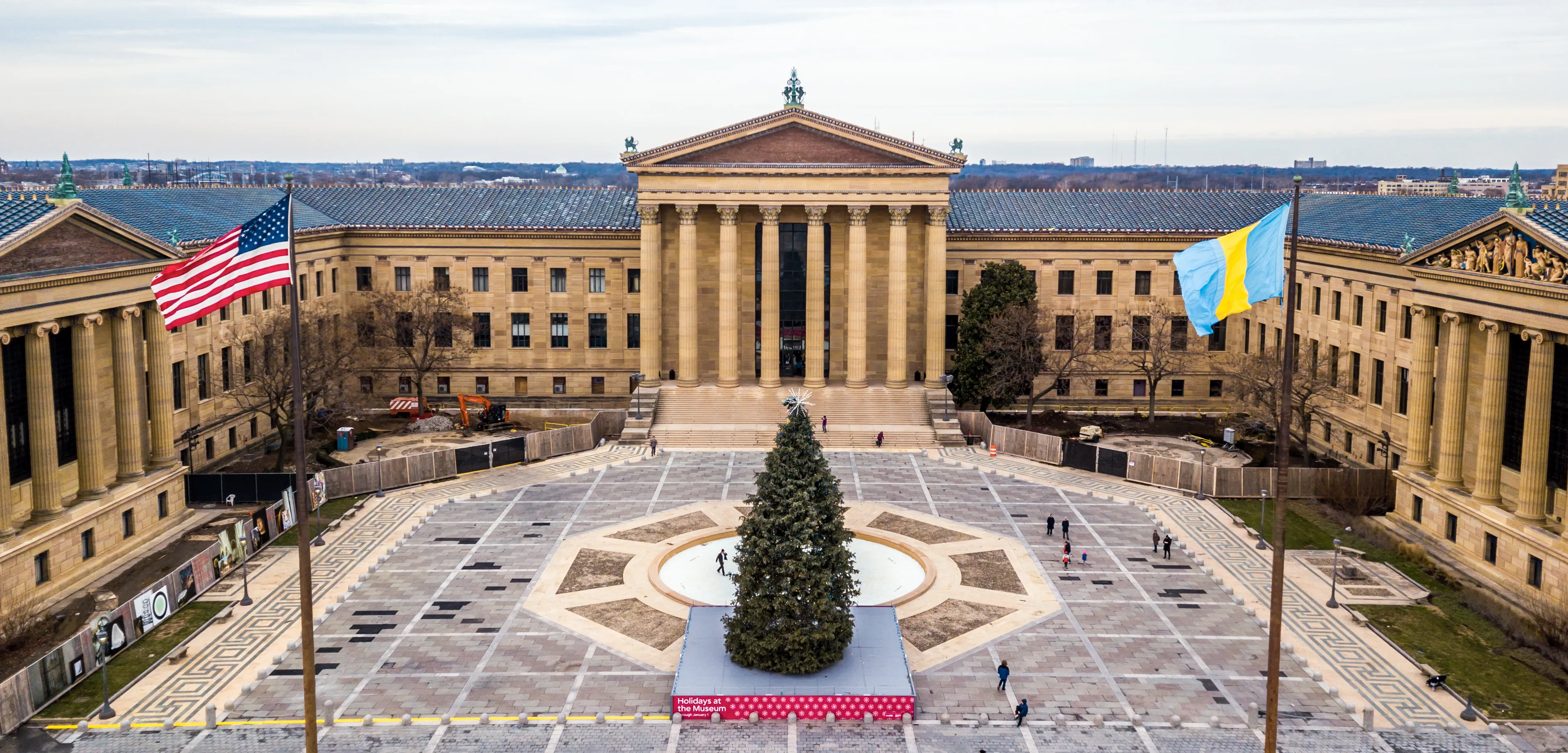
General admission is now $30 for adults, up from the $20 listed in older guides. Children 18 and under are always free. The museum sits at the terminus of the Benjamin Franklin Parkway, in a Neoclassical building whose 72 stone steps were immortalized by Sylvester Stallone in Rocky (1976). The bronze Rocky statue at the base of the steps is one of the most photographed objects in Philadelphia, which tells you something about the relationship between high art and popular culture in this city.
What to See If You Only Have Two Hours
Start with the Duchamp collection. The PMA holds the world's most important collection of works by Marcel Duchamp, assembled largely through the generosity of collectors Walter and Louise Arensberg. The collection includes major paintings, readymades, and the artist's final masterwork, Étant donnés (1946-1966), a mixed-media installation that can only be viewed through two small peepholes in a wooden door. Duchamp created it in secret over twenty years and revealed it only after his death. It remains one of the most discussed and debated works in modern art history. If you have time for nothing else, see this.
From there, move to the Thomas Eakins galleries. The PMA holds the world's most comprehensive collection of works by Philadelphia's greatest painter. The Gross Clinic (1875), depicting surgeon Dr. Samuel Gross performing an operation before a gallery of medical students, is one of the most powerful works of American realism. The painting's combination of scientific precision and psychological intensity got it rejected from the Centennial Exposition's art exhibition in 1876, which is how the PMA itself was founded. The irony is worth savoring.
If time permits, the European painting galleries include works by Rogier van der Weyden, Rubens, Poussin, Delacroix, Monet, Renoir, Cézanne, Van Gogh, and Toulouse-Lautrec. Picasso's Three Musicians (1921), a masterpiece of Synthetic Cubism, is usually on view.
The 2026 Exhibition Program: A 150th Birthday Worth Attending
The PMA's 2026 schedule is built around two anchors and several supporting shows.
A Nation of Artists (opened April 12, 2026) is a landmark collaboration between the PMA, the Pennsylvania Academy of the Fine Arts, and the private Middleton Family Collection. The dual-venue exhibition brings together American art from the founding era through the present, highlighting the creative vision and cultural diversity that shaped the United States. It is the kind of show that could only happen in Philadelphia, where the country's oldest art museum and oldest art academy sit within walking distance of each other.
Rising Up: Rocky and the Making of Monuments (opened April 25, 2026, closes August 2) explores the iconic Rocky statue and its complicated relationship with public art, civic identity, and the line between kitsch and culture. If you have ever wondered why a movie prop became one of Philadelphia's most beloved public sculptures, this exhibition provides the answer.
Van Gogh's Sunflowers: A Symphony in Blue and Yellow (June 6 to October 11, 2026) displays two of Van Gogh's celebrated sunflower paintings side by side: the 1888 version on loan from the National Gallery in London and the 1889 version from the PMA's own collection. This is a rare opportunity to see two paintings from the series in direct conversation.
Workshop of the World: Arts and Crafts in Philadelphia (July 12 to October 11, 2026) explores the region's contributions to the Arts and Crafts movement after the 1876 Centennial Exposition, with over 250 objects including ceramics, furniture, metalwork, textiles, and stained glass. The exhibition features work by Samuel Yellin, Henry Chapman Mercer, Violet Oakley, and contemporary makers including Roberto Lugo and Syd Carpenter.
From July 2 through August 2, general admission includes access to all special exhibitions at no additional charge, a significant savings given that special exhibitions typically require separate tickets.
How It Compares
The PMA is an encyclopedic museum in the same category as the Metropolitan Museum of Art and the Art Institute of Chicago. It is smaller than the Met (240,000 objects versus the Met's 1.5 million) but more focused in its strengths. The Duchamp collection is unmatched anywhere. The Eakins holdings are unmatched anywhere. The Arms and Armor collection is one of the finest in the United States.
Against the Museum of Fine Arts Boston, the PMA has a stronger American art collection and a more distinctive architectural identity. Against the Whitney Museum in New York, the PMA is broader in scope and historical range, though the Whitney has a deeper commitment to contemporary American art specifically.
The period rooms are a standout feature. The PMA has dismantled, transported, and reconstructed complete interiors from historic buildings, including a medieval French cloister, a Japanese ceremonial teahouse, a Chinese palace hall, and rooms from historic American and European buildings. These allow you to experience art as it was meant to be seen, in the environments for which it was created, not as isolated objects on white walls.
Insider Tips
Friday evenings are the best time to visit. Pay What You Wish admission runs from 5 to 8:45 PM every Friday through September 4, 2026. The museum is less crowded in the evening, and the policy means you can see the permanent collection for whatever you can afford. After September 4, Friday evenings continue at a discounted rate of $15.
The first Sunday of every month is Pay What You Wish all day. This is a permanent policy, not limited to the 2026 promotion. Arrive early, as it draws larger crowds than a typical Sunday.
The Rocky Steps are free. Running up the 72 steps is a Philadelphia ritual. The view from the top, looking down the Benjamin Franklin Parkway toward City Hall, is one of the best free views in the city. The Rocky statue at the base is usually surrounded by a line of tourists waiting for photos, but it moves quickly.
The Barnes Foundation is a 10-minute walk away. If you are making a day of it, the Barnes Foundation, at 2025 Benjamin Franklin Parkway, houses one of the world's finest collections of Post-Impressionist and early Modern paintings. The Rodin Museum is also on the Parkway, closer to the PMA. You can visit all three in a single day if you start early.
The period rooms are easy to miss. They are tucked into the lower galleries and are not always clearly signed. Ask at the information desk for directions to the Japanese teahouse and the medieval cloister, both of which are worth seeking out.
Getting there: The museum is at 2600 Benjamin Franklin Parkway. The nearest SEPTA station is Fairmount on the Broad-Ridge Spur line, about a 10-minute walk. Bus routes 7, 32, 33, and 48 all serve the area. Parking is available in the museum's underground garage.
Practical Information
Admission: $30 adults, $28 seniors, $14 students, free for children 18 and under, free for members. Pay What You Wish Friday evenings 5 to 8:45 PM through September 4, 2026. First Sunday of every month: Pay What You Wish all day. From July 2 through August 2, general admission includes all special exhibitions.
Hours: Tuesday through Sunday 10 AM to 5 PM (Thursday until 8:45 PM, Sunday from 11 AM). Closed Mondays.
Book tickets: philamuseum.org
Final Verdict: Who Is This Actually For?
Anyone interested in American art, Duchamp, Eakins, or encyclopedic museum collections. The 150th anniversary programming makes 2026 an unusually good time to visit, with the Van Gogh Sunflowers pairing and the Rocky statue exhibition both running through the summer and fall. At $30, general admission is not cheap, but the return of Pay What You Wish Fridays and the first-Sunday policy give you affordable options if you plan ahead. The period rooms, the Arms and Armor collection, and the Duchamp holdings are reasons to visit even if you skip every special exhibition. Skip it only if you have zero interest in art before 1950, and even then, the contemporary programming might surprise you.