Musee de l'Orangerie: Standing Inside Monet's Vision in 2026
2026 is the centenary of Claude Monet's death, and the Musee de l'Orangerie is marking it with Monet, Painting Time, a major exhibition examining his entire body of work through the lens of time: the fleeting moments of Impressionism, the serial fragmentation of the Haystacks and Rouen Cathedral, and the final continuum of the Water Lilies. Nearly 40 paintings, mostly from the Musee d'Orsay and Musee Marmottan Monet, will be gathered alongside the permanent Nymphéas installation. If you are planning a trip to Paris in 2026, this is the show to prioritize.
But even without the centenary exhibition, the Orangerie would be essential. It offers what may be the most powerful single art experience in any museum: walking into the purpose-built oval galleries that house Monet's monumental Water Lilies (Nymphéas) murals. Eight enormous paintings wrap around two elliptical rooms, immersing you in a 360 degree panorama of water, light, reflection, and color that Monet spent the last thirty years of his life perfecting.
The Water Lilies: An Immersive Experience
These paintings are not simply large. They are architectural in scale. Each panel measures approximately 2 meters high and stretches up to 17 meters wide. Standing in the center of either oval room, you are surrounded by Monet's water garden at Giverny across the full range of natural light: morning, midday, afternoon, and sunset. The loose, atmospheric brushwork of his final decades dissolves into pure color and sensation at viewing distance.
Monet conceived the Water Lilies as a gift to France, a place of peaceful contemplation in the aftermath of World War I. He worked on the panels from the 1910s until his death in 1926, refining them obsessively despite deteriorating eyesight. The galleries were designed specifically to house these works, with natural light filtering through translucent ceilings to create the diffused illumination Monet intended. The installation was completed in 1927, just months after the artist's death.
A major renovation completed in 2006 restored the natural overhead lighting that Monet had specified and that decades of modifications had compromised. The renovation also opened the lower level to display the Guillaume Collection in newly designed galleries, creating the two-level museum experience visitors see today.
For painters, the Water Lilies are an essential pilgrimage. Seeing them in reproduction provides no preparation for their physical presence. The scale of the brushwork, the layering of pigment, the chromatic complexity visible only at close range, and the enveloping spatial experience of the oval galleries must be experienced in person.
Monet, Painting Time: The 2026 Centenary Exhibition
The centenary exhibition, organized within the Orangerie itself, takes advantage of the unique setting. The museum describes the Nymphéas galleries as the "Sistine Chapel of Impressionism" (a phrase coined by Andre Masson in 1952), and the exhibition uses this context to reexamine Monet's entire career through the concept of time.
The show traces Monet's development from the 1870s, when he was regarded as the Impressionist artist par excellence, through the series paintings of the 1890s (Haystacks, Poplars, Rouen Cathedral), to the final Water Lilies cycle. The exhibition argues that Monet's relationship with time, from capturing fleeting moments to exploring duration and continuum, is the thread that connects his entire body of work. Nearly 40 paintings from the Musee d'Orsay, Musee Marmottan Monet, and international loans will be on view.
This is the first major Monet exhibition held within the same building as the permanent Nymphéas installation, creating a dialogue between the series paintings and the monumental decorations they culminated in.
Henri Rousseau: A Painter's Ambition (Through July 20, 2026)
Running alongside the permanent collection is Henri Rousseau, A Painter's Ambition, a collaboration with the Barnes Foundation in Philadelphia. The exhibition opened in Philadelphia in October 2025 and moved to the Orangerie in March 2026. It brings together a significant body of Rousseau's works that passed through the hands of art dealer Paul Guillaume, connecting the exhibition to the Orangerie's own Guillaume Collection.
The show is the first time the Barnes Foundation has lent works to a European institution, making it a notable event for anyone interested in early 20th century modernism and the relationship between naive and avant-garde painting.
The Jean Walter and Paul Guillaume Collection
Beyond the Water Lilies, the Orangerie houses the Jean Walter and Paul Guillaume Collection on the lower level. Guillaume was one of Paris's most visionary art dealers, and the collection provides a concentrated survey of the artistic revolution that transformed European painting between 1860 and 1930.
Cezanne still lifes and landscapes demonstrate the structural analysis of form that would influence Cubism. Renoir's late nudes radiate with luminous flesh tones. Matisse's Odalisques explore pattern, color, and sensuality. Modigliani's elongated portraits carry their distinctive elegance. Henri Rousseau's jungle paintings anticipate Surrealism with their naive power.
The intimacy of the galleries, far smaller than the Louvre or Musee d'Orsay, allows prolonged contemplation of each work without the crowd pressure that larger institutions impose. You can stand alone in front of a Modigliani for ten minutes. Try doing that at the Louvre.
Why Painters Need to Visit
The Orangerie holds particular significance for practicing painters and art students. The Water Lilies represent Monet's final artistic statement, the culmination of a lifetime devoted to observing and painting natural light. Seeing these works in person reveals aspects of Monet's technique that reproduction cannot convey:
- The physical thickness and texture of the paint, built up in layers over years
- The surprising variety of colors within seemingly uniform passages (purples, greens, blues, pinks, and unexpected ochres)
- The gestural confidence of individual brushstrokes that dissolve into atmospheric effects at viewing distance
- The sheer ambition of attempting to capture the totality of visual experience on canvas
For painters studying color, light, and atmospheric effects, the Water Lilies provide an unparalleled education. Monet's ability to create the sensation of light reflecting on water through pure manipulation of pigment, without the crutch of precise drawing or defined forms, demonstrates the expressive power of color and brushwork at their most liberated.
How the Orangerie Compares
The Musee d'Orsay has the broader Impressionist collection, with works by Monet, Renoir, Degas, Van Gogh, Cezanne, and Gauguin across an enormous former railway station. The Orangerie has a narrower focus but a more intense experience. The Orsay shows you Impressionism as a movement. The Orangerie shows you what Impressionism became at its absolute peak.
The Musee Marmottan Monet on the western edge of Paris holds the largest collection of Monet paintings in the world (over 100 works, many donated by his son Michel). If you are a serious Monet enthusiast, do both: Marmottan for the breadth, Orangerie for the depth.
Compared to the Metropolitan Museum or the National Gallery in London, the Orangerie is tiny. You can see everything in 90 minutes. That is the point. It is a museum designed for sustained attention, not marathon visits.
Planning Your Visit
Admission: €12.50 online, €11 at the museum. Reduced admission is €8.50. Friday night rate (after 6 PM during exhibition periods) is €10 online / €8.50 on-site. Under 18 and EU residents under 26 enter free. First Sunday of each month is free for all, but reservation is mandatory.
Combined ticket: The Orangerie plus Musee d'Orsay combined ticket is €20, a good deal if you plan to visit both.
Hours: Open daily except Tuesdays, 9 AM to 6 PM. Last admission at 5:15 PM, galleries close at 5:45 PM. Friday late openings until 9 PM during exhibition periods. Closed May 1, the morning of July 14, and December 25.
Best time to visit: Monday mornings are the quietest. Most Paris museums are closed on Monday, but the Orangerie is open. You may have the Water Lilies galleries nearly to yourself. Avoid weekend afternoons, when tourist groups fill the oval rooms.
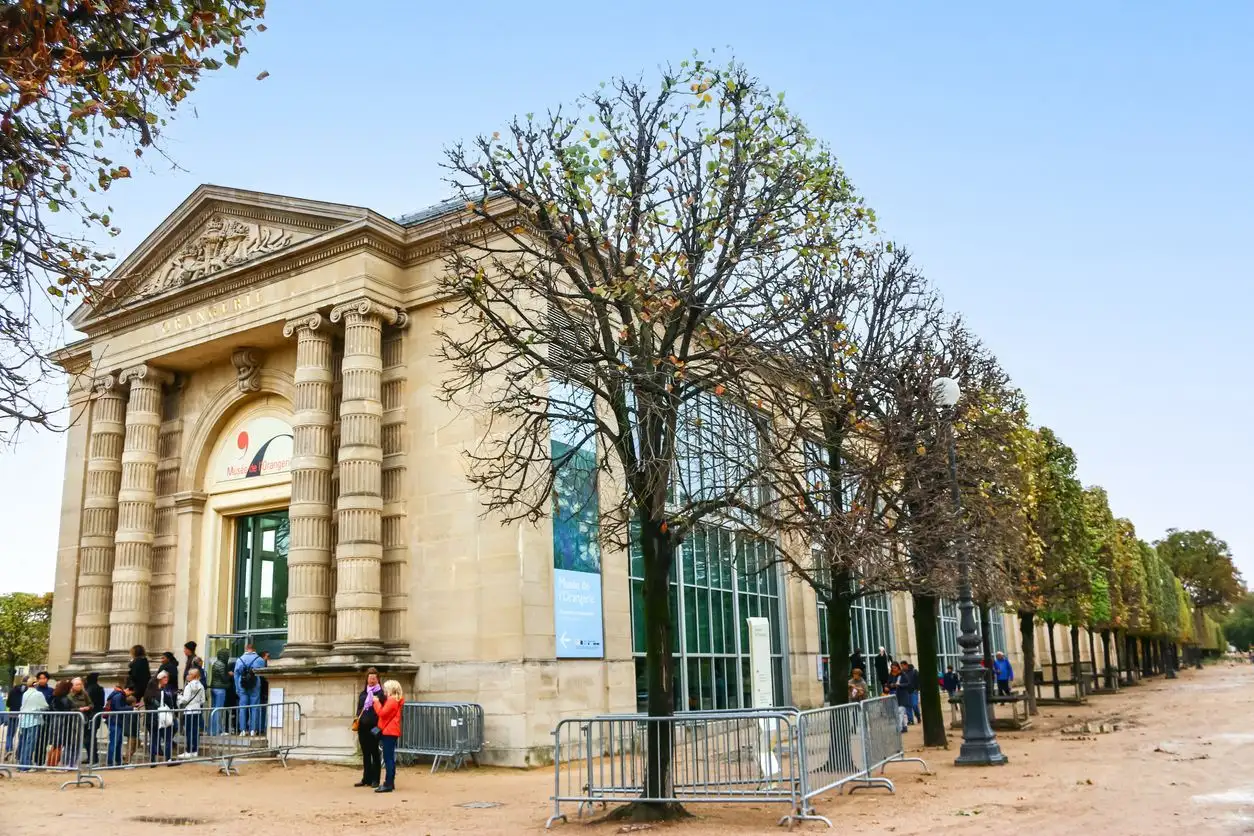
Getting there: The Orangerie is in the Tuileries Garden, at the western end nearest Place de la Concorde. Concorde metro station (Lines 1, 8, 12) is a 3 minute walk.
Nearby: The Tuileries Garden itself is worth spending time in. The Jeu de Paume, a contemporary art space, is across the garden. Place de la Concorde and the Champs-Elysees are immediately adjacent.
Booking: Advance ticket booking is strongly recommended, particularly during the Monet centenary exhibition in 2026. The museum's limited capacity means queues can be long during peak periods.
Final Verdict: Who Is This Museum For?
The Orangerie is for anyone who loves Impressionist painting, but it is especially for painters. The Water Lilies are Monet's final and most ambitious statement, and seeing them in the space he designed for them is an experience that changes how you think about color, light, and the possibilities of paint.
The museum's compact size is its greatest strength. You can give sustained attention to a small number of exceptional works rather than rushing through vast galleries. The 2026 centenary exhibition makes this an especially important year to visit.
The downside? The museum's popularity means it can feel crowded, particularly in the Water Lilies galleries. Go early, go on a Monday, and book in advance. And if you only have time for one Impressionist museum in Paris, the choice between the Orangerie and the Orsay depends on what you want: the Orsay for the full story of Impressionism, the Orangerie for its most profound expression.
Book tickets and check exhibition dates at musee-orangerie.fr.