Zeitz MOCAA: Africa's Largest Contemporary Art Museum, Built Inside a Grain Silo
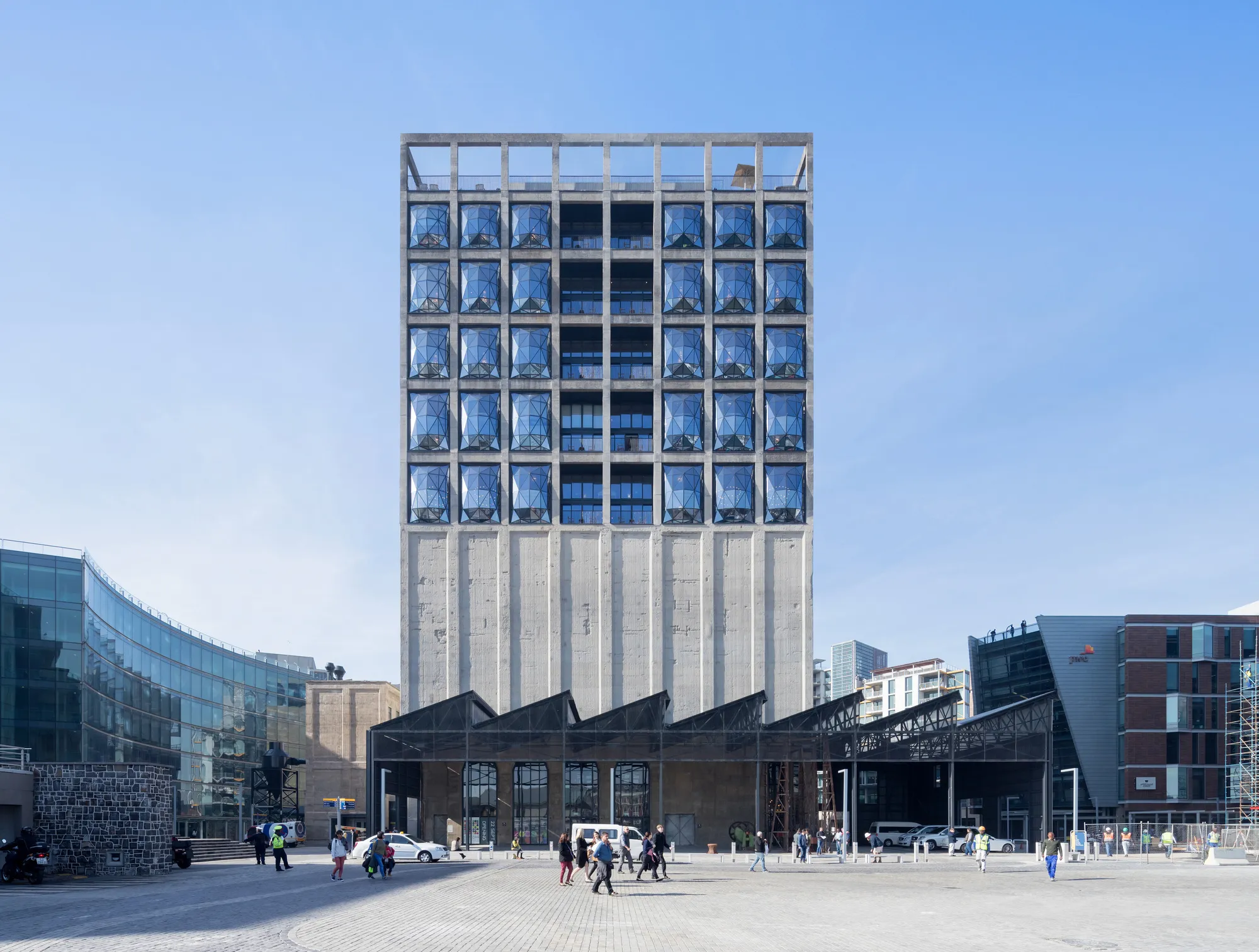
Zeitz MOCAA is the largest museum dedicated to contemporary art from Africa and its diaspora. It opened in September 2017 inside a decommissioned grain silo complex on Cape Town's V&A Waterfront, converted by British designer Thomas Heatherwick into 80 gallery spaces carved from 42 concrete tubes that rise 57 meters above the harbor. The building is the most photographed museum in Africa, and the atrium, with its organic, cave-like forms inspired by a single grain of corn scaled to architectural size, is genuinely stunning. But the building is the easy part. The harder question is whether the institution inside it has lived up to its founding promise.
The museum's first executive director and chief curator, Mark Coetzee, was suspended within 18 months of the opening following allegations of staff harassment. Koyo Kouoh, a Cameroonian-born curator based in Switzerland, took over in March 2019 and spent six years transforming the institution. She persuaded co-founder Jochen Zeitz to donate his collection rather than loan it, enlarged the board of trustees, established a Global Council and an American Friends organization, and built partnerships with sponsors including Gucci and BMW. She turned a troubled startup into a museum with genuine international credibility. In December 2024, Kouoh was appointed curator of the international exhibition at the 2026 Venice Biennale, the first African woman to receive the commission. She died on May 10, 2025, at age 57, ten days before she was scheduled to announce the Biennial's title and themes. Fawaz Mustapha, the Chief Operations Officer, is currently serving as Acting Executive Director.
That context matters because Zeitz MOCAA is not just a building. It is an institution trying to prove that contemporary African art deserves the same infrastructure, funding, and institutional respect that European and American art have received for centuries. The 2026 Gala on February 20 will be the first since Kouoh's passing and is framed as both a tribute and a commitment to continuing her vision.
The Heatherwick Building: What You Walk Into
The silo complex was built in 1924 and was once the tallest building in sub-Saharan Africa. Heatherwick's studio carved out the interior of the 42 concrete tubes to create a central atrium whose curved, organic forms produce a space that feels more like a cathedral than a museum. The rough concrete surfaces of the original tubes are preserved, and natural light filters through openings cut into the structure. The result is a building that visually communicates its own transformation: industrial infrastructure repurposed for cultural use.
The 80 gallery spaces range from intimate rooms within individual tubes to large open galleries created by removing walls between tubes. The upper floors contain a rooftop sculpture garden, and the building also houses The Silo Hotel, a boutique property occupying the upper floors above the museum. The BMW Centre for Art Education and the Koyo Kouoh Atelier (a museum residency program for Cape Town-based artists, renamed in Kouoh's honor) are also on-site.
If you are interested in architecture, the building alone justifies the visit. The atrium is one of the most dramatic interior spaces in any museum worldwide. But the galleries themselves are more conventional: white-walled, flexible, and functional. The contrast between the raw atrium and the polished exhibition spaces is intentional and effective.
The Collection and Current Exhibitions
The museum's collection is built around Jochen Zeitz's personal holdings of contemporary African art, now donated to the institution. It includes major works by El Anatsui, the Ghanaian-born sculptor whose monumental wall pieces are made from thousands of flattened bottle caps and aluminum seals woven together with copper wire. William Kentridge is represented with works that combine drawing, animation, and film addressing South African history and identity. Zanele Muholi's photographic self-portraits, which explore race, gender, and queer identity in South Africa, are among the most visually striking and politically charged works in the collection.
The 2025-2026 exhibition season includes several shows running through 2026:
- Spring Is Rebellious: The Art and Life of Albie Sachs (through August 31, 2026) traces the shared artistic and political histories of South Africa and Mozambique through the life of the freedom fighter, writer, and judge.
- Zohra Opoku: Survey Exhibition (opened September 11, 2025) is the first museum survey of the Ghanaian-German artist, reflecting on a decade of work exploring cloth, memory, and identity.
- A Protea Is Not a Flower (opened October 16, 2025) is a multigenerational dialogue between South African artists and writers exploring exile, memory, and return, with Lerato Shadi and Robin Rhode responding to Gerard Sekoto, Bessie Head, and Don Mattera.
- Cauleen Smith: Survey Exhibition (opened November 13, 2025) is an expansive survey of the African-American artist's experimental film, sculptural objects, drawings, and text-based textiles.
Looking ahead to late 2026, the museum has announced IMPRINT (October 1, 2026 to March 28, 2028), an artist-led studio residency hosting Cape Town publishing collectives in the Koyo Kouoh Atelier, and Turning Towards the Sun (December 10, 2026 to August 15, 2027), a multimedia exhibition featuring newly commissioned films by Zeresenay Berhane Mehari, Mati Diop, Jim Chuchu, Wanuri Kahiu, and The Otolith Group, developed through the African Film and Media Arts Collective led by Julie Mehretu and Mehret Mandefro.
How It Compares
Zeitz MOCAA is the largest contemporary art museum in Africa, but it is not the only one. The Zeitz MOCAA is often compared to the Tate Modern in London for its industrial-building conversion approach, but the comparison is superficial. Tate Modern is a former power station with a vastly larger collection and budget. Zeitz MOCAA is a former grain silo with a narrower focus (contemporary African art) and a much shorter institutional history.
Within South Africa, the Norval Foundation in Stellenbosch is a smaller but serious contemporary art institution with a stronger focus on South African modernism. The Iziko South African National Gallery in Cape Town's Company's Garden holds historical South African art but lacks Zeitz MOCAA's contemporary focus and international profile.
Internationally, Zeitz MOCAA occupies a unique position. No other museum anywhere is dedicated specifically to contemporary art from Africa and its diaspora at this scale. The Musee du Quai Branly in Paris holds African art but frames it through an ethnographic and historical lens. Zeitz MOCAA frames African art as contemporary, living, and globally connected. That framing is the institution's most significant contribution.
Insider Tips
Go on Wednesday morning if you are an African citizen. Free entry every Wednesday from 10 AM to 1 PM for all African citizens with a valid South African ID or African passport. This is the best deal at any major museum on the continent.
Take the free daily tour. One-hour tours are offered Monday through Friday at 12:30 PM, free with admission. Book on arrival at the front desk. Capacity is limited, so sign up early. The guides are knowledgeable and provide context that the wall texts do not.
Budget 2 to 3 hours. The building has 80 gallery spaces across multiple floors, and the atrium alone deserves 15 minutes of looking. Most visitors spend about 2.5 hours including the permanent collection and one or two temporary exhibitions.
The V&A Waterfront location is both a strength and a weakness. The waterfront is Cape Town's most tourist-heavy area, with restaurants, shops, and hotels. It is safe, well-lit, and easy to reach. It is also not where most Capetonians go for art. If you want a more local art scene, visit the galleries in Woodstock or the city bowl after Zeitz MOCAA.
The museum has a generator. South Africa experiences periodic power outages (load shedding), but Zeitz MOCAA is not affected. If you are visiting during a scheduled outage period, the museum remains fully operational.
Parking is available at the V&A Waterfront Silo District Parking Garage (P3). Direct access to the museum is available from the garage. The waterfront is also accessible by MyCiTi bus and ride-hailing services.
Practical Information
Admission: R265 for adults, free for visitors under 18 (bring ID for teens). Free for African citizens on Wednesdays from 10 AM to 1 PM with valid ID or passport.
Hours: Daily 10 AM to 6 PM. Last entry at 5:30 PM. Open every day including Mondays.
Getting there: Silo District, S Arm Road, V&A Waterfront, Cape Town. Secure parking at the Silo District Parking Garage (P3) with direct museum access. MyCiTi bus routes serve the V&A Waterfront.
Book tickets: zeitzmocaa.museum/buy-tickets
Final Verdict: Who Is This Actually For?
Anyone interested in contemporary African art, period. Zeitz MOCAA is the only museum at this scale dedicated to the subject, and the collection includes artists whose work you will not find gathered anywhere else in these quantities: El Anatsui, Zanele Muholi, William Kentridge, Njideka Akunyili Crosby, Wangechi Mutu. The building is spectacular. The exhibition program under Koyo Kouoh's tenure was ambitious and intellectually serious, and the 2026-2027 season suggests the institution is continuing that trajectory despite the loss of its director.
The R265 admission is steep for South African pricing context (roughly $14 USD), which is why the Wednesday free-entry policy for African citizens matters. International visitors paying full price are effectively subsidizing access for local visitors, which is a model that makes sense for an institution trying to build both local and global audiences.
If you are in Cape Town and care about contemporary art, skip Zeitz MOCAA only if you have already seen it. The exhibitions rotate regularly, the building rewards repeat visits, and the institution is still young enough that each visit reveals something you have not seen before.