MASP Sao Paulo: Latin America's Best Art Museum Has a Display Method That Changes Everything
MASP is running a major retrospective of Sandra Gamarra Heshiki in 2026, co-organized with MALI in Lima. The exhibition, structured around the concept of "replica" as a response to dominant narratives, unfolds simultaneously in both institutions, creating a dialogue between two of South America's most important art museums. It is exactly the kind of cross-institutional collaboration that positions MASP as a regional leader, not just a Brazilian one.
Under director Adriano Pedrosa, who in 2024 became the first Latin American curator of the Venice Biennale, MASP has expanded its programming to include African art, Afro-Brazilian art, and exhibitions that challenge the Eurocentric framework of its original collection. The museum welcomed approximately 1.2 million visitors in 2025, making it one of the most visited art museums in the Southern Hemisphere.
But what makes MASP truly exceptional is not its collection alone. It is the crystal easels.
Lina Bo Bardi's Crystal Easels: The Most Radical Display in Any Museum
When MASP moved to its current building in 1968, architect Lina Bo Bardi designed a display system that rejected every convention of museum hanging. Instead of placing paintings on walls in chronological or thematic rows, she mounted them on transparent glass panels set in concrete blocks, creating freestanding easels arranged throughout the gallery space.
The result is that paintings float. You can walk around them, see the back of the canvas, read the label on the reverse, and encounter works as individual objects rather than as items in a wall sequence. The hierarchy of traditional museum hanging, where "important" paintings get prime wall space and secondary works are relegated to side galleries, disappears. Every painting is equal. Every painting stands alone.
The easels were removed in the 1990s and replaced with conventional wall hanging. They were restored in 2015, and the current installation is a reconstruction of Bo Bardi's original vision. If you have visited the Louvre, the Metropolitan Museum, or the National Gallery, you know the standard museum experience: walk along a wall, look at paintings in sequence, move to the next room. MASP's crystal easels break that pattern entirely. You navigate the gallery the way you navigate a city square, encountering art from multiple directions, creating your own path.
For painters, this display method has a specific value: you can see the backs of canvases, which reveals construction methods, restoration history, and sometimes inscriptions or labels that are normally hidden. You can also view paintings from oblique angles, which reveals the texture and impasto of brushwork in ways that head-on viewing does not.
The Building: A Brutalist Icon on Avenida Paulista
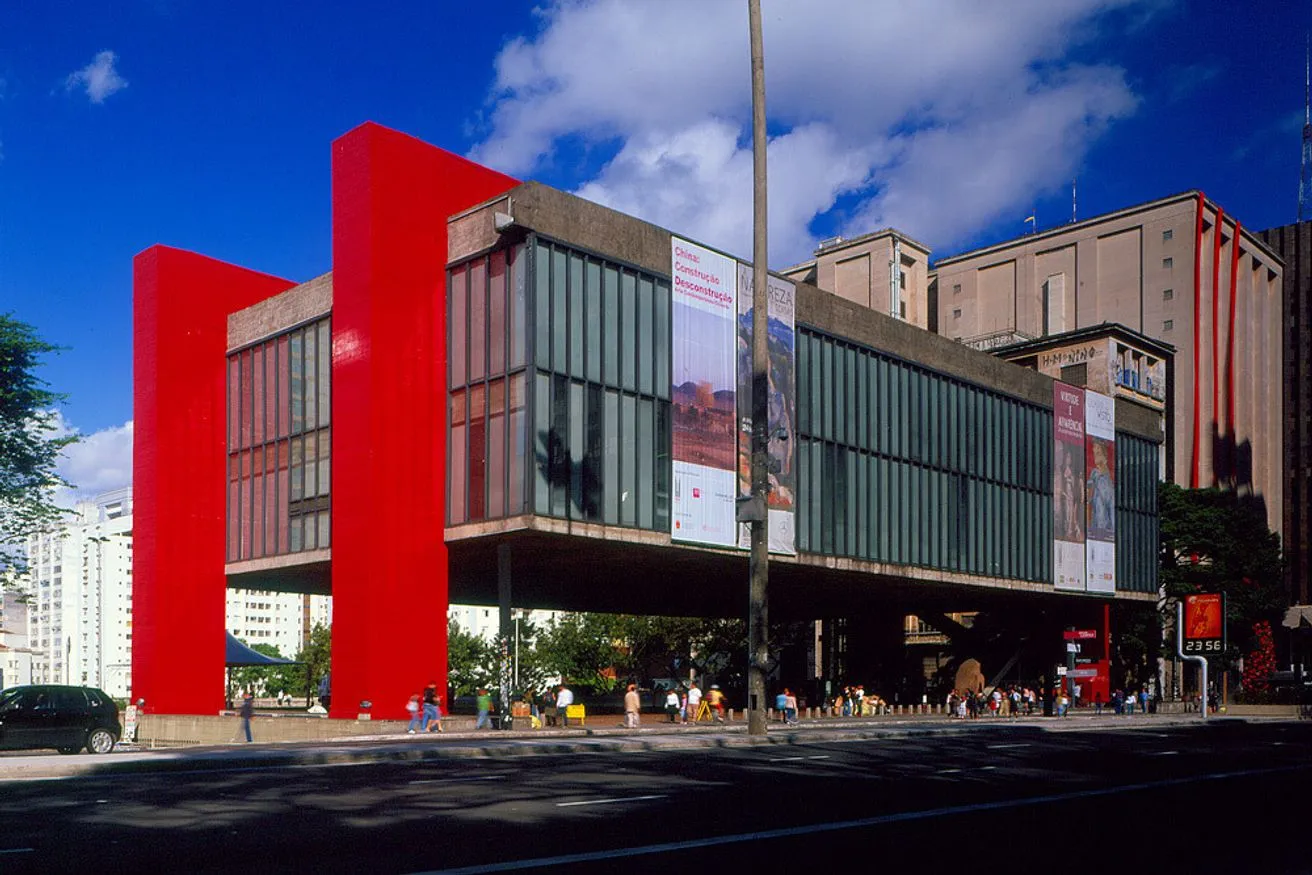
MASP's building, completed in 1968, is one of the most important works of modern architecture in Latin America. Bo Bardi's concept was structurally audacious: the museum is elevated on four massive red concrete pillars, creating a 74 meter clear span that leaves the ground level entirely open as a public plaza. This open space, the vao livre (free span), was Bo Bardi's democratic gift to the city: a covered public square that hosts antique fairs, cultural events, political demonstrations, and everyday social life.
The building sits on Avenida Paulista, Sao Paulo's most famous boulevard and the financial heart of Latin America. On Sundays, the avenue closes to traffic and becomes a pedestrian promenade, and the space beneath the museum fills with markets, performers, and crowds. The architecture is not a container for art. It is a civic space that happens to contain art.
The European Collection: Old Masters in the New World
MASP's collection of European painting is the finest in Latin America and one of the most important outside Europe. Works span from the Italian Renaissance through the 19th century, and the list of artists represented would be the pride of any major European museum: Raphael, Mantegna, Bellini, Hieronymus Bosch, El Greco, Velazquez, Rembrandt, Frans Hals, Goya, Delacroix, Manet, Monet, Renoir, Degas, Cezanne, Van Gogh, Toulouse-Lautrec, Modigliani, and Picasso.
This collection was assembled largely in the late 1940s and 1950s, when the postwar European art market offered extraordinary opportunities for buyers with capital and connoisseurship. Founder Assis Chateaubriand, a media magnate, provided the money. Pietro Maria Bardi, an Italian art dealer and critic, provided the eye. Together they built a collection that no Latin American institution has matched since.
Rembrandt's Self-Portrait is one of the collection's most celebrated works. Raphael's Resurrection of Christ and Bosch's The Temptation of Saint Anthony are highlights of the Renaissance and early Netherlandish holdings. Velazquez's Portrait of the Count-Duke of Olivares is one of the most important Spanish paintings outside Spain.
Brazilian Art: From Colonial to Contemporary
MASP's Brazilian art collection traces the development of Brazilian artistic identity from colonial religious painting through modernist revolution to contemporary practice.
Tarsila do Amaral's Abaporu (1928) is one of the most important paintings in Brazilian art history. The work that inspired the Anthropophagic Movement, a cultural manifesto proposing that Brazilian artists should "cannibalize" European influences and transform them into something distinctively Brazilian. The painting's strange, monumental figure, with its enormous foot planted on the Brazilian earth, has become an icon of Brazilian cultural identity.
Candido Portinari's monumental paintings document Brazilian life: coffee workers, rural landscapes, social conditions. Anita Malfatti, Di Cavalcanti, Alfredo Volpi, and other pioneers of Brazilian modernism are represented with works that demonstrate the creative energy of Brazil's modern art movement.
Contemporary Brazilian art includes works by Helio Oiticica, Lygia Clark, Lygia Pape, and other members of the Neo-Concrete movement, whose radical experiments with participatory art and the dissolution of boundaries between art and life represent one of the most important contributions to international contemporary art from any country.
Current Exhibitions (2026)
- Sandra Gamarra Heshiki: The first panoramic retrospective, co-organized with MALI. Structured around the concept of "replica" as a response to dominant narratives.
- MASP's permanent collection is displayed on the crystal easels on the second floor, with works rotated periodically. The collection is organized thematically rather than chronologically, reflecting Pedrosa's curatorial approach.
How MASP Compares
MASP is the most important art museum in Latin America. Its European collection is deeper than any other museum in the region, and its Brazilian holdings are among the best. The crystal easels make it one of the most intellectually stimulating museum experiences anywhere.
Compared to MALI in Lima, MASP has a much stronger European collection and a more iconic building, but MALI has the pre-Columbian depth that MASP lacks. Compared to the MNBA in Santiago, MASP is larger, more international, and more architecturally significant, but the MNBA has free admission and a stronger Matta collection.
Compared to the Metropolitan Museum or the Louvre, MASP is smaller and more focused. But the crystal easels offer something those museums cannot: a display method that makes you see paintings differently. The Met and the Louvre present art on walls. MASP presents art in space.
The admission price is high by Brazilian standards (R$ 85 for international visitors), but Thursdays are free for everyone, and the museum is open until 8 PM that day. If you are on a budget, Thursday is the day to go.
Planning Your Visit
Admission: R$ 85 for international visitors. Brazilian residents pay R$ 55. Students, teachers, and low-income visitors pay R$ 28. Children under 10, seniors over 60, and disabled visitors enter free. Thursdays are free for all visitors (10 AM to 8 PM).
Hours: Tuesday to Sunday, 10 AM to 6 PM. Thursday, Saturday, and Sunday until 8 PM. Closed Mondays.
Getting there: MASP is at Avenida Paulista 1578. The nearest metro station is Trianon-MASP on Line 2 (Green). The museum is directly above the station exit.
Best time to visit: Thursday morning at 10 AM. Free admission, fewer crowds, and the full day to explore. Sunday mornings are also relatively quiet, but the afternoon brings large crowds, especially when Avenida Paulista closes to traffic.
Nearby: Avenida Paulista itself is Sao Paulo's main cultural corridor. The Itau Cultural institute, the Casa das Rosas, and numerous galleries are within walking distance. The Sunday street market beneath the museum's open span is one of the best in the city.
Restaurant: The MASP restaurant on the lower level offers Brazilian and international cuisine. It is reasonably priced for the quality and is a good option for lunch during a longer visit.
Language: Interpretive materials are in Portuguese and English. The crystal easels have bilingual labels on the reverse of each painting.
Final Verdict: Who Is This Museum For?
MASP is for anyone who wants to see the best art collection in Latin America displayed in the most architecturally significant museum building in the Southern Hemisphere. The crystal easels alone justify a visit: they are the most radical and successful rethinking of museum display in the past century, and they make you see paintings as objects rather than images.
The European collection is extraordinary for a museum less than 80 years old. The Brazilian holdings tell the story of a country whose art history is as rich as any in the Western world. And under Pedrosa's direction, the museum is expanding its scope to include African art, Afro-Brazilian art, and cross-institutional collaborations with museums across South America.
The downside? The admission price is steep for international visitors. The galleries can get crowded on weekends. And the building's Brutalist concrete, while architecturally significant, can feel cold and cavernous. But go on a Thursday when it is free, spend 3 to 4 hours, and let the crystal easels change how you think about looking at paintings.
Buy tickets and check exhibition dates at masp.org.br.