Louvre Museum: The World's Most Visited Art Museum Has a Pricing Problem
As of January 14, 2026, the Louvre charges two different prices depending on where you are from. EU citizens and residents pay €22. Everyone else pays €32. That is a 45 percent increase for non-European visitors, implemented by the French government to fund renovations and shore up finances after a brazen October 2025 heist of French Crown Jewels exposed serious security failures. Trade unions at the Louvre called the dual pricing "shocking philosophically, socially, and on a human level" and went on strike. The pricing is now in effect anyway.
This is the context you are walking into when you visit the Louvre: a museum under financial pressure, dealing with chronic overcrowding (8.7 million visitors in 2024, 77 percent of them foreign tourists), and led by director Laurence des Cars, who has implemented more than 20 emergency security measures since the heist. The Louvre is still the greatest encyclopedic art museum in the world. But visiting it in 2026 requires more strategy than ever.
From Fortress to Museum
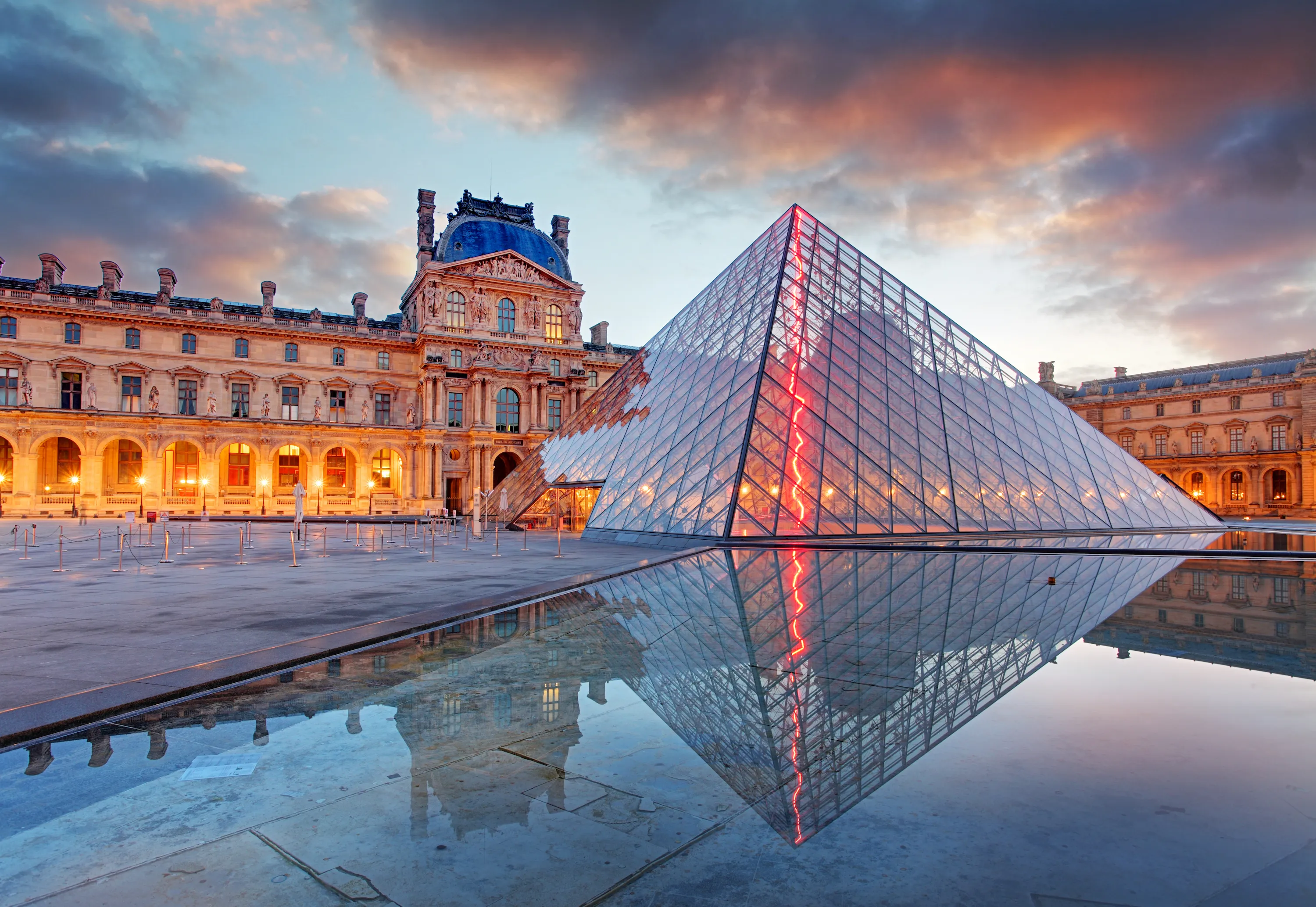
The Louvre began as a 12th century fortress under Philip II. You can still see the medieval fortress walls in the basement, a strange reminder that this building was military before it was cultural. It became a royal palace, then a museum during the French Revolution in 1793. I.M. Pei's glass pyramid entrance, added in 1989, was controversial at the time and is now the building's most recognizable feature.
The museum holds over 38,000 objects across eight departments, spanning from ancient Egypt to the mid-19th century. Only about 35,000 are on display at any given time. The building is so large that if you spent 30 seconds looking at every object on display, you would be inside for over 290 hours.
The Three Things Everyone Sees First
The Mona Lisa is in the Denon wing, Room 711, behind bulletproof glass in a climate-controlled case. Here is the honest truth: the painting is smaller than you expect (77 by 53 cm), the room is always crowded, and you will be jostling with hundreds of people holding phones above their heads. The painting itself is extraordinary, a masterpiece of sfumato technique and psychological ambiguity. But the viewing experience is unpleasant. Go on a Wednesday or Friday evening after 6 PM when the crowds thin out, or accept that you will have a 5-second glimpse from 15 feet away.
The Winged Victory of Samothrace stands at the top of the Daru staircase in the Denon wing. This is the one that actually delivers the emotional punch people expect from the Louvre. A 2nd century BC Hellenistic sculpture of the goddess Nike, her marble drapery pressed against her body as if caught in a gale. You round the staircase landing and there she is, wings spread, dominating the space. No glass, no crowd barrier, no bulletproof case. This is what museum-going should feel like.
The Venus de Milo is in the Sully wing, Room 345. The missing arms have generated centuries of speculation about what gesture the goddess was making. The sculpture is beautiful but overexposed. If you are short on time, skip it and spend those 15 minutes in the nearby Greek antiquities galleries, which are quieter and full of extraordinary objects most visitors walk past.
What You Should Actually Prioritize
The Louvre is too large to see in one visit. Anyone who tells you otherwise is lying. The strategy is to pick two or three areas and go deep.
The Italian Renaissance galleries (Denon wing, first floor) hold the museum's most famous paintings. Beyond the Mona Lisa, you will find Leonardo's Virgin of the Rocks, Raphael's portraits, and large-scale Italian Renaissance works that most people rush past on their way to Leonardo. Spend time here. The galleries themselves are grand, with high ceilings and parquet floors, and the paintings are hung salon-style, which means the higher works are at an angle for viewing from below.
The Egyptian Antiquities Department is overwhelming in the best way. Over 50,000 objects document 4,000 years of Egyptian civilization. The Seated Scribe (c. 2500 BC) is the one to seek out: a limestone figure with inlaid crystal eyes that still look alert and alive after 4,500 years. The Egyptian galleries are in the Sully wing and are significantly less crowded than the Denon wing.
The Decorative Arts Department (Richelieu wing) is the Louvre's secret weapon. Period rooms from French royal residences, furniture, ceramics, and metalwork that show how the other half lived. Most tourists skip this entirely, which means you can walk through entire galleries of 18th century French furniture in near solitude.
The Islamic Art Department opened in 2012 in a space designed by Mario Bellini and Rudy Ricciotti, with a golden, undulating ceiling that is one of the most beautiful contemporary museum interiors in Paris. The collection spans three continents and thirteen centuries.
How the Louvre Compares
The Louvre covers art from antiquity to 1848. For art from 1848 to 1914, you go to the Musee d'Orsay. For art after 1914, you go to the Centre Pompidou. This three-museum system is how Paris tells the story of Western art, and the Louvre is the first and largest chapter.
Compared to the Metropolitan Museum in New York, the Louvre is more focused on Western and Mediterranean civilizations. The Met covers the entire globe. But the Louvre's depth in Egyptian, Near Eastern, and European art is unmatched. Compared to the British Museum, the Louvre has far more painting, while the British Museum has stronger antiquities and a more problematic colonial acquisition history.
The Dual Pricing Controversy
The January 2026 price hike is worth understanding. Under the new system, EU citizens and residents pay €22. Non-EU visitors pay €32. Children under 18 from any country enter free, as do EU residents under 26. The first Friday of each month after 6 PM is free for everyone (except July and August), and July 14 (Bastille Day) is free for all.
The French government expects the differentiated pricing to raise €20 to 30 million annually for renovation. The Louvre needs it: the building has documented water damage, overcrowding issues, and security gaps that the October 2025 crown jewels heist made embarrassingly public. Director Laurence des Cars has pushed for major infrastructure investment, and the extra revenue is earmarked for that purpose.
If you are a non-EU visitor, €32 is still less than the Met's $30 (roughly €28) and comparable to the Rijksmuseum's €22.50. The Louvre is not cheap, but it is not outrageously priced relative to its peers. Book online to skip the ticket line, which can take an hour on busy days.
Practical Strategy for Visiting
Best time to go: Wednesday or Friday evening. The Louvre stays open until 9:45 PM those nights, and after 6 PM the crowds drop dramatically. You can walk up to the Mona Lisa with only a few people in front of you.
Worst time to go: Saturday or Sunday afternoon in summer. The museum is at maximum capacity, the air conditioning struggles, and the Denon wing becomes a slow-moving river of tour groups.
How long to spend: 3 to 5 hours for a focused visit. Pick 2 to 3 departments and do them properly. Do not try to see everything.
Getting there: Palais Royal-Musee du Louvre metro station (Lines 1 and 7) drops you right at the pyramid entrance.
Dining: Cafe Marly on the Richelieu wing terrace offers upscale dining with a view of the pyramid. It is expensive and the food is decent, but the setting is worth it for a special occasion. For casual food, the cafeteria under the pyramid is fine and reasonably priced.
The Louvre is free on the first Friday of each month after 6 PM (except July and August) and on July 14. Book a free timed ticket online in advance for these days.
Final Verdict: Who Is This Museum For?
The Louvre is for everyone, but it rewards preparation. If you show up without a plan, you will spend 4 hours walking through crowded galleries, see the Mona Lisa from 15 feet away, and leave exhausted. If you plan ahead, pick specific galleries, and go on a Wednesday evening, you will have one of the great museum experiences of your life.
The dual pricing is a real issue for non-EU visitors, and the overcrowding is a problem the museum has not solved. But the collection is unmatched. The Egyptian galleries alone justify the ticket price, and the Italian Renaissance galleries contain more masterpieces per square meter than any other museum in the world.
Book timed tickets and plan your route at louvre.fr.