Musee d'Orsay: The World's Greatest Impressionist Collection Has a Renoir Problem
Through July 19, 2026, the Musee d'Orsay is running Renoir and Love: A Joyful Modernity (1865-1885), a major exhibition examining Renoir's treatment of love, intimacy, and domestic life during the two decades when he helped define Impressionism. Alongside it, Renoir Drawings (through July 5, 2026) presents the artist's works on paper. These shows arrive at a moment when Renoir's reputation is actively contested: beloved by general audiences, dismissed by many critics and contemporary artists. The Orsay's decision to mount a major Renoir exhibition in 2026 is a curatorial statement, and it is worth engaging with.
The Musee d'Orsay holds the world's finest collection of Impressionist and Post-Impressionist painting. It sits in a former Beaux-Arts railway station on the Left Bank of the Seine, directly across the river from the Louvre. The museum covers art from 1848 to 1914, the period when Paris was the undisputed capital of the art world, and it tells that story with a depth no other institution can match.
Director Christophe Leribault has led the museum since 2021, continuing a program of ambitious exhibitions and collection reinterpretation. The museum welcomes approximately 3.5 million visitors annually, making it one of the most visited art museums in the world.
The Building: A Station Saved by Art
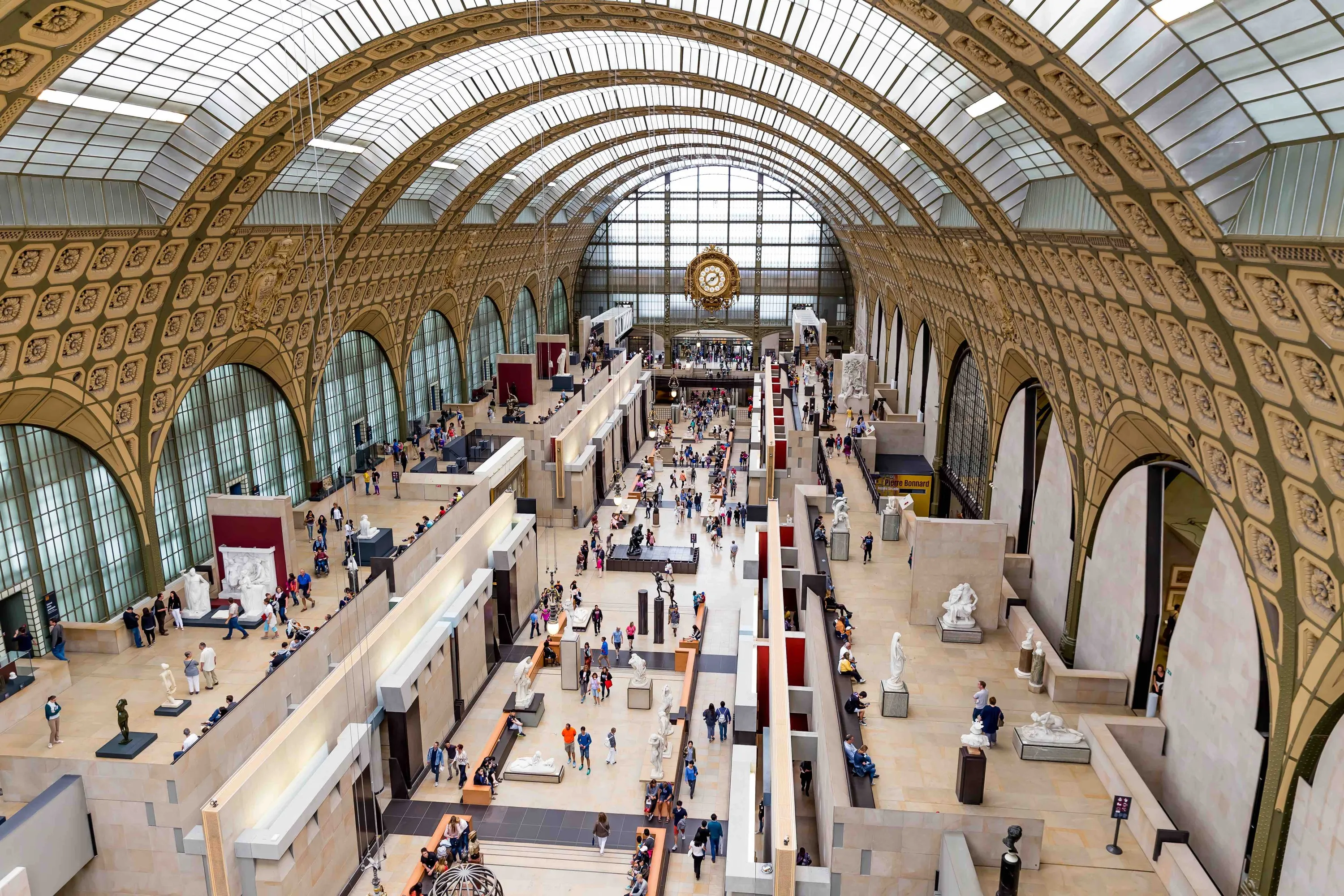
The Gare d'Orsay was built for the 1900 Universal Exhibition as a modern railway terminal. By 1939, the platforms were too short for modern trains, and the station fell into decline. It was nearly demolished in the 1970s. The decision to convert it into a museum was made in 1977, and the Musee d'Orsay opened in 1986 under president Francois Mitterrand.
The conversion by architects ACT Architecture and Gae Aulenti preserved the grand central hall while inserting gallery floors into the space. The result is one of the most dramatic museum interiors anywhere: a vast, light-filled atrium with the station's original clock at one end, galleries arranged around the perimeter, and a terrace overlooking the Seine. The architecture alone is worth the price of admission.
The Impressionist Collection: Why You Came Here
The Orsay's Impressionist galleries on the upper level are the museum's heart. This is where you find the paintings that changed the course of art history.
Claude Monet is represented across his entire career, from early Impressionist works to the series paintings of the 1890s. The Orsay holds multiple Haystacks, Rouen Cathedral views, and Water Lilies, allowing you to see how Monet used serial painting to explore the effects of changing light on the same subject.
Edgar Degas is here in depth: the ballet dancers, the race horses, the bathers. Degas was the most technically accomplished draftsman of the Impressionist group, and the Orsay's holdings show his mastery of pastel, oil, and sculpture side by side.
Pierre-Auguste Renoir dominates the current exhibition program, but the permanent collection also holds major works: Bal du moulin de la Galette, with its dappled sunlight filtering through trees onto a crowd of Parisian revelers, and Luncheon of the Boating Party, one of the most beloved Impressionist canvases.
Vincent van Gogh has a dedicated gallery that is always crowded. Starry Night Over the Rhone (not to be confused with the MoMA painting) captures the night sky with a swirling intensity that makes you understand why Van Gogh's work still stops people in their tracks. The Church at Auvers and Self-Portrait are also here.
Paul Cezanne holds a critical position in the collection. His late still lifes and landscapes, with their faceted forms and analytical approach to perception, bridge Impressionism and Cubism. The Card Players and multiple Mont Sainte-Victoire views show why Picasso called Cezanne "the father of us all."
What the Orsay Does That No Other Museum Does
The Orsay covers a specific 66 year period (1848 to 1914) with a completeness no other museum achieves. The Louvre covers antiquity to 1848. The Centre Pompidou covers 1914 to the present. The Orsay fills the gap, and it does so by presenting not just painting but the full range of visual production from that period.
Sculpture: The ground floor sculpture court contains monumental works by Rodin, Carpeaux, and Dalou. Rodin's The Gates of Hell and The Thinker are here (though the most famous versions are at the Musee Rodin nearby). The sculpture collection shows how 19th century artists pushed against academic conventions in three dimensions just as the Impressionists did in two.
Decorative Arts: The Orsay's decorative arts galleries are underappreciated. Art Nouveau furniture, glass by Galle and Daum, jewelry by Lalique, and entire period rooms from the 1900 Universal Exhibition. If you are interested in design, these galleries are essential.
Photography: The Orsay holds one of the most important early photography collections in the world, documenting the parallel development of photography and painting during the medium's first decades.
Architecture models and drawings: The museum documents the radical transformation of Paris under Baron Haussmann, with architectural models and drawings that show how the city was rebuilt in the mid-19th century.
Current Exhibitions (2026)
- Renoir and Love: A Joyful Modernity (1865-1885) (through July 19, 2026): The headline exhibition, examining Renoir's treatment of love and intimacy during his most innovative period.
- Renoir Drawings (through July 5, 2026): A complementary show of works on paper.
- Impressionist Fans: An Exceptional Gift from the Kan Family (through June 21, 2026): A focused display of painted fans by Impressionist artists.
- 100 Works That Tell the Story of Labor (through August 2, 2026): A thematic parcours through the collection examining representations of work.
How the Orsay Compares
The Orsay and the Musee de l'Orangerie are sister institutions. The Orsay has the broad collection. The Orangerie has the immersive Water Lilies installation and the Guillaume Collection. A combined ticket for both museums is available, and the Carte Blanche pass offers unlimited access to both for one or two years.
Compared to the Metropolitan Museum, the Orsay is more focused but deeper in its period. The Met has Impressionist works spread across multiple departments. The Orsay concentrates them in one building, telling the story of how Impressionism emerged, developed, and transformed into Post-Impressionism and early modernism.
Compared to the National Gallery in London, the Orsay has a narrower time range but a more revolutionary collection. The National Gallery covers the entire Western painting tradition. The Orsay covers the 66 years that upended it.
What Is Wrong with the Orsay
The layout is confusing. The museum's multiple levels, split galleries, and irregular circulation paths make navigation harder than it should be. The signage is inconsistent, and you will likely walk past galleries you meant to see. Pick up a floor plan at the entrance and mark your priorities.
The crowds in the Van Gogh and Monet galleries can be oppressive, particularly on weekends and in summer. The narrow gallery widths in the Impressionist rooms were not designed for modern tourist volumes. Go on a Thursday evening (open until 9:45 PM) for a quieter experience.
The restaurant on the second floor, designed in the original station hotel style, is beautiful but overpriced. The cafe on the ground floor is adequate for a quick stop.
Planning Your Visit
Admission: €16 online, €14 at the museum. Reduced rate €11 (sold on-site only). Thursday night rate (from 6 PM) is €12 online / €10 on-site. The "Enfant and Cie" rate (€13 online / €11 on-site) allows EU adults accompanying a young person under 18 to visit at a reduced price. Under 18 and EU residents under 26 enter free. First Sunday of each month is free for all, but reservation is required.
Combined tickets: The Orsay plus Musee Rodin combined ticket is valid for 3 months. The Carte Blanche gives unlimited access to both the Orsay and the Orangerie for one or two years.
Hours: Tuesday through Sunday, 9:30 AM to 6 PM. Thursday late opening until 9:45 PM. Closed Mondays, May 1, and December 25. Last admission to the museum at 5 PM, last admission to exhibitions at 5:15 PM, galleries close at 5:30 PM. Thursday last admission at 9 PM, galleries close at 9:15 PM.
Best time to visit: Thursday evening after 6 PM. The crowds thin dramatically, and the night rate is cheaper. If you must go during the day, aim for a Wednesday morning at opening.
Getting there: Solferino metro station (Line 12) is closest. Musee d'Orsay RER station (Line C) is directly outside. Assemblee Nationale and Rue de Bac stations (Line 12) are also nearby.
Nearby: The Musee de l'Orangerie is a 15 minute walk through the Tuileries Garden. The Musee Rodin is a 10 minute walk. The Louvre is across the river, 15 minutes on foot.
Final Verdict: Who Is This Museum For?
The Musee d'Orsay is for anyone who wants to understand why Impressionism mattered and how it changed the course of art. It is the best museum in the world for Monet, Degas, Renoir, Van Gogh, and Cezanne, and it presents them in a building that is itself a masterpiece of adaptive reuse.
The Renoir exhibitions in 2026 are a curatorial provocation. Whether you love Renoir's sensuality or find his late work saccharine, the shows give you the material to make your own judgment. That is what a great museum does: it presents the work and lets you decide.
The crowds and the confusing layout are real problems. But the collection is unmatched, the building is extraordinary, and the Thursday evening hours offer a genuinely peaceful way to experience some of the greatest paintings ever made.
Book tickets and check exhibition dates at musee-orsay.fr.