
In February 2025, the Prado Museum in Madrid did something the Louvre had tried and failed to do: it persuaded the nuns of the Monastery of Santo Domingo el Antiguo in Toledo to loan their paintings, reuniting eight of the nine canvases El Greco created for the monastery's altarpieces in 1577-79. It was the first time those works had been seen together since they were dispersed in 1830. Standing in front of "The Assumption of the Virgin" at the center of the Prado's Central Gallery, with El Greco's saints flanking it as they once did in Toledo, you get the clearest possible picture of what this painter was actually doing: not decorating a space, but building a complete theological argument in paint.
That argument is what makes El Greco difficult to categorize and easy to misread. He was born Domenikos Theotokopoulos in Crete in 1541, trained under Titian in Venice, spent time in Rome, and arrived in Toledo in 1577 with a visual vocabulary assembled from three different traditions. None of those traditions fully accounts for what he made from them. The elongated figures, the acid cold palette, the compressed swirling heavens that sit above realistic earthly scenes: these are not mannerisms borrowed from Mannerism, they are a specific solution to a specific problem. How do you paint the difference between human reality and divine reality on the same canvas?
This guide walks through how El Greco arrived at that solution, why it went unappreciated for 200 years, and why it looks so extraordinary now.
From Crete to Venice to Toledo
Crete in the mid-16th century was under Venetian rule, which gave a young icon painter named Domenikos access to both Byzantine traditions and Italian Renaissance ideas at the same time. Byzantine icon painting had its own strict formal conventions: gold backgrounds, frontal figures, specific gestures with theological meaning, and deliberate elongation of human forms to signal spiritual rather than physical reality. That last point is worth staying with. When critics in 18th-century Spain theorized that El Greco's distorted figures were the result of astigmatism, they were ignoring the fact that he had been trained for years in a tradition that elongated figures on purpose. The stretching was never a defect. It was a language.
He moved to Venice around 1567 and entered the orbit of Titian, then in his eighties and still the most important colorist in Europe. El Greco absorbed Titian's approach to color as light: the way warm flesh tones could be played against cool drapery, how glazing transparent layers of paint could create a luminosity that opaque pigment never achieved. This training shaped everything that came after. The silver-greens and lavender-grays in his Toledo religious paintings are Venetian in origin, filtered through Counter-Reformation intensity.
He arrived in Toledo in 1577 at the invitation of Diego de Castilla, the dean of the cathedral, whose son had met El Greco at the Farnese Palace in Rome. Toledo was the right city for him. It was the spiritual capital of Counter-Reformation Spain, saturated with religious intensity, home to a sophisticated intellectual class that valued theological learning alongside art. El Greco spent the last thirty-seven years of his life there and never returned to Italy.
The First Spanish Commission: Santo Domingo el Antiguo
Within weeks of arriving in Toledo, El Greco received the two most significant commissions of his career to that point: "The Disrobing of Christ" for Toledo Cathedral, and three altarpieces for the Cistercian convent of Santo Domingo el Antiguo. The altarpiece commission required him to design the architectural structure of all three altarpieces, paint eight large canvases, and oversee five sculptures for the main altarpiece's crown. For a painter arriving in Spain with no Spanish track record, it was an extraordinary vote of confidence.
The program he devised for the main altarpiece was structurally radical for Castile. He placed "The Assumption" as the central image, with the four saints as lateral figures below and "The Trinity" in the upper section. As Leticia Ruiz, head of the Prado's Spanish Renaissance Painting collection and curator of the 2025 reunion exhibition, explained: "He had the ambition to change the reticular idea that prevailed in Castile and propose a Venetian-style one instead. He placed The Assumption in the center: the rest of the pieces appear to be awaiting the central canvas." This was not a decorative arrangement but a theological one, with the Assumption as the axis around which heaven and earth organized themselves.
The nine paintings were completed in 1579 and drew immediate attention as the work of a fully developed master. According to the Prado's 2025 exhibition documentation, the canvases showed "a creative maturity that linked him to some of the best painters of the Italian Renaissance."
The Burial of the Count of Orgaz
"The Burial of the Count of Orgaz" (1586-88) is still hanging in the church of Santo Tomé in Toledo where it was commissioned, and it is worth traveling to see it in that context rather than in reproduction. The painting depicts the legendary burial of Don Gonzalo Ruiz de Toledo, a 14th-century nobleman of famous piety, whose funeral was allegedly attended by Saints Stephen and Augustine descending from heaven to lower him into his grave. El Greco painted this scene with a company of contemporary Toledo citizens as witnesses, including, it is generally accepted, a portrait of himself looking directly at the viewer from the upper left.
The composition operates in two entirely different visual registers simultaneously. The lower half, where the burial takes place, uses coherent spatial logic: figures standing in a credible arrangement, lit by naturalistic light, rendered with a psychological specificity that El Greco brought to all his portraiture. The upper half, where the soul of the Count ascends toward Christ and the Virgin in heaven, abandons all of this. Space compresses. Figures overlap in ways that make no physical sense. Color goes acid. Forms spiral and compress. The division between the two zones is not a failure of compositional unity but the whole point: the painting is showing you two orders of reality that operate by completely different rules, and the formal difference between the zones is the argument.
The Visual Language of Spiritual Experience
El Greco's elongation of figures is the thing most people notice first and usually misread. The figures in his late work sometimes exceed ten or eleven head-lengths in height, far beyond the classical canon of eight. His contemporaries occasionally found this disturbing. Later critics, as mentioned, attributed it to defective eyesight. Both responses miss the logic.
Byzantine icon painting elongated figures to signal the elevation of spiritual over physical matter. El Greco absorbed that convention and intensified it within the context of Counter-Reformation theology, which emphasized the inadequacy of material existence and the aspiration of the soul toward God. The stretched figure is not a body drawn inaccurately. It is a body being drawn upward, spiritualized in the act of representation itself.
His palette reinforces this. The cold acid yellows, icy greens, and lavender grays of his heavenly scenes do not correspond to any natural light source. The figures in "The Resurrection" (c.1600) and "The Disrobing of Christ" (1577-79) appear lit from within, a visual convention inherited from Byzantine practice where gold backgrounds functioned as divine light. El Greco translated this into oil paint by using internally generated luminosity rather than a depicted sun or window. The light has no source because it is not physical light.
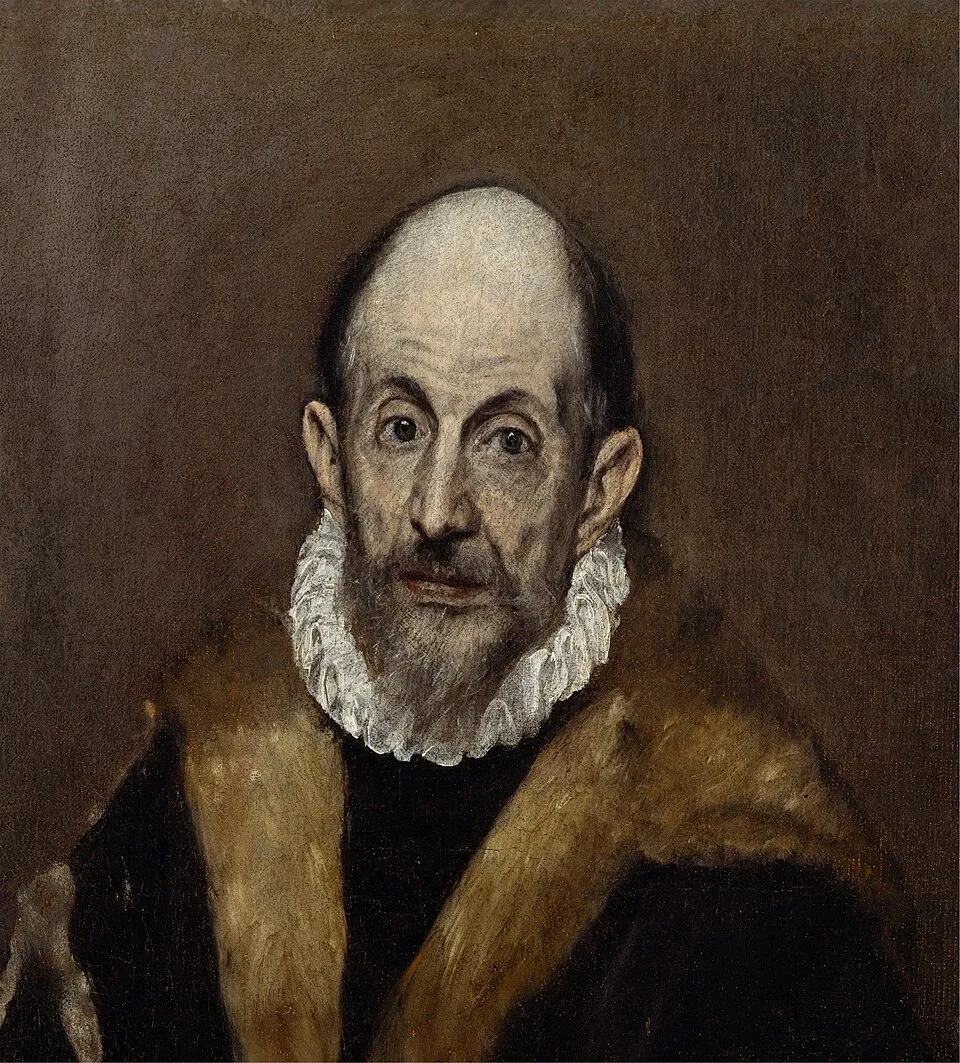
El Greco, "Portrait of a Man" (c.1595-1600). Oil on canvas. The National Gallery, London. El Greco's portraits achieve a psychological concentration that anticipates later traditions of European portraiture by a century. Image: Wikimedia Commons.
The Portraits
"The Nobleman with His Hand on His Chest" (c.1580) at the Prado is a good demonstration of how different El Greco's portraiture is from his religious work, and how the difference reveals something about the range of his ability. The figure emerges from a nearly black background. The white ruff and the placed hand are the composition's primary light sources. The face is painted with almost no distortion: just careful observation, precise rendering of how light falls across specific planes, and a quality of concentrated attention in the eyes that makes the viewer feel observed rather than observer. El Greco painted inner life through outer detail here, without needing to stretch or compress anything.
This matters because it confirms that his distortions in the religious work were chosen, not imposed. He could paint a fully naturalistic face with remarkable accuracy. When he chose not to, in the heavenly zones of his altarpieces or in the swirling celestial crowds of his late work, the departure from naturalism was deliberate, controlled, and purposeful.
Why Modern Art Eventually Caught Up
For roughly two centuries after his death in 1614, El Greco's reputation was marginal. His work was kept largely in Toledo, away from the major European collections, and the painters who dominated critical opinion in the 17th and 18th centuries had no framework for understanding what he was doing. When taste shifted in the 19th century, Spanish intellectuals associated with the Generation of 1898 began claiming him as a specifically Spanish visionary, which was only partially accurate but brought his work back into circulation.
What actually rehabilitated him was the emergence of Expressionism in Northern Europe in the early 20th century. Ernst Ludwig Kirchner and his colleagues in Die Brucke were doing something structurally similar to what El Greco had been doing in Toledo: using distortion, non-naturalistic color, and compressed space to paint states of feeling rather than physical appearances. Suddenly El Greco looked like a precursor rather than an eccentric. Cezanne made copies of his paintings at the Louvre. Picasso saw the elongated figures and the compressed space in El Greco's work as precedent for what he was working toward in the Blue Period and the early stages of Cubism.
The formal solutions El Greco found for Counter-Reformation religious painting turned out to have implications far beyond religion. That is a genuinely rare thing in art history.
View of Toledo
"View of Toledo" (c.1599-1600) at the Metropolitan Museum of Art in New York is the most discussed of El Greco's landscapes, and it deserves close attention because it shows how completely his formal approach had become a single unified thing rather than a set of borrowed conventions. The city sits on its hill under a sky that is neither storm nor calm but something between the two: greenish-gray, dramatically lit, charged with the same quality of suppressed intensity that his heavenly zones carry. The topography of Toledo is rearranged from actuality; the cathedral appears in a different position than it occupies in reality. El Greco painted not the city as it was but the city as it felt, which is entirely consistent with how he painted everything else.
Standing in front of the original at the Met, what strikes you is the small scale: 121 x 109 cm. The emotional weight of the image, the sense of a whole city bearing the pressure of a sky about to break, is out of proportion to the physical object. That disproportionate intensity, between the modest size of the canvas and the amplitude of the experience it delivers, is what El Greco's best work consistently produces.
Final Thoughts
El Greco spent nearly four decades in Toledo and never returned to Venice or Rome. His reputation was low for two centuries after his death, recovered in the early 20th century when Expressionism gave critics the language to understand what he had been doing, and is now recognized as among the most original and significant in Western painting. The 2025 Prado reunion of the Santo Domingo altarpieces, the first time those works had been together since the 19th century, was a reminder that his greatest achievement is not any single painting but the coherence and ambition of the whole body of work he built in Toledo.
If you want to see El Greco's religious paintings in the place that shaped them, Toledo remains the essential destination: the church of Santo Tomé for "The Burial of the Count of Orgaz," the cathedral for "The Disrobing of Christ," and the Museo del Greco for the View and the Apostle series. For the broader context of Counter-Reformation Catholic art that commissioned his work, the guide to Baroque art covers the devotional tradition in which he operated. For the Venetian training that gave him his color, the guide to Venetian painting provides the essential background. And to understand how the Expressionists who eventually rehabilitated his reputation were working, the guide to Expressionism traces the movement that finally gave art history the vocabulary for what El Greco had always been doing.


