Harvard Art Museums Open Access: The Best German Expressionism Collection Outside Germany, Free to Download
If you want to study Ernst Ludwig Kirchner's distorted figures or Erich Heckel's aggressive colour choices in high resolution without flying to Berlin, the Harvard Art Museums are your best option. The Busch-Reisinger Museum, one of three museums housed under the Harvard Art Museums umbrella, holds the most important collection of German Expressionist art outside Germany. And all of it is available under Creative Commons Zero (CC0), free for any use.
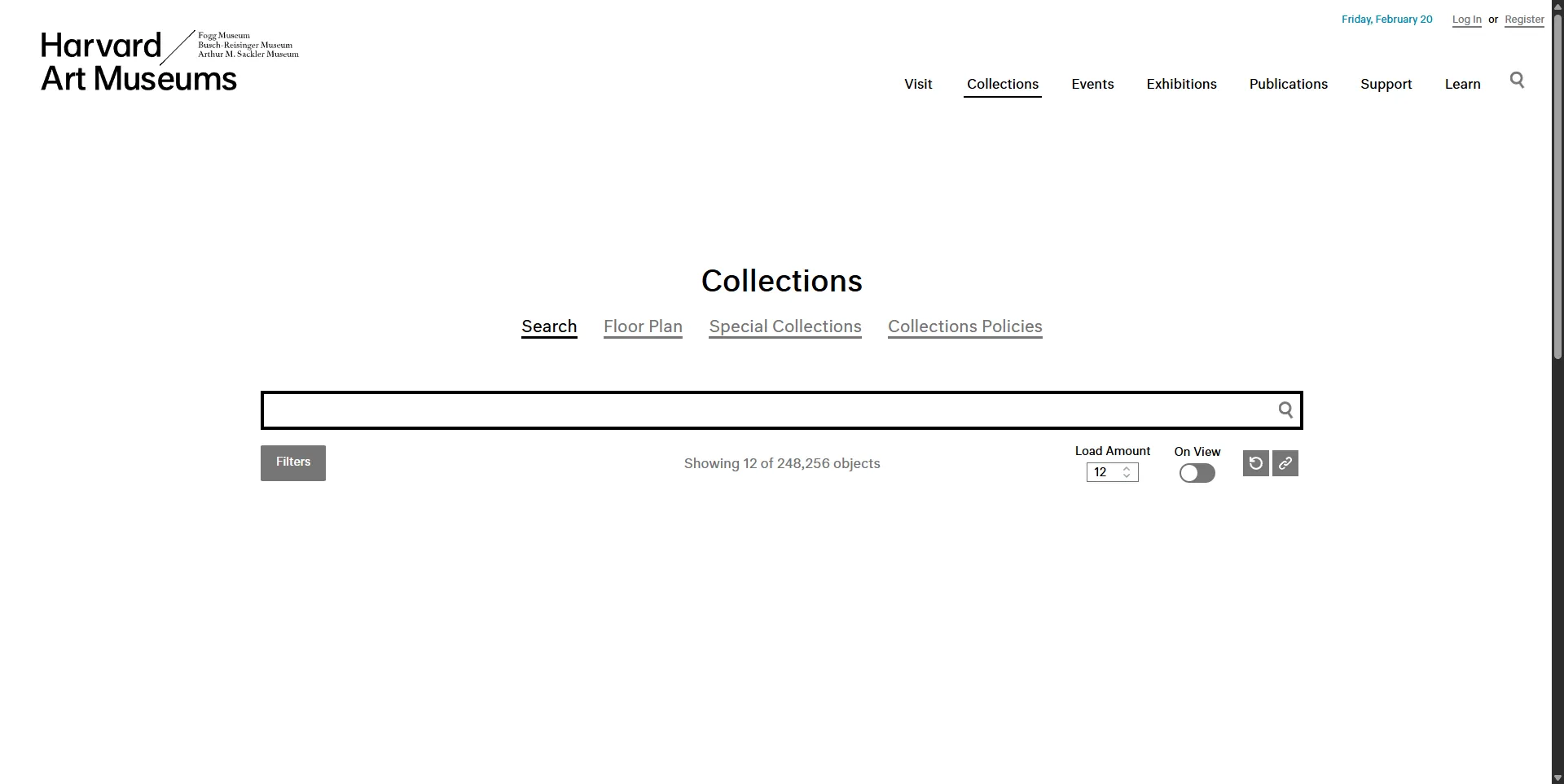
The Harvard Art Museums comprise the Fogg Museum (European and American art), the Busch-Reisinger Museum (German and Northern European art), and the Arthur M. Sackler Museum (Asian, ancient, and Islamic art). Together, they have made over 250,000 high-resolution images freely available with no attribution required and no usage restrictions.
What Makes Harvard Different
Most major museum open access programs focus on breadth. The Met covers 5,000 years of art from every continent. The MFA Boston offers an encyclopaedic collection. Harvard's collection is smaller but has three areas where it outperforms every other American museum: German Expressionism, Byzantine art, and ancient coins.
Harvard also has the best developer tools of any university art museum. The REST API is well-documented and provides access to objects, people, exhibitions, publications, galleries, and more. The IIIF support includes both Image and Presentation APIs, enabling deep zoom and cross-institutional comparison. And uniquely, the API includes a color extraction feature that returns the dominant colours extracted from each artwork, mapped to CSS3 colour values and hue names. If you are building a tool that matches artworks by colour palette, this is the only museum API that gives you that data out of the box.
The German Expressionism Collection
The Busch-Reisinger Museum's German Expressionism holdings are the reason many researchers come to Harvard's collection. The collection covers the full range of German Expressionist practice:
Die Brucke works include major paintings and prints by Ernst Ludwig Kirchner, Erich Heckel, Karl Schmidt-Rottluff, and other founding members. The collection is valuable for studying the distorted forms, intense colours, and expressive brushwork that define early German Expressionism.
Bauhaus works include Paul Klee, Wassily Kandinsky, Laszlo Moholy-Nagy, and other Bauhaus masters. For designers studying the origins of modern design practice, this collection connects art history to contemporary design thinking.
Neue Sachlichkeit (New Objectivity) works document German art in the 1920s and 1930s, with Otto Dix, George Grosz, and other figures of the movement. This is an often-overlooked period that bridges Expressionism and the political art of the Weimar Republic.
Byzantine Art and Ancient Coins
The Byzantine art collection is one of the most important in the United States, covering the early Christian period through the fall of Constantinople in 1453. The collection includes mosaics, ivory carving, metalwork, and manuscript illumination. The Byzantine icons are particularly valuable for studying the gold backgrounds, stylised figures, and iconographic conventions that define this tradition.
The ancient coins collection, held by the Sackler Museum, is one of the most significant in the United States. Greek coins show the portraiture and symbolic imagery of ancient Greek coinage. Roman coins document the development of imperial portraiture across centuries of Roman history. For artists studying ancient visual language, coins are an often-overlooked format that shows how design conventions worked at a miniature scale.
The API: A Developer's Perspective
Harvard's API requires a free API key, which you can request through the museums' website. Once you have a key, you can query objects by classification, century, colour, culture, exhibition, gallery, medium, period, person, technique, worktype, and year made.
The API supports Elasticsearch query string syntax for complex searches. You can find objects that have never been viewed on the website, filter by whether an object has an image, or search by specific colour values. The hasimage parameter (0 or 1) lets you filter for objects with available images.
Important limitation: image URLs for objects with rights restrictions are excluded for most API users. This means images for many 20th and 21st century works will not be available through the API. Harvard states they are working on a solution, but as of 2026, this restriction remains.
The IIIF Presentation API lets you request manifests for any object by appending /object/OBJECT_ID to the base URL. This enables integration with IIIF-compatible viewers like Mirador and OpenSeadragon.
Harvard vs. Other Open Access Programs
Compared to the Met Open Access, Harvard has fewer images (250,000 vs 492,000+) but a more distinctive collection focus. The Met does not have a comparable German Expressionism or Byzantine art holding. Harvard's API is more feature-rich (colour extraction, more query parameters) but requires an API key while the Met's API does not.
Compared to the Getty Open Content, Harvard offers more images (250,000 vs 88,000) but less consistent image quality. The Getty's photography collection is stronger. Harvard's German Expressionism and Byzantine holdings have no equivalent at the Getty.
Compared to the MFA Boston, Harvard's collection is more specialised. Both are in the Boston area and both offer CC0 images. The MFA has a stronger Asian art and Egyptian art collection. Harvard has the unique German Expressionism and Byzantine specialisations.
Insider Tips
Request an API key early. The API is the most powerful way to explore this collection, but you need a key. Request one through the museums' website before you start your project.
Use the colour search. The color parameter lets you find artworks by specific colour values. This is unique among museum APIs and useful for designers building colour-coordinated projects.
Filter by hasimage=1. Not every object record has an associated image. Always filter for objects with images to avoid empty results.
Use IIIF for deep zoom. Harvard's IIIF implementation supports very large images. The example of "Floating Fans" on their website is 91,342 x 3,385 pixels, viewable through OpenSeadragon.
Check the Sackler Museum for Asian art. While the MFA Boston has the stronger Japanese collection, Harvard's Sackler Museum holds important Chinese bronzes, Song dynasty ceramics, and other Asian material worth exploring.
Who Is This For?
Harvard Art Museums Open Access is for researchers and artists focused on German Expressionism, Byzantine art, or ancient numismatics. It is for developers who want the most feature-rich museum API available, with colour extraction and IIIF support. It is for educators who need CC0 images of specific European and ancient art traditions.
It is not for you if you need encyclopaedic coverage (use the Met), if you need photography (use the Getty), or if you want to browse without an API key (the Met's API is keyless).
Getting Started
Browse the Harvard Art Museums collection online, or request an API key for programmatic access. The API documentation on GitHub provides full endpoint references, query examples, and IIIF integration guides. No attribution is required for CC0 images, though citation is encouraged for scholarly use.