In 1666, Isaac Newton passed a beam of sunlight through a glass prism and split it into a spectrum of colors. This was a landmark moment in the science of optics, but it also raised a question that science has been trying to answer ever since: why do those colors make us feel different things? Red does not simply look like red. It feels urgent, warm, and charged with energy. Blue does not simply look like blue. It feels cool, spacious, and calm. These effects are not random. They are consistent enough across cultures and contexts that artists have been deliberately exploiting them for thousands of years.
The psychology of color in art is one of the most practically useful bodies of knowledge for anyone who wants to understand why paintings, photographs, or designed environments affect them the way they do. Once you understand the basic principles, you start seeing them everywhere, not just in paintings but in film, interior design, advertising, and architecture. Artists do not choose colors randomly. Every choice is either deliberate or influenced by tradition, and in either case it has effects on you whether or not you are aware of it.
The Biological Foundation: Why Color Affects Us at All
The emotional effects of color are partly biological. Human color vision evolved in an environment where color carried survival information. Red was the color of blood, fire, and ripe fruit. Blue was the color of open sky and deep water. Green was the color of vegetation and shade. The nervous system learned to associate these colors with specific states of alertness, relaxation, or appetite over hundreds of thousands of years of evolution.
Research consistently shows measurable physiological effects from color exposure. Red increases heart rate, raises blood pressure slightly, and speeds up reaction time. This is why stop signs, fire engines, and warning labels are red. Blue has the opposite effect: it lowers heart rate and blood pressure and is associated with extended concentration. Studies of workplace productivity have found that blue environments support focused analytical work, while red environments support tasks requiring brief intense physical effort.
A 2025 study published in BMC Psychology used EEG to compare how art and non-art students perceive color, measuring P2 and P3 event-related potential components. The findings showed that warm and cool hues evoked larger P3 amplitudes than neutral hues, indicating stronger emotional and attentional responses. The non-art group showed greater variability in P2 amplitudes across hues, while art-trained individuals showed more uniform neural processing. This suggests that artistic training shapes not just what you think about color but how your brain physically processes it. The full study is available at BMC Psychology.
These physiological responses form a baseline, but they are not the whole story. Color psychology is not simply biology applied to paint. Culture, context, personal history, and artistic training all modify how we respond to color in significant ways.
Goethe, Itten, and Albers: Color Theory as Emotional Science
Three figures are essential to understanding how color psychology entered art theory formally.
Johann Wolfgang von Goethe, better known as a poet and dramatist, published his "Theory of Colors" (Zur Farbenlehre) in 1810. Goethe disagreed with Newton's purely physical account of color and argued instead that color is fundamentally a perceptual and psychological phenomenon. He proposed that colors on the "warm" side of the spectrum (red, orange, yellow) produce feelings of activity, warmth, and stimulation, while colors on the "cool" side (blue, violet, green) produce feelings of calm, distance, and restraint. He mapped colors onto emotional states: yellow to cheerfulness, red to dignity and grace, blue to sadness and weakness. Some of his specific mappings seem dated now, but the fundamental insight that color is psychological as well as physical was correct.
Johannes Itten, who taught at the Bauhaus from 1919 to 1923, developed the first systematic art school curriculum based on color psychology. His book "The Art of Color" (1961) remains one of the most influential texts on the subject. Itten identified seven kinds of color contrast: contrast of hue, light-dark contrast, cold-warm contrast, complementary contrast, simultaneous contrast, saturation contrast, and the contrast of extension (the relative amounts of different colors). His point was that color does not have a fixed emotional meaning but creates meaning through its relationships to other colors. A red that dominates a composition is very different from a red that appears as a small accent against blue.
Josef Albers, who also taught at the Bauhaus and later at Black Mountain College and Yale, took this further in his masterwork "Interaction of Color" (1963). Albers demonstrated through hundreds of exercises that our perception of a color is almost entirely determined by its surroundings. The same gray square appears lighter against a dark background and darker against a light background. A red looks more orange next to purple and more violet next to orange. Color is fundamentally relational: it never exists in isolation, and its emotional effect is always a product of context.
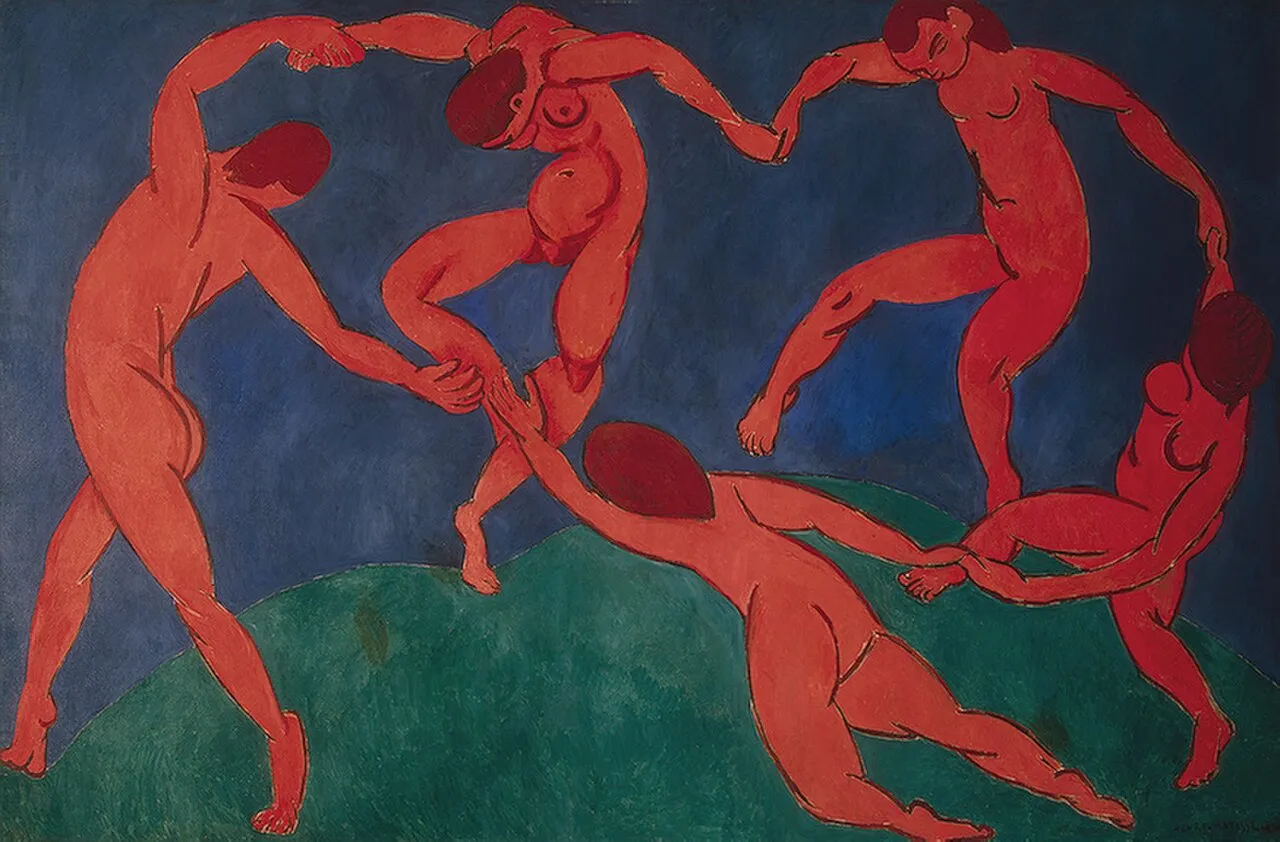
Henri Matisse, "The Dance" (first version, 1909), oil on canvas, 259.7 x 390.1 cm. Museum of Modern Art, New York. The three-color palette of coral red, saturated blue, and deep green creates an almost primal emotional charge. Matisse reportedly said he was thinking of the joy of life when he painted it. Image: Public domain, via Wikimedia Commons
Warm Colors: Energy, Danger, and Desire
Warm colors occupy the red, orange, and yellow end of the spectrum. In painting, warm colors advance visually: they appear closer to the viewer than cool colors and tend to dominate a composition even when they occupy less area. This is why a single red object in a predominantly blue scene immediately draws the eye.
Red is the most studied color in color psychology and the one with the strongest and most consistent effects. In competitive sports contexts, red has been shown to increase the perception of dominance and aggression: a 2005 study published in Nature found that athletes wearing red in Olympic combat sports won significantly more bouts than those wearing blue, even when matched for ability. In art, red has been used to signal passion (Renaissance depictions of the Virgin Mary's inner robe), danger (warning imagery across cultures), and power (the red robes of cardinals and emperors).
A 2026 study published in Frontiers in Psychology proposed the "Theme-Color-Emotion" (TCE) framework, which found that theme and color jointly account for viewer-reported emotional valence in ways that neither dimension captures alone. Cool colors (blue, green) clustered with calm and contemplative emotions, while warm colors (red, orange, yellow) clustered with pleasant and exciting emotions. The TCE framework achieved 87.6% accuracy in classifying artworks according to viewer-reported emotional valence, a 9.3 percentage point improvement over a single-color baseline. This confirms what painters have always known: color does not work alone. It works in combination with subject matter. The full study is at Frontiers in Psychology.
Yellow is the color of sunlight, gold, and warmth but also of caution and sickness in excessive amounts. Matisse used yellow as a carrier of light and optimism throughout his career. Van Gogh's aggressive use of cadmium yellow in "The Night Cafe" (1888) was deliberate: he wrote to his brother Theo that he used the clashing yellows and reds to convey "the terrible passions of humanity" through color alone. The yellow here does not feel cheerful. Combined with violent complementary contrasts, it feels menacing.
Cool Colors: Space, Calm, and Melancholy
Blue recedes visually, creating depth and distance in a composition. This is one reason why skies and backgrounds in landscape painting are almost universally blue or blue-grey: cool colors naturally suggest spatial distance. But blue also carries powerful emotional associations that artists use directly.
Picasso's Blue Period (roughly 1901 to 1904) is the most famous deliberate use of blue as an emotional key. Following the suicide of his close friend Carlos Casagemas, Picasso made paintings almost entirely in shades of blue and blue-green, depicting isolated, emaciated, and sorrowful figures. The choice of palette was not arbitrary: blue's associations with cold, distance, and sadness were already well established in Western painting and Picasso exploited them with extraordinary emotional consistency. Works like "La Vie" (1903) and "The Old Guitarist" (1903 to 1904) feel cold and hopeless not only because of their subject matter but because the dominant blue drains the compositions of warmth.
The relationship between blue and spirituality is another consistent thread. In medieval and Renaissance painting, the Virgin Mary's outer robe was almost always painted in expensive ultramarine blue, the most costly pigment available. The choice was theological (blue as the color of heaven and divine grace) but it also had a psychological effect: blue's association with vastness and the sky made it the natural color for the divine.
Simultaneous Contrast and the Color Interactions Artists Exploit
One of the most important phenomena in color psychology for understanding painting is simultaneous contrast, first described systematically by the chemist Michel Eugene Chevreul in 1839. When two colors are placed adjacent to each other, each appears to push the other toward its complementary color. Orange next to blue makes the orange look redder and the blue look greener. Yellow next to purple makes the yellow look greener and the purple look bluer.
The Impressionists built their technique around this principle. By placing complementary color strokes side by side on the canvas rather than blending them, they created visual vibration that made their paintings more luminous than anything achieved with conventional blending. Claude Monet's late water lily paintings exploit simultaneous contrast between warm orange-pinks and cool blue-purples to create the shimmering, evanescent quality that makes them feel like light itself rather than paint on canvas.
Mark Rothko took color relationships to their emotional extreme. His large color field paintings from the 1950s and 1960s consist of two or three soft-edged rectangles of color floating against a ground, but the color relationships between those rectangles are calculated with extraordinary precision to produce specific emotional states. Rothko famously wanted viewers to stand close to his paintings and said that if you were moved to tears by them, you were having the experience he intended. Many people report exactly that response. The effect comes almost entirely from color relationships and the way the soft edges between color areas create a sense of breathing or pulsing. Our post on color theory for art appreciation goes deeper into the technical vocabulary behind these relationships.
Cultural Variation: Color Meanings Are Not Universal
While the biological basis of color response is largely consistent across cultures, the symbolic meanings attached to specific colors vary significantly. White is the color of purity and weddings in Western European and North American traditions but the color of mourning and death in many East Asian cultures. In China, red is the color of prosperity, luck, and celebration. In some African cultural traditions, yellow is associated with royalty and wealth rather than caution.
A 2024 cross-cultural study found that the association between blue and calmness, and red and excitement, shows consistent patterns across 31 countries. This suggests that some color-emotion associations are genuinely universal, likely rooted in shared biology. But the specific meanings layered on top of those associations, what red means in a religious context versus a political one, what white means at a wedding versus a funeral, are culturally learned. Understanding the cultural coding of color is part of understanding art from any tradition other than the one you grew up in.
Artists who work across cultural contexts sometimes deliberately exploit this ambiguity. The contemporary Chinese-American artist Cai Guo-Qiang uses the red and gold of Chinese tradition in work that also engages with Western color psychology, creating compositions that carry different but overlapping emotional charges for different viewers.
How to Use This Knowledge When Looking at Art
Understanding color psychology gives you a practical tool for analyzing your own responses to paintings. When a painting produces a strong emotional reaction in you, the first question to ask is often about color. What is the dominant color temperature? Are the colors harmonious (analogous colors close on the spectrum) or tense (complementary colors in opposition)? How much color contrast is there between light and dark? How saturated or muted are the colors?
These questions often explain why two paintings of similar subjects feel completely different. A battle scene painted in muted earth tones feels tragic and exhausted. The same battle scene in high-saturation reds and oranges feels exciting. The color is doing as much work as the subject matter, sometimes more. For more on how artists build emotional meaning through visual choices, see our guide to how art communicates emotion without words. You might also find our guide to abstract art useful, since abstract painting relies almost entirely on color to carry its emotional weight.
Final Thoughts
Color psychology in art is not mysticism or marketing spin. It is the study of how our nervous systems, shaped by millions of years of evolution and then fine-tuned by cultural learning, respond to the specific wavelengths of light that artists direct at us. Matisse knew it when he chose his three-color palette for "The Dance." Rothko knew it when he calculated his floating color rectangles to produce specific emotional states. Van Gogh knew it when he made "The Night Cafe" feel dangerous through color contrast alone.
The more you pay attention to color as an active element in paintings rather than a surface quality, the more you will understand what paintings are actually doing to you. If you want to develop your eye further, our guide to how to look at art for beginners covers the full toolkit for reading visual compositions. What color do you find most emotionally powerful in paintings? Share your thoughts in the comments below.