Marcel Proust's narrator bites into a madeleine cake soaked in lime-blossom tea and is overwhelmed by the complete, involuntary recovery of his childhood in Combray. The taste triggers a memory so total and so vivid that for a moment the present dissolves and the past is more real than the room he is sitting in. Proust spent several thousand pages tracing the mechanisms of this involuntary memory, which he considered the only form of memory that captures the past as it was actually experienced rather than as it has been edited by subsequent understanding. The madeleine is the most famous literary example of what neuroscience now calls cue-triggered autobiographical memory: a sensory stimulus activating a network of memories that the conscious mind could not have retrieved on its own.
Visual art can produce the same effect as Proust's madeleine, sometimes with the same shocking totality. A painting of a particular kind of afternoon light, a photograph of a kitchen table set for a family meal long dispersed, a film still from a movie you saw at a specific moment in your life: certain images reach back through time and return you to an experience with a specificity and emotional charge that purely verbal memory rarely achieves. This is not coincidence. It is the result of specific connections between visual processing, autobiographical memory, and the emotional systems that determine which memories are stored most durably.
The Psychology of Nostalgia: What It Actually Is
Nostalgia has a complicated history as a concept. The word was coined in 1688 by the Swiss physician Johannes Hofer to describe what he considered a medical condition: the extreme homesickness of Swiss mercenaries stationed abroad, characterized by sadness, weeping, fever, and a consuming preoccupation with returning home. For the next two centuries, nostalgia was classified as a serious disorder, sometimes fatal.
Contemporary psychology has reframed nostalgia almost entirely. Research by Constantine Sedikides and colleagues at the University of Southampton, beginning in the mid-2000s and continuing through 2024, found that nostalgia is predominantly a positive emotion. It makes people feel more socially connected, raises self-esteem, and increases a sense of meaning and continuity in life. A 2023 study published in the journal "Cognition and Emotion" by Sedikides and Wildschut confirmed that nostalgic reflection tends to center on personally meaningful social experiences: being with people you love, places that carried significance, moments of pleasure and connection. It reinforces the sense that your life has been worth living and has had coherent themes rather than being a random sequence of events.
Crucially, nostalgia is not simply a response to the past. It is a response to a past that has been idealized in specific ways. Nostalgic memories are selective: they emphasize the positive aspects of remembered experiences and filter out the negative. The past of nostalgic memory is a constructed past, not a literal record, and artworks that trigger nostalgia do so partly by resonating with the idealized, emotionally charged version of the past that we carry rather than the documentary version. This is why a photograph of a kitchen you never sat in can produce a more powerful nostalgic response than an actual photograph of your own childhood kitchen: the image resonates with the constructed past, not the real one.
Vermeer and the Nostalgia of the Everyday
Johannes Vermeer (1632-1675) painted domestic scenes in Delft with a quality of light and attention that produces nostalgic responses in viewers who have no connection to 17th-century Holland. His paintings show women reading letters, pouring milk, trying on pearl necklaces, making lace. They are painted with the quality of light that comes through north-facing windows on overcast days: cool, diffuse, falling with extraordinary evenness on the surfaces of ordinary rooms and the faces of ordinary people.
The nostalgia that Vermeer's paintings produce is not for a specific memory but for a quality of experience: the stillness of a morning before the household wakes, the particular weight of time in a room where someone is absorbed in a task. The art critic Lawrence Gowing wrote that Vermeer painted "the mystery of the habitual," the way that ordinary domestic existence, when observed with sufficient attention, reveals itself as quietly extraordinary. The nostalgic response is a recognition of something in our own lives that we have experienced but not fully appreciated, now reflected back by a painting made three and a half centuries ago.
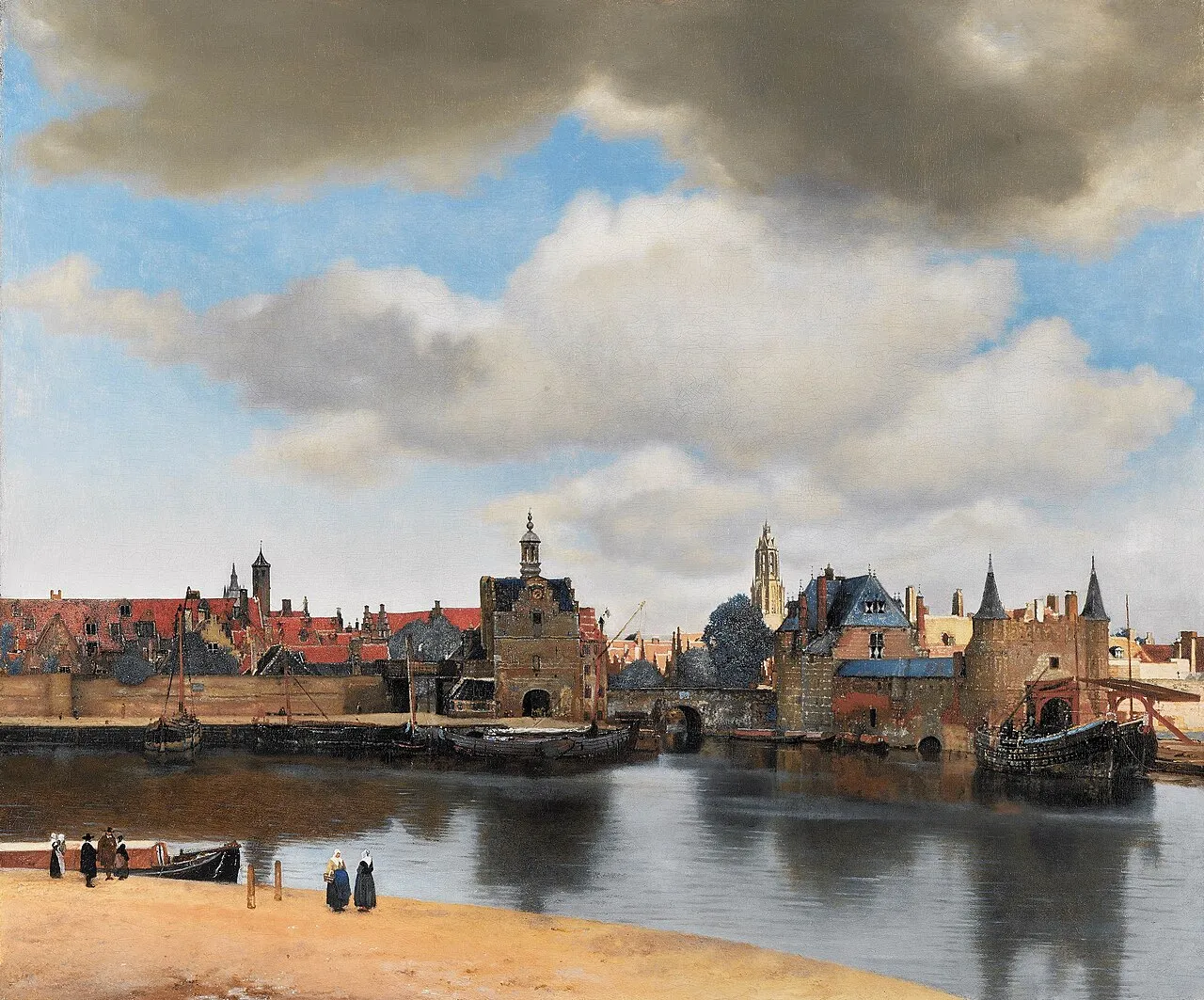
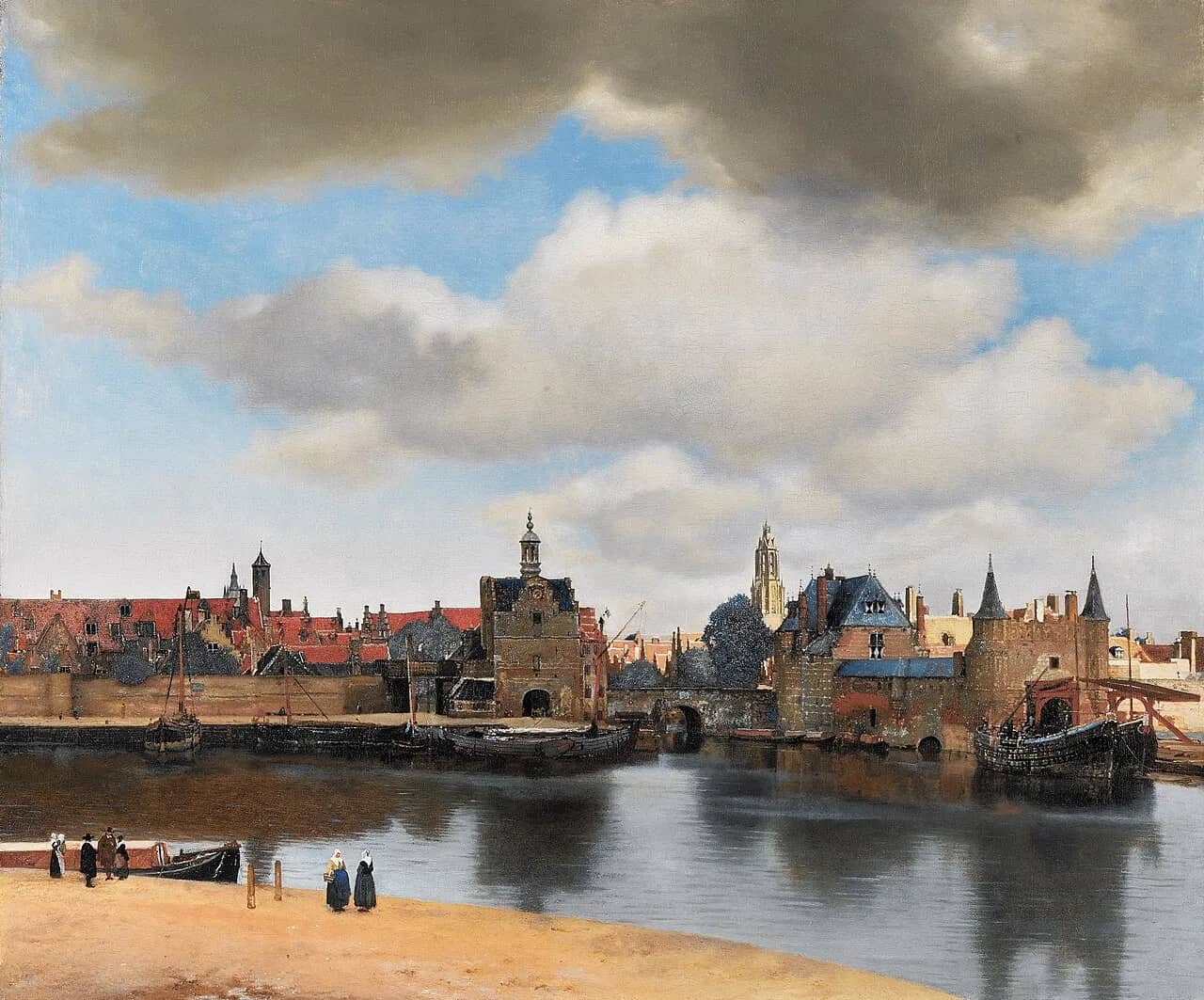
Johannes Vermeer, "View of Delft" (c. 1660 to 1661), oil on canvas, 96.5 x 115.7 cm. Mauritshuis, The Hague. Proust considered this the most beautiful painting in the world and wrote a scene in which his fictional character Bergotte dies looking at "a little patch of yellow wall" in it. Image: Public domain, via Wikimedia Commons
Proust identified the "View of Delft" as his favorite painting, and in his novel he has the fictional painter Bergotte die in a museum gallery, struck by the perfection of "a little patch of yellow wall" in the painting. The passage is usually read as an image of the immortality of great art: Bergotte's life is extinguished but the patch of yellow wall endures. It is also, characteristically for Proust, an image of how a visual detail can anchor a complete emotional world. The painting itself, which you can see at the Mauritshuis in The Hague, has that effect on viewers who have never read Proust and have no connection to Delft. The overcast morning light on the city across the Schie canal produces a quality of longing that is not about Delft specifically but about the experience of seeing a place you know held in a particular quality of light that will never come again in exactly that way.
Edward Hopper and American Nostalgia
Edward Hopper (1882-1967) painted American light with the same quality of nostalgic attention that Vermeer brought to Dutch light. His paintings of diners, gas stations, offices, and hotel rooms return obsessively to specific times of day and specific qualities of light: the harsh direct sun of noon in summer, the warm orange-yellow of interior light seen through windows at night, the cold blue-white of early morning. These are not dramatic moments. They are the moments that surround drama, the quiet intervals when no one is watching and nothing is happening.
Hopper's nostalgia is specifically American and specifically modern. His paintings evoke not a rural or aristocratic past but the particular atmosphere of American commercial spaces in the mid-20th century: the red vinyl of diner seats, the geometry of roadside architecture in the 1930s and 1940s, the quality of fluorescent light in an office late at night. For viewers who grew up in America during certain decades, Hopper's paintings are powerfully nostalgic. For viewers with no such connection, they produce a nostalgia for an experience they never had, which is one of the most characteristic effects of particularly effective nostalgic imagery. "Nighthawks" (1942), his most reproduced painting, shows four figures in a late-night diner seen through curved glass from the dark street outside. The painting has no narrative. It has light, space, and the particular quality of urban solitude at 3 am, and that is enough to trigger the response.
Photography and the Deepest Nostalgia
Photographs produce nostalgia more reliably than almost any other image type. The philosopher Roland Barthes, in "Camera Lucida" (1980), wrote about what he called the punctum of a photograph: the detail that "pricks" or "wounds" the viewer, the small particular thing that bypasses intellectual analysis and produces direct emotional response. The punctum is almost always connected to time and loss: it is the detail that makes the mortality of the depicted subject feel suddenly real. A woman's shoes, a child's posture, the particular way a hand is held.
Vernacular photography, the accumulated family photographs, school portraits, and holiday snapshots of ordinary people, has developed into a recognized art form partly because its nostalgic power is so immediate and so universal. Christian Boltanski made large-scale installations using found photographs of people who died in the Holocaust and elsewhere, creating environments that confronted viewers with the specific, individual faces of the dead at a scale that made the loss feel physical. Taryn Simon's photography archives explore the relationship between images and institutional memory, documenting the ways photographs are used as evidence, classification tools, and instruments of state power.
Barthes wrote about a photograph of his mother as a child, taken before he was born, which produced in him the most intense and particular form of grief. She was there, in that image, more vividly than in his own memories of her. And yet she was also irrevocably gone, because the photograph showed her in a time he could not access, as a person he had never known. This paradox, the photograph as both recovery and loss of the same moment, is the most essential property of nostalgic imagery. The image gives you the presence and the absence simultaneously, and the emotional weight comes from holding both at once.
Nostalgia for Times You Never Lived
One of the strangest and most interesting forms of artistic nostalgia is the response to art from periods you never experienced. Many people report powerful nostalgic responses to Victorian photography, medieval illuminated manuscripts, or 18th-century portraiture despite having no personal connection to those periods. This is sometimes called anemoia, a term coined in the online "Dictionary of Obscure Sorrows": nostalgia for a time you have never known.
This response tells us something important about how nostalgia works. It is not primarily a memory response. It is an emotional response to a specific quality of representation: the sense that something specific and real was here and is now gone. A 19th-century portrait produces this response because the person depicted was a specific living human being who had inner experiences as vivid and particular as your own, and they are completely gone. The painting is both their presence and their absence simultaneously. The Fayum mummy portraits, covered in our post on art and grief, produce this effect more intensely than almost any other historical objects: a face looking at you across two thousand years, present and absent at the same time.
This connects directly to what makes the best art from the past feel alive rather than merely historical. The Fayum portraits, the paintings of Vermeer, the photographs of early masters like Julia Margaret Cameron: all of them produce the distinctive combination of recovered presence and acknowledged loss that is the core of nostalgic experience. For more on how the art of earlier periods carries its historical context into the present, see our guide to how to look at art from any period.
What Nostalgia in Art Actually Does
Nostalgia in art is one of the most universal and least discussed aesthetic experiences. It operates quietly, through the back channels of emotional memory and personal association, and it can hit viewers who consider themselves immune to sentimentality with unexpected force. Vermeer, Hopper, a found photograph in an antique market, a film from your childhood: all of these can produce the sudden recovery of time that Proust spent thousands of pages describing.
The next time you feel unexpected nostalgia in front of an artwork, pay attention to what specifically triggered it. Was it a quality of light? A scale of space? A detail of domestic life? The answer often reveals something about your own emotional history that is worth knowing. For related reading on how art shapes and processes emotion, see our posts on art and grief and why artworks give you chills. What artwork takes you back most powerfully? Share in the comments below.