
In June 2026, Refik Anadol opened DATALAND in downtown Los Angeles. It is being called the world's first museum of AI art. The building contains five multi-sensory galleries where data becomes pigment and artworks evolve in real time, shaped by human interaction and machine intelligence. One gallery uses over half a billion pixels to create rooms that reflect the natural world, drawing on datasets from collaborations with the Smithsonian Institution and the Getty. Another gallery responds to visitors' biometric data. You walk in, and the art responds to your body. DATALAND is not a VR headset experience. It is a physical building you enter, where the boundary between digital art and physical space has dissolved entirely.
That dissolution is what virtual reality art has been working toward since artists first started experimenting with immersive environments. VR art is not just paintings viewed through a headset. It is art that creates a three-dimensional digital space you can enter, move through, and interact with. It shifts the relationship between viewer and artwork from observation to inhabitation. You do not look at a VR painting. You stand inside it. You walk around the elements. You look up and see something above you. The canvas is not a flat surface. It is a world.
For five hundred years, the fundamental relationship between artwork and viewer was fixed: the artwork hangs on a wall, the viewer stands in front of it. VR art breaks that relationship open. This guide explores what VR art is, where it came from, who is making it, and where you can experience it in 2026.
What Is VR Art?
VR art uses virtual reality technology to create artistic experiences that immerse viewers in a three-dimensional digital environment. This can take several forms. A headset-based VR artwork places the viewer inside a visual space they navigate by moving their head or body. A room-scale installation uses projection or display technology to create immersion without a headset, filling a physical room with imagery that responds to the viewer's presence. An interactive VR piece allows the viewer to modify the environment through gesture or controller input.
The common thread is immersion: the artwork surrounds the viewer rather than presenting itself for observation at a distance. This immersive quality connects VR art to a longer tradition of installation art, which has been exploring what it means to enter an artwork rather than view it since the 1960s. The Rhizome organization, affiliated with the New Museum in New York, has been documenting and preserving digital and internet-based art since 1996 and provides useful context on how VR art fits into the broader history of new media art.
The Roots of VR Art: Installation and Immersion
VR art did not arrive without precedent. The tradition of immersive installation art stretches back to the 1960s. Yayoi Kusama's infinity mirror rooms, first installed in 1965, created the illusion of endless space through mirrored reflection. The viewer entering a Kusama infinity room is inside an environment that appears boundless. The spatial and psychological effect of that immersion is the work, not incidental to it. Our guide to Kusama's career covers this work in detail.
James Turrell has spent decades creating spaces where light is the primary material. His Skyspace installations, over eighty of which exist worldwide, are rooms where an aperture in the ceiling opens to the sky, and carefully calibrated ambient light transforms the perceived color and depth of the opening throughout the day. You sit inside a Turrell. The sky becomes an object to look at in a way it does not when viewed from outside.
Olafur Eliasson's "The Weather Project" (2003-04), which filled the Turbine Hall of Tate Modern with a semicircular disc of yellow light and haze to simulate a sun, was experienced by millions of visitors who lay on the floor to look at the reflected ceiling and treated the interior of an art institution as a landscape to inhabit. That experience of entering an environment and being changed by it is exactly what VR art pursues through digital means.
teamLab: Digital Immersion at Architectural Scale
teamLab is a Tokyo-based collective of artists, programmers, engineers, and architects that has produced some of the most widely experienced immersive art in the world. Their installations use projection, sensor technology, and custom software to create spaces where visitors interact with fluid, organic digital imagery that responds to their movement. In October 2025, teamLab opened "Biovortex" in Kyoto, a permanent exhibition spanning 10,000 square metres with more than 50 immersive digital artworks. Reuters reported that the collective chose Kyoto specifically for its historical context, aiming to create a dialogue between ancient Japanese aesthetic traditions and digital technology. teamLab Phenomena Abu Dhabi opened in April 2025 as part of the Saadiyat Cultural District.
In teamLab's environments, digital flowers bloom on floors and walls, waterfalls flow continuously across surfaces and bodies, and schools of fish part around visitors as they walk through them. The imagery is simultaneously beautiful, responsive, and unmistakably digital. teamLab do not try to make their work look like the physical world. They explore what a world that only exists digitally might look like. Their permanent spaces, including teamLab Borderless at Azabudai Hills and teamLab Planets in Tokyo, have attracted millions of visitors.
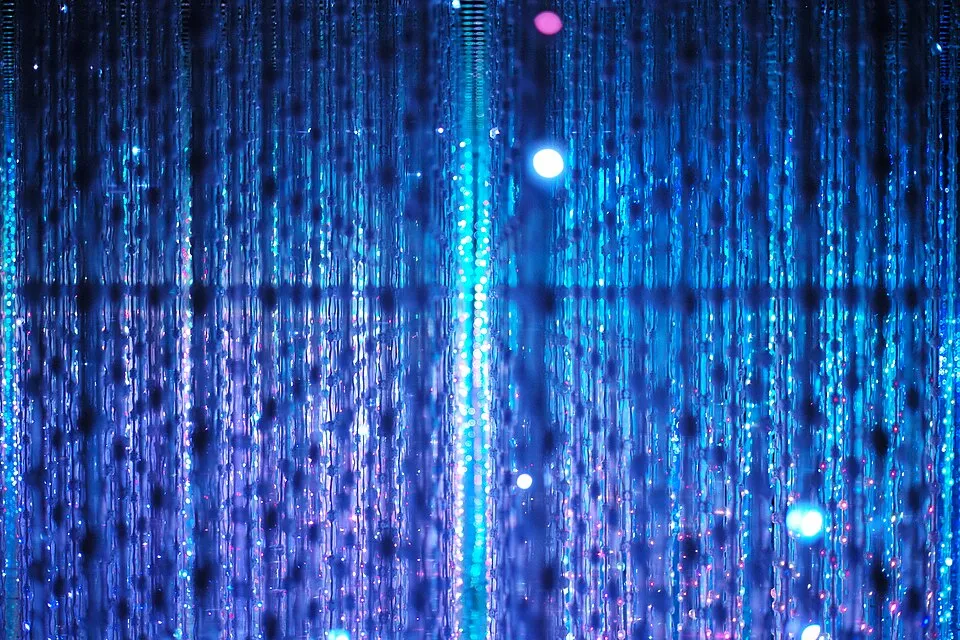
teamLab immersive installation. Their large-scale projection environments use sensor technology to make digital imagery respond to visitors' movements. Image: via Wikimedia Commons
Refik Anadol: Data as Pigment
Refik Anadol is a Turkish-American media artist whose practice centers on using machine learning and large datasets as the raw material for immersive visual work. He treats data the way a sculptor treats clay: as something to be shaped and presented rather than merely analyzed. His commission for the Museum of Modern Art in New York, "Unsupervised" (2022-23), used MoMA's collection metadata as the input for a machine learning system that generated continuously evolving visual forms on a large screen in the museum atrium. In 2024, MoMA acquired the work for its permanent collection, making it one of the first AI-generated immersive works to enter a major museum collection.
With the opening of DATALAND in June 2026, Anadol has established a permanent home for this kind of work. The Art Newspaper reported that the museum uses the Large Nature Model, a foundational AI trained on one of the most extensive permission-based datasets of the natural world, to create rooms where data becomes a living, evolving medium. Anadol's work raises questions that are central to the future of art: when an AI generates the imagery, who is the artist? When the work evolves in real time, is it ever finished? When the data comes from nature, is the artwork a representation of nature or a new kind of nature itself? For more on these questions, see our guide to whether AI art is still art.
Marshmallow Laser Feast: The Natural World Made Strange
Marshmallow Laser Feast (MLF) is a London-based collective whose VR and immersive works consistently use scientific data to reframe our perception of natural phenomena. Their work "In the Eyes of the Animal" (2015) placed visitors in a VR forest experienced through the visual systems of four different animals: a dragonfly, an owl, a frog, and a mosquito. The work was not about VR technology. It was about what the world looks like when you have compound eyes or ultraviolet sensitivity.
Their installation "We Live in an Ocean of Air" (2019), created for the Saatchi Gallery in London, used motion tracking and custom VR headsets to visualize the air as a flowing visible medium, showing the oxygen released by a giant Sequoia tree flowing through and around visitors' bodies. Science visualization and art-making became indistinguishable in the experience. MLF's approach is less about creating fantasy worlds and more about using digital tools to reveal aspects of the physical world that our senses cannot normally access.
The Tools: How VR Art Gets Made
VR art is created using a combination of 3D modeling software, game engines, and specialized VR painting tools. Tilt Brush, originally developed by Google and now open source as Open Brush, lets artists paint in three-dimensional space using a VR headset and hand controllers. You literally paint in the air, creating three-dimensional brushstrokes that you can walk around and view from any angle. Unity is the most widely used real-time 3D engine for VR art projects, running on Meta Quest, PlayStation VR, SteamVR, and all major headset platforms. Unreal Engine by Epic Games offers higher visual fidelity and is the preferred tool for artists working on photorealistic or high-end rendered environments. TouchDesigner, discussed in our guide to motion graphics, is widely used for sensor-responsive installations and projection-mapped environments.
The accessibility of these tools is changing who can make VR art. You no longer need a film studio or a specialized lab. A VR headset and a decent computer are enough to start creating immersive environments. This is analogous to what happened with photography in the nineteenth century and digital art in the late twentieth: the tools get cheaper, the barrier to entry drops, and a wave of new artists floods in. For a broader look at how digital tools are changing art making, our guide to the history of digital art traces this trajectory from early experiments to current AI-driven work.
Where to Experience VR and Immersive Art in 2026
The exhibition infrastructure for VR and immersive art has grown substantially. teamLab's permanent spaces in Tokyo and Abu Dhabi attract millions of visitors. DATALAND in Los Angeles is now open as the first dedicated AI art museum. Meow Wolf, the Santa Fe-based collective that creates immersive environments at the intersection of art, theater, and design, has permanent venues in Santa Fe, Las Vegas, Denver, and Grapevine, Texas. The Atelier des Lumieres in Paris projects large-scale digital artworks drawn from art history onto the walls and floor of a former foundry and receives over a million visitors annually. Cosm, operating immersive dome venues in Los Angeles and Dallas, is running ongoing experiences including Liquidverse, Orbital, and Big Wave projected on massive dome screens throughout 2026.
The Venice Biennale and Tribeca Film Festival both now include significant VR art programming. The Sundance Film Festival's New Frontier section has been showcasing VR work since 2012. Many major contemporary art fairs have added digital and immersive work sections. And a growing number of VR artworks are available through platforms including Meta's Horizon Worlds, allowing anyone with a compatible headset to experience works commissioned by institutions worldwide.
Final Thoughts
VR art is the most significant expansion of the exhibition space since photography made it possible to experience artworks without traveling to them. It changes the spatial relationship between viewer and work in ways that affect what images can mean and what art can ask of a body in a space. Whether it is experienced through a headset in a living room or a projection in a converted industrial building, the question it keeps asking is the same: what does it mean to be inside an image?
The work being made right now by teamLab, Anadol, Marshmallow Laser Feast, and a growing generation of artists with access to increasingly powerful tools suggests that immersive art is not a passing technological fascination but a fundamental shift in how art is made and experienced. If you want to understand the broader context of time-based and technology-driven art, the guides to installation art and generative art provide essential background. And if the tools themselves interest you, the guide to creative coding covers the programming environments that underpin much of this work. Have you experienced a VR or immersive art installation? What did it feel like? Share your experience in the comments below.


