
In 2001, Casey Reas and Ben Fry were at the MIT Media Lab working on a question that sounds simple but had not been asked in quite this way before: what would a programming language look like if it were designed specifically for visual artists? The language they built, Processing, wrapped Java in a simplified syntax for drawing and animation and shipped with a sketch interface that ran your code immediately. It became the foundation of a global movement. Today, tens of thousands of artists, designers, musicians, and architects use code as their primary creative medium. That community is not computer scientists who drifted toward art. It is mostly people who started with drawing, painting, or design and discovered that writing code opened territory they could not reach any other way.
Creative coding sits at the center of some of the most ambitious visual art being made right now. Refik Anadol's "Unsupervised" at MoMA used machine learning on the museum's collection metadata to produce a continuously evolving generative installation that ran for over a year. Vera Molnar's algorithmic drawings from the 1960s and 1970s entered major museum collections including MoMA, the Centre Pompidou, and the Victoria and Albert Museum, and her market reputation surged in her final years as generative art rediscovered its own history. If you have been curious about creative coding but assumed it was too technical for a visual practice, this guide gives you the honest picture: what the tools are, what they make possible, and how to take your first steps without a computer science background.
What Creative Coding Actually Is
Creative coding is the practice of writing code whose primary purpose is expressive or aesthetic rather than functional. A software developer writes code to solve problems: process transactions, retrieve data, display information reliably. A creative coder writes code to explore visual, sonic, or interactive possibilities. The criteria for success are different. A creative program succeeds when it produces something surprising, beautiful, or emotionally resonant, not when it performs a task efficiently.
This distinguishes creative coding from web development, app development, or data engineering, even though all of them involve writing code. It also distinguishes creative coding from simply using creative software. When you draw in Procreate, you are using a tool someone else built. When you write a sketch in p5.js, you are building the tool as part of making the work. That distinction matters for the kind of creative agency it produces. You are not choosing between preset brushes. You are defining what a brush is.
Creative coding overlaps substantially with generative art, which specifically involves autonomous systems that produce output through rules and randomness. Creative coding is the broader category: any artistic practice where writing code is central to the making.
Why a Visual Artist Should Consider Code
The most common objection from artists is that code feels like a left-brain activity at odds with intuitive visual work. That objection usually dissolves when you encounter a tool designed for artists rather than engineers. But there are genuine reasons to engage with code as part of a visual practice, and they go beyond novelty.
Scale and variation. Code lets you generate visual work at scales and in quantities that hand processes cannot match. Vera Molnar, the Hungarian computer art pioneer who began working with algorithms in 1968, described the computer as enabling her to explore "the whole library" of visual possibilities rather than the handful she could reach manually. A single piece of code can produce thousands of distinct images from the same underlying structure, which is enormously useful for understanding how visual systems behave. You can test variations faster than you can draw them.
Interactivity. Code makes it straightforward to create work that responds to input: mouse movement, sound levels, camera feeds, time of day, or live data streams. This kind of responsiveness is difficult or impossible with most traditional media. It also opens the door to work that changes every time someone encounters it, which is a genuinely different relationship between the artwork and the viewer.
Process as practice. Many artists find that writing code forces them to describe their visual intuitions precisely enough that they understand those intuitions better. The discipline of translating a visual idea into instructions that a computer can execute sharpens thinking about composition, rhythm, and structure in ways that transfer back to non-digital work. Several painters have reported that learning to code changed how they think about their brushwork, because coding forced them to decompose what a brushstroke actually does.
Processing and p5.js: The Accessible Gateway
Processing remains the most widely used creative coding environment for visual artists. It wraps Java in a simplified syntax designed for drawing and animation, and it comes with a visual sketch interface that runs your code immediately. A basic Processing sketch that draws a moving circle requires about five lines of code. The environment handles setting up a display window, managing frame rates, and exporting images or video. What you write is the visual logic.
p5.js is a JavaScript library that brings Processing's philosophy to the web browser. Created by Lauren McCarthy in 2013 with the explicit mission of making coding accessible to artists and designers, p5.js runs in any modern browser without installation. The p5.js web editor at editor.p5js.org lets you write, run, and share sketches from a browser tab, which removes every setup barrier that might otherwise slow a beginner down. According to the p5.js project documentation, the library is now used in curricula at over 500 institutions worldwide.
For most visual artists starting with creative coding in 2026, p5.js is the practical entry point. No installation required. A large and active community. Free high-quality tutorials. A reference library where every function comes with runnable examples you can modify directly on the page. The barrier to entry is effectively zero if you have a browser and an internet connection.
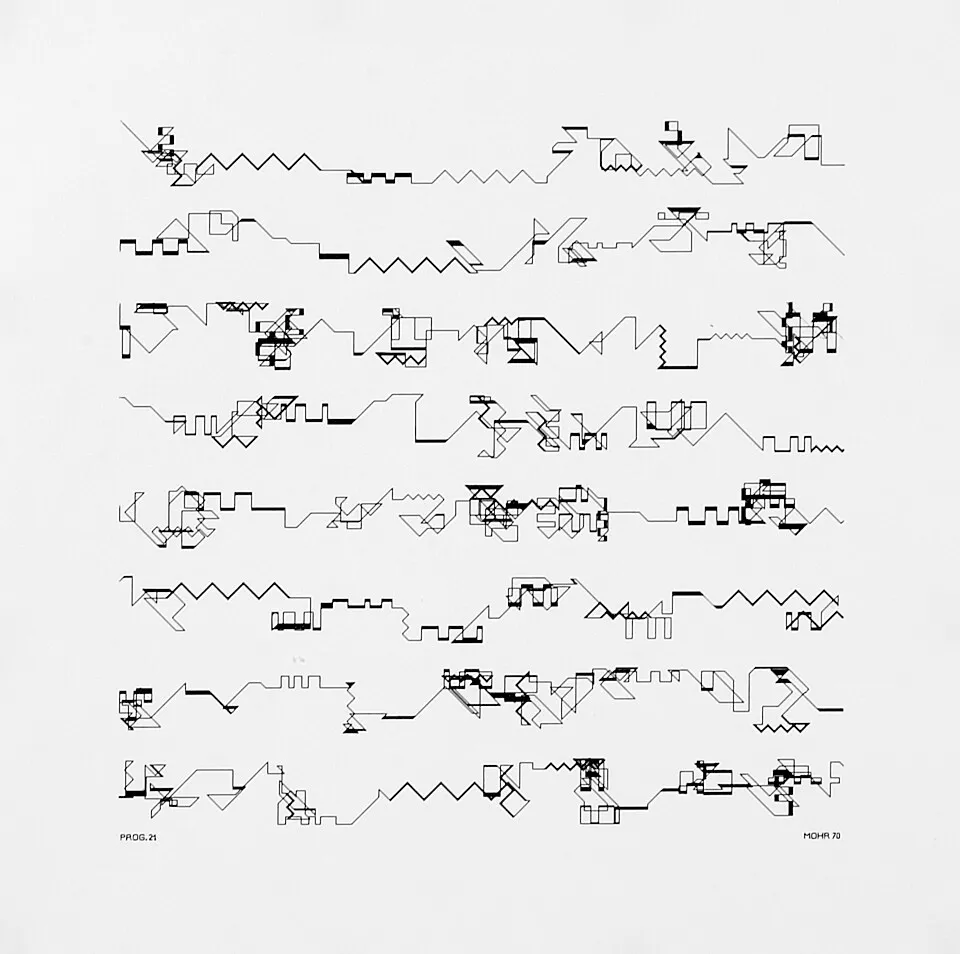
Manfred Mohr, "P021G" (1970). Computer-generated plotter drawing. One of the earliest examples of code as visual art. Image: Public domain, via Wikimedia Commons
Beyond p5.js: When You Need More
As a practice develops, you may want tools better suited to specific applications that p5.js does not handle optimally.
openFrameworks is a C++ toolkit built for artists working in real-time audio-visual performance, live visuals, and physical computing. It is more complex to set up than p5.js, but it handles demanding real-time applications with a speed and efficiency that JavaScript cannot match. Many artists who perform live visuals or build interactive installations prefer openFrameworks for its performance and its strong connection to hardware including depth cameras and microcontrollers.
TouchDesigner, made by Derivative, has become the industry standard for live visual performance and large-scale installation work. Instead of writing text-based code, you connect visual processing nodes in a network. It is not entirely free, though a non-commercial license is available. A significant portion of the major immersive art environments you encounter at galleries and festivals are built in TouchDesigner. If you have been to an immersive digital art exhibition in the last five years, there is a good chance the real-time pipeline was TouchDesigner.
Max/MSP with Jitter has been a standard for sound-reactive visual work since the 1990s. Its visual patching approach influenced both TouchDesigner and many other node-based tools. Artists like Ryoji Ikeda, known for precise data-driven audio-visual performances, have used Max-based systems throughout their careers.
Unreal Engine and Unity, primarily game engines, are increasingly used by artists building real-time interactive environments and immersive installations. We cover this territory more fully in the guide to virtual reality art.
Getting Started: Three Practical Steps
If you have never written code and want to begin creative coding, this is the most effective path.
Step one: Spend one hour with the p5.js web editor. Go to editor.p5js.org. The default sketch draws an ellipse. Change the numbers. Change the colors. Press play repeatedly after each modification. Do not try to understand everything at once. The goal of the first hour is simply to see that changing numbers changes images, and to get comfortable with the trial-and-error rhythm that characterizes creative coding practice.
Step two: Follow Daniel Shiffman's "The Coding Train" on YouTube. Shiffman is likely the most effective teacher of creative coding currently working. His series "Code! Programming with p5.js for Beginners" starts from zero and proceeds through drawing, animation, interaction, data, and machine learning integration, all with genuine enthusiasm for the aesthetic possibilities at each stage. His approach treats code as a visual medium from the first lesson, not as a technical subject you endure before getting to the visual part.
Step three: Make one small sketch per week for four weeks. Creative coding improves through accumulated practice more than through formal study. Each sketch builds intuition about how the system behaves. The first few will feel frustrating. By the fifth or sixth something will click. By the twelfth you will find yourself combining elements from earlier sketches in ways you did not plan in advance, which is when the practice starts to feel genuinely generative rather than mechanical.
Artists Making Remarkable Work with Code
Understanding what creative coding produces at a high level gives useful direction before committing time to learning it.
Vera Molnar (1924-2023) is the foundational figure. She began working with computers in Paris in 1968 and produced plotter drawings through code that introduced controlled randomness into geometric systems. Her work is held by MoMA in New York, the Victoria and Albert Museum in London, and the Centre Pompidou in Paris. She is widely regarded as one of the most important artists in the history of computer art, and her reputation only grew in the final years of her life as the generative art market brought renewed attention to her six decades of systematic work. The Centre Pompidou's 2024-2025 retrospective of Molnar's work was the first major museum survey dedicated to her career.
Manfred Mohr began making computer art in 1969 in Paris, initially using a Benson flatbed plotter to produce drawings generated by code he wrote himself. His decades-long investigation of the n-dimensional hypercube as a visual subject produced hundreds of works that demonstrate what sustained commitment to a creative coding practice looks like over time.
Casey Reas, co-creator of Processing, continues to make paintings, prints, and videos generated through code. His "Process" series translates written instructions into software systems that produce visual output, drawing a direct line between the conceptual instruction-based art of Sol LeWitt in the 1960s and the code-based practice of today. The connection is not metaphorical. LeWitt's wall drawings and Reas's software both treat the instruction as the artwork and the execution as a manifestation.
Refik Anadol uses machine learning and large datasets to create architectural-scale projections and immersive data sculptures. His commission at MoMA, "Unsupervised" (2022), used the museum's collection metadata as source material for a continuously evolving generative installation. It brought creative coding to one of the world's most prominent fine art contexts and demonstrated that the practice has fully arrived in institutional spaces. You can explore how digital art has developed broadly alongside these coding-specific practices.
What to Expect
Creative coding is not a replacement for other art-making practices. It is an expansion of the toolkit that has been building since the late 20th century. The learning curve is real, but it is much shorter than it was when Vera Molnar needed a mainframe operator to run her programs. The tools are now designed for artists, the community is large and generous, and the tutorials are freely accessible.
You do not need a computer science background. You need curiosity, a tolerance for things not working on the first attempt, and enough time to sit with a sketch until something interesting happens. Start with p5.js, spend an hour breaking the default sketch, and see where it takes you. For the broader context of what code-driven visual systems have become, the guide to generative art covers the history and aesthetics in depth. For how creative coding connects to the longer history of conceptual art's instruction-based practice, that guide traces the lineage from LeWitt to code. What kind of visual work would you want to make with code? Share your ideas in the comments.


