
Most people, looking at "Nighthawks" for the first time, feel something before they think anything. The painting works on you before you have analyzed it. The question is what exactly it is doing to produce that response, and the answer turns out to be more technically specific than you might expect.
"Nighthawks" was completed in January 1942, weeks after Pearl Harbor brought the United States into the Second World War. Edward Hopper had been working on the painting before the attack; the war did not inspire it. But the painting's combination of artificially lit warmth against deep surrounding darkness, its four figures who share a room without sharing an experience, touched something in the American mood of that specific moment. It sold immediately to the Art Institute of Chicago, where it has remained ever since. In more than eighty years, it has never been permanently loaned elsewhere.
In this guide, you will learn how the painting is technically constructed, what Hopper was doing with light and space, who the figures are and what they are doing, and why this particular image has become the most recognized painting in American art history.
What You Are Looking At
The scene is a corner diner at night. The city outside is empty: no pedestrians, no cars, nothing moving. The street is dark and the storefronts across the way are shuttered. Inside the diner, glassed on two sides, four people are present. A counterman in a white uniform works behind the counter at a task facing away from the customers. A man in a dark hat and jacket sits at the counter with his back to us. A woman in a red dress sits beside him, holding something small. A third man in a suit sits at the far end of the counter, angled slightly away.
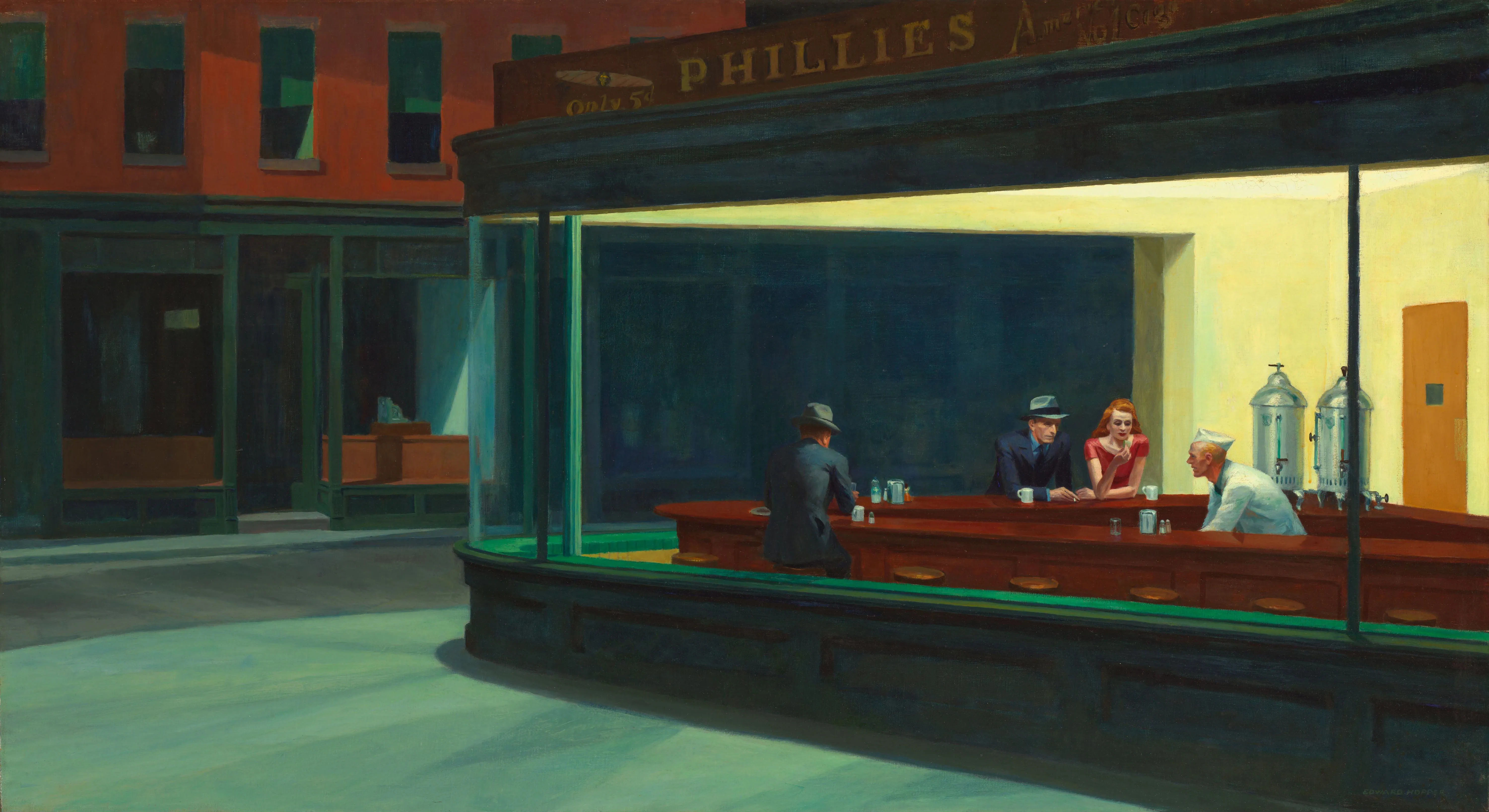
Nighthawks, Edward Hopper, 1942. Oil on canvas, 84.1 x 152.4 cm. Art Institute of Chicago. The Art Institute's collection page has high-resolution details. Wikimedia Commons.
None of the four is interacting with any of the others. The couple near the center might be together, but they are not touching and not quite looking at each other. The solitary man could be waiting or simply sitting. The counterman is occupied with something we cannot see. Each person is enclosed in their own private experience while being physically close to the others. This is the painting's subject. The title says it plainly: nighthawks, slang for people out late at night, keeping company with the dark.
The Diner Has No Door
Look at the painting carefully and you will not find a door. The curved glass front wraps the full length of the diner without interruption. This is deliberate. Hopper based the setting on a real diner at Greenwich Avenue and Seventh Avenue in Manhattan, but he simplified and compressed the architecture to produce a specific effect: a beautiful, warm, fully visible space that the viewer cannot enter. You are permanently outside, on the dark street, looking in.
In painting after painting, Hopper places the viewer as a watcher looking into a lit interior from a dark exterior. A woman reads alone by a window. A man sits in a hotel lobby at 2am. An office floor is still lit at dusk with a solitary figure at a desk. The viewer is implicated without being included. "Nighthawks" makes this dynamic unusually explicit by removing the door entirely, turning the diner into something like an aquarium: fully visible, completely inaccessible.
The Specific Quality of the Light
The diner interior is the only light source in the composition. Everything else is dark: the street, the storefronts opposite, the sky. The quality of the diner light matters enormously and Hopper got it exactly right. It is the harsh, greenish-white light of 1940s commercial fluorescent tubes, the kind of light that bleaches surfaces and makes people look slightly wrong. It is not warm or domestic. It is institutional, functional, impersonal light: light that says the place is open, not that anyone should feel comfortable here.
Hopper spent decades studying light. He filled notebooks with observations about how light falls on buildings at different times and in different conditions. He and his wife Jo walked the streets of Manhattan specifically to study building facades. The light in "Nighthawks" is not invented. It is the precisely observed light of a specific kind of corner in a specific kind of city at a specific hour, and it reads as artificial and cold in exactly the way that kind of light actually looks when you are standing outside at midnight looking through glass.
The Figures and Their Ambiguity
Jo Hopper, Edward's wife and herself a trained painter who had studied under Robert Henri, modeled for the woman in red. She modeled for virtually all the female figures in Hopper's mature work. Hopper modeled the solitary man at the far end of the counter on himself. Jo's meticulous diaries, now among the most useful documentary sources on his paintings, record that the central couple had "some unnamed trouble" between them. Hopper declined to elaborate. He did not title his figures, provide their names, or explain their situations. He wanted them looked at, not explained.
The ambiguity is structural. The painting stages a narrative situation without completing it. Who are the couple? Are they actually together or just sitting near each other? What is the solitary man doing there? Why is the counterman working so late? Viewers have been generating answers for more than eighty years. Film noir used the image as a direct visual reference. The painting has saturated American visual culture so completely that it now functions as shorthand: when a director or novelist wants to evoke a particular quality of urban aloneness, they invoke this image or something like it.
Why the Painting Endures
"Nighthawks" endures because it is honest about something that most cultural representations of public life prefer to avoid. It shows people in a shared space who are not connecting. It shows a city that is empty and indifferent after midnight. It shows warmth that is artificial, light that does not comfort, proximity that is not intimacy. These were true in 1942 and are true now. The painting does not moralize about them or invite pity. It observes them with the same flat, precise, unsentimental attention Hopper applied to everything he painted, and that refusal to soften the observation is what keeps the image alive. Ready to explore Hopper's full body of work and career? See the complete artist spotlight. What does "Nighthawks" make you feel? Share in the comments below.


