
Pick up a handmade book and you feel immediately that it was made by someone. The slight irregularity in the spine, the stitch visible along the back, the way it falls open flat without resisting you: all of it is evidence of choices. A handmade book is simultaneously tool, container, and artwork, and the person who made it left the record of their attention in every joint and sewn signature. Unlike a painting you hang on a wall and look at, a handmade book is an object you open, hold, turn over, and move through in time. That combination of the functional and the beautiful is what has kept bookbinding alive as a serious craft for more than fifteen hundred years.
Designer bookbinding, the term used for bookbinding practiced as fine art rather than commercial production, has its own galleries, competitions, and collecting community. The best examples sell at auction for thousands of pounds and are acquired by major museum collections. Most people who encounter fine bookbinding for the first time are struck not by how exotic it is but by how immediate it is: the binding is clearly made by a person, using materials you can identify, and the quality of the craft is directly legible in the object. There is no gap between the skill and the result.
This guide covers the history of the bound book, the structural approaches that define the field, the artists who made bookbinding a recognized fine art form, and where the craft stands in 2026. Whether you are drawn to it as a collector, a practitioner, or someone curious about beautiful making, it rewards sustained attention.
A Brief History of the Bound Book
Before the bound book existed, text traveled on scrolls: papyrus or parchment rolled and stored in cylindrical cases. The codex, the form of the book we recognize today, with leaves gathered into signatures and sewn at the spine, developed in the first few centuries of the Common Era. The oldest surviving bound books date from around the 4th and 5th centuries CE and come from Coptic Christian communities in Egypt. The Coptic binding, in which signatures are sewn directly to each other through a chain stitch visible on the spine, remains one of the most structurally elegant binding forms ever devised and is still widely used today, particularly for sketchbooks and journals.
Islamic binding traditions from the 7th century onward developed elaborate cover decoration: geometric leather tooling, doublures (inner cover linings in decorated leather or silk), and fore-edge painting. European medieval monasteries produced bindings of extraordinary richness, wooden boards covered with worked leather, sometimes set with jewels or ivory panels, fastened with metal clasps. These were protective objects for texts considered sacred, and their grandeur reflected the value placed on what they contained.
With the development of printing in Europe from the 1450s onward, book production shifted from hand-copying to mechanical press, and binding gradually separated from writing and illustration as a distinct trade. As the British Library's overview of bookbinding history notes, by the 17th century Paris had established itself as the center of fine European bookbinding, with binders working for royal and aristocratic patrons in styles that remain reference points for decorative binding today.
Structures: How Binding Works
Understanding bookbinding starts with structure. Every binding solves the same fundamental problem: how to hold multiple leaves of paper in a fixed order, attach them to a cover, and allow the book to open and close repeatedly without the text block or the cover failing. Different traditions have solved this problem differently, and the range of structural approaches is much wider than most non-practitioners realize.
The most common Western binding is the case binding, in which the sewn and glued text block is attached to a pre-made cover through the endpapers. This is the structure of virtually every hardback book you have ever bought. It is efficient for large print runs but relatively inflexible, and it does not lie flat when open unless the spine has been properly rounded and backed during production.
The Coptic stitch is characterized by its exposed spine: the sewing is visible along the back of the book as a chain stitch that is both structural and decorative. It opens completely flat, making it the preferred structure for sketchbooks, journals, and music manuscripts where the reader needs to keep the book open without holding it. Japanese stab binding, or yotsume toji, sews the entire text block together from outside the covers through a series of holes along the spine edge, leaving a decorative stitch pattern visible on the outside. French link stitch, longstitch, and dozens of other structures each have different aesthetics, different opening qualities, and different implications for the materials used.
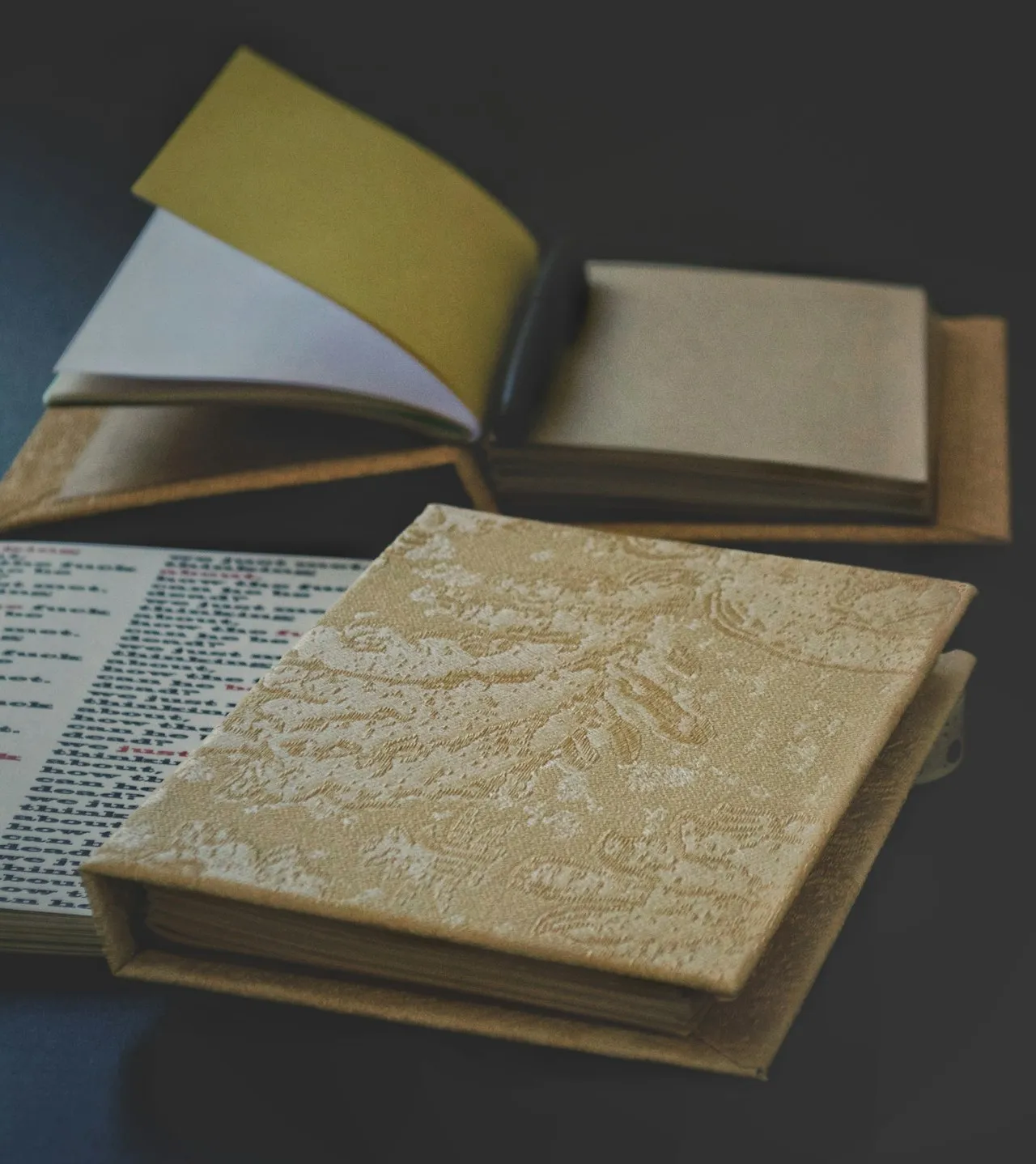
Handbound books with exposed Coptic stitch spines, one of the oldest surviving binding structures still in active use. The visible sewing is a structural feature, not a decorative afterthought. Photo: Unsplash
The Craft of Decoration: Covering, Tooling, and Marbling
The cover of a fine bound book is where craft becomes most visibly art. Traditional leather covering involves paring, which means thinning the leather at the edges with a skiving knife so it turns smoothly around the boards without building up unsightly bulk at the corners. The leather is then pasted evenly, without air bubbles, and the cover decorated through techniques accumulated over centuries.
Gold tooling is the most demanding of these techniques. A metal finishing tool, heated to a specific temperature, is pressed through gold leaf onto a leather surface prepared with a size, an adhesive layer typically made from egg white or paste. If the temperature, pressure, and timing are correct, the gold adheres permanently in the precise impression of the tool's design. If any variable is wrong, the gold fails to stick or the leather burns. The intricate gilded lines across fine bindings are the product of hundreds of individual impressions, each requiring complete control.
Marbled paper, used for endpapers and cover papers, is made by floating pigments on a water or carrageenan (seaweed gel) surface, raking them into patterns with combs and styluses, and laying paper onto the surface to lift the image. The patterns, with traditional names like Spanish wave, French curl, and peacock, cannot be exactly replicated. Each sheet is unique. The tradition originated in the Ottoman Empire and Persia, reached Italy in the 16th century, and spread from there to France and Northern Europe. Fine 18th and 19th century books with marbled endpapers are collected for those papers alone.
Designer Bookbinding as Fine Art
The transition of bookbinding from craft to recognized fine art form in the 20th century was driven by practitioners who treated the book cover as a surface for original visual design. In France, Paul Bonet (1889 to 1971) developed abstract cover compositions using geometric gold tooling with no precedent in historical binding, positioning his work explicitly within contemporary art rather than decorative craft. Pierre Legrain, Henri Creuzevault, and Rose Adler similarly brought modernist graphic ideas to cover design. Their work from the 1920s through the 1950s forms the core of most major collections of designer bindings.
In Britain, Edgar Mansfield (1907 to 1996) pioneered a sculptural approach to leather covering, using onlays, gouge work, and unconventional materials to create covers that are three-dimensional objects rather than decorated flat surfaces. Philip Smith (born 1928) developed the "maril" technique, in which small pieces of colored leather are inlaid to build up pictorial images of remarkable complexity across both covers and spine. His "bookwalls," groups of books whose covers together form a single image across multiple volumes, remain among the most ambitious works in the medium.
Today, designer bookbinding is practiced internationally. The Designer Bookbinders organization in the UK, founded in 1968, holds exhibitions and competitions and maintains a collection. The Guild of Book Workers in the United States performs a similar function. Fine binders work in France, Germany, the Netherlands, Japan, Australia, and across North America. The Codex Foundation in Berkeley holds Codex: The International Book Fair for Artists' Books every other year, bringing together hundreds of practitioners and institutions.
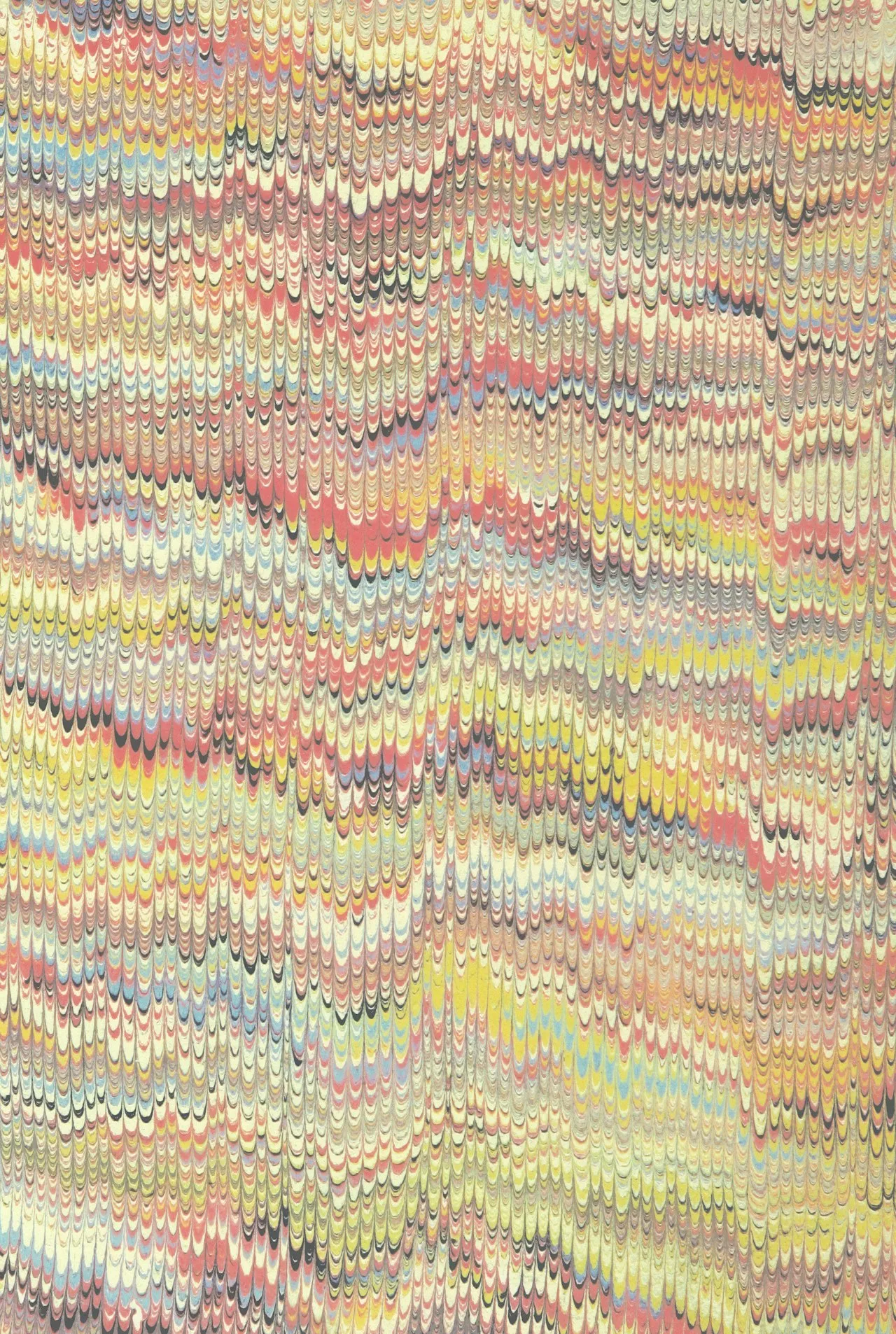
Marbled paper, used for endpapers and cover papers in fine bookbinding. Each sheet is unique; the floating-pattern technique originated in the Ottoman Empire and spread to Italy in the 16th century. Photo: Unsplash
Artists' Books: The Book as Object
Alongside designer bookbinding, the broader field of artists' books treats the book not as a vehicle for text but as a form in itself, to be designed, constructed, and experienced as a visual and physical artwork. Artists' books can take almost any form: accordion folds, tunnel books, sculptural pop-ups, or conventional bound structures whose content subverts the reader's expectations at every turn.
The artists' book as a consciously defined form begins in the 1960s with works like Ed Ruscha's "Twentysix Gasoline Stations" (1963), which used the book format to present deadpan documentary photography in a way that challenged gallery-based art. Dieter Roth's proliferating book works, William Blake's earlier hand-illustrated and hand-printed books, and the Fluxus movement's "Fluxkits" all helped establish the book as a legitimate art medium. By 2026, artists' books are collected by major libraries and museums alongside prints and drawings. The Victoria and Albert Museum, the Bodleian Library in Oxford, and the Special Collections of many university libraries maintain significant holdings.
Getting Started: Materials and Entry Points
Bookbinding is one of the most accessible crafts to begin. The basic materials for a Coptic stitch or Japanese stab binding, paper, bookboard, bookcloth or decorative paper, waxed linen thread, a bone folder, and an awl, cost very little and are widely available. A pamphlet stitch can be learned in an afternoon. The first binding you make will probably be structurally sound even if it is not beautiful, and improvement comes quickly and visibly with practice.
Community workshops, art centers, and craft studios in most cities offer introductory classes. The London Centre for Book Arts and many craft guilds run both short courses and longer programs for those who want to develop the craft seriously. Online resources have expanded considerably in recent years, with detailed video tutorials available for most standard binding structures.
For collectors, the secondary market for fine bindings is active through specialist book fairs such as the London International Antiquarian Book Fair and the New York Antiquarian Book Fair. Auction houses including Christie's and Bonhams regularly include designer bindings in their printed books and manuscripts sales. The craft exists at every level of ambition, from an afternoon making a simple journal to a lifetime spent mastering the exact temperature and pressure that fine gold tooling demands. For how craft and material-making connect to fine art more broadly, the beginners reading guide is a starting point across the full range of disciplines. The exploration of how paper itself becomes art continues in the companion piece on paper arts, and the printmaking tradition that bookbinding intersects with is covered in our woodblock printing guide.


