
Katsushika Hokusai's "Under the Wave off Kanagawa," universally known as "The Great Wave," was designed as a commercial product. It was print number one in the series "Thirty-Six Views of Mount Fuji," published in Edo (now Tokyo) around 1831 by the publisher Nishimuraya Yohachi, priced at about 16 mon, roughly the cost of a bowl of noodles. It was produced in multiple editions during Hokusai's lifetime, with the quality of the printing and paper varying between editions, and hundreds of impressions survive in museum and private collections worldwide.
None of this commercial, mass-produced origin diminishes what the image is. "The Great Wave" is one of the most compositionally sophisticated images in the history of graphic art, and its influence on Western art, when it became known in Europe in the second half of the 19th century, was direct and transformative. Monet owned a copy. Van Gogh copied it in pen and ink. Debussy used it for the cover of the score of "La Mer." The image moved from a popular Japanese print medium designed for an urban mass market to a foundational reference point of Western modernism in the space of a few decades.
Hokusai and the Print Tradition
The woodblock print tradition in Japan, known as ukiyo-e ("pictures of the floating world"), was a popular commercial medium producing images of actors, courtesans, sumo wrestlers, landscapes, and mythological subjects for an urban middle-class audience from the 17th century onward. Hokusai, born in Edo in 1760, was one of the most prolific and versatile artists in this tradition, producing an estimated 30,000 works over a career that spanned more than seven decades.
The woodblock printing process required collaboration between the artist, who made the original drawings, the engravers who cut the image into multiple woodblocks (one per color), the printers who inked and pressed the blocks, and the publisher who financed and distributed the result. The "artist" credited on a print made most of the aesthetic decisions but did not personally handle the wood or the ink. The process was industrial in the modern sense, with each edition potentially running to hundreds of identical impressions. The artist spotlight Hokusai: The Great Wave and a Life in Japanese Prints covers his full career and the ukiyo-e tradition.
A 2025 study published in the journal Heritage Science used hyperspectral imaging and X-ray fluorescence to analyze the pigments on early impressions of The Great Wave across multiple museum collections. The researchers confirmed that the earliest impressions used a thick, saturated Prussian blue applied in multiple layers, while later impressions from worn blocks show a thinner, paler application. They also identified a previously undocumented pink pigment in the sky area of some early impressions, a fugitive organic lake that has faded almost completely in most surviving copies. This explains why the sky in many impressions appears almost white: it was originally a soft pink gradient that has been lost to light exposure over nearly two centuries.
The Composition
The composition is asymmetrical and dynamic in a way that broke with earlier ukiyo-e landscape conventions. The great wave fills the upper two-thirds of the image, its claw-like crest reaching down toward three oshiokuri boats in the trough below. Mount Fuji, the nominal subject of the series, is reduced to a small, almost subsidiary triangle in the lower center, seen through the arch of the wave's breaking crest as if framed within it.
The brilliance of this compositional decision is that it makes the wave the subject and Fuji the background, reversing the conventional hierarchy while still technically fulfilling the series premise. Fuji is present but it is overwhelmed. The natural world is overwhelming the human frame of reference: the boats and their oarsmen are tiny, fragile, fighting forces that dwarf them. The image is simultaneously a landscape, an action scene, a meditation on human vulnerability in nature, and a supremely elegant formal composition.
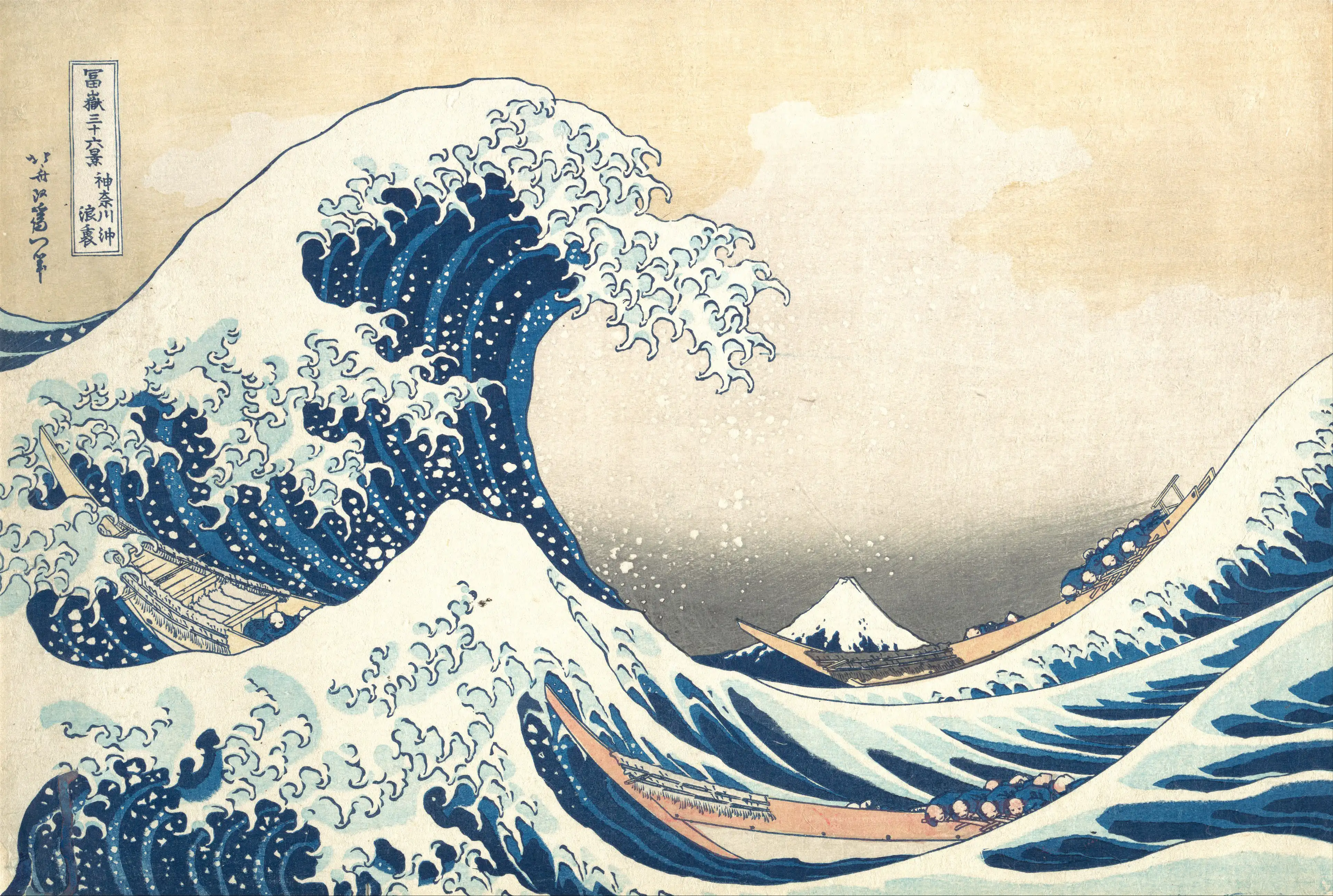
Katsushika Hokusai, "Under the Wave off Kanagawa" (c.1831), color woodblock print, 25.7 x 37.9 cm. Multiple museum collections worldwide, including the Metropolitan Museum of Art, New York. The distinctive Prussian blue was a newly imported pigment from Germany that became widely available in Japan just before this series was published. Image: Public domain, via Wikimedia Commons
Prussian Blue and the Palette
The wave's characteristic blue was produced using Prussian blue, a synthetic pigment developed in Berlin in 1704 and imported to Japan beginning in the late 18th century. By 1820 it was widely available and relatively inexpensive. Its intense, stable blue was significantly more vibrant than any natural blue pigment available in Japan before its introduction, and its arrival transformed the ukiyo-e color palette.
Earlier editions of "The Great Wave" (from the early 1830s) show the Prussian blue at its most saturated, used confidently for the wave and the sky. Later edition printings from the same blocks, made after the blocks had been used extensively and the engraving had worn, show paler colors and less detail in the foam. The difference between early and late impressions of the same print design is substantial, which is why print collectors and museums specify edition condition when identifying specific impressions.
Japonisme and Western Art
The arrival of Japanese prints in France in the 1850s and 1860s, initially as packing material for porcelain exports, created an immediate aesthetic sensation among French artists. The prints offered visual conventions that were radically different from those of European academic painting: bold outline, flat areas of unmodulated color, unusual viewpoints, asymmetrical composition, and a relationship to natural subjects that was both precise and highly stylized.
Hokusai's work was central to this influence. Claude Monet hung Japanese prints throughout his home at Giverny, including Hokusai's work. Van Gogh copied two Hiroshige prints in oil paint and wrote extensively about Japanese art in his letters to Theo. The compositional principles of ukiyo-e were absorbed into Impressionism and Post-Impressionism and eventually into graphic design: the flat-color, bold-outline aesthetic that still dominates commercial illustration and poster design owes a direct debt to the Japanese print tradition that Hokusai helped define. The Complete Guide to Art Movements covers Japonisme as part of the Impressionist story.
A Global Image
The "Great Wave" now appears on a range of merchandise that rivals the Mona Lisa and Van Gogh's Starry Night for cultural ubiquity. It is also used in scientific contexts: seismologists and oceanographers use it as an instantly recognizable image for tsunami-related publications and events. It has appeared in political cartoons representing Japanese economic power in the 1980s, environmental disaster coverage in the 21st century, and in the immediate aftermath of the 2011 Tohoku earthquake and tsunami, which prompted an enormous volume of media comparison between Hokusai's image and actual footage.
The comparison was complicated. Hokusai's wave is not a tsunami: it is a type of deep-ocean rogue wave known in Japanese as a "kanagawa." But the image's power is such that it serves to represent all overwhelming waves, all oceanic force. That a print designed for a mass market in 1831 Edo should serve as the primary cultural reference for a 21st-century natural disaster affecting Japan demonstrates something important about the longevity of images that achieve the specific combination of formal quality and emotional directness that "The Great Wave" achieves.
In 2025, the British Museum opened a major exhibition "Hokusai: The Great Picture of Everything" focusing on the artist's late-period works and his ambitious large-scale paintings, many of which have rarely been seen outside Japan. The exhibition included new research on Hokusai's working methods in his eighties, when he produced some of his most ambitious work despite declining health. The Ashmolean Museum in Oxford has also announced a 2026 exhibition tracing the global journey of The Great Wave specifically, from its creation as a commercial print to its current status as a universal visual icon, with loans of early impressions from collections in Tokyo, Paris, and New York.
For more on what makes an image endure, see Famous Paintings Explained: What 20 Iconic Works Are About. For the broader story of how Japanese prints influenced Western art, read about Impressionism and the evolution of art styles. For more on the visual elements that make this composition work, see our art toolkit guide.


