
Every other sculptural material is solid before you work it and remains solid throughout. Stone, wood, clay, metal: all can be shaped, but they begin as stuff and end as stuff. Glass is different. In its working state, it is a viscous liquid, moving on the end of a blowpipe in response to gravity and breath, cooling from bright orange through red to black as it stiffens toward rigidity. A single gathering of molten glass from a furnace held at 1100 degrees Celsius gives the glassblower roughly two minutes of working time before the material becomes unworkable. Everything happens in that window.
This temporal quality is glass's defining characteristic as an art medium. The form of a blown glass vessel is not the result of slow accumulation, like a sculpture built up in clay, nor of slow subtraction, like a stone carving. It is the result of a continuous negotiation between the glassblower's intention and a material that is simultaneously cooperative and resistant, always pulling toward symmetry under centrifugal force, always dropping under gravity, always cooling. To make exceptional glass, you have to work with these tendencies rather than against them, and that means understanding the material at a level that takes years of practice to develop.
The result, when it works, is an object that appears to have been formed by natural forces as much as human ones: a vessel whose walls thin to near-transparency at the rim, whose colours bloom and layer in ways that could not have been exactly planned, whose surface holds the light differently at every angle. That quality is not incidental to glass art's appeal. It is the point.
A History of Glassblowing
Glass as a material has been known since ancient Egypt and Mesopotamia, where it was formed by core-forming techniques (winding glass threads around a removable clay core) or by casting in moulds. Glassblowing as a specific technique, using an iron blowpipe to inflate a gather of molten glass, developed in the Levant around the 1st century BCE, almost certainly in the area of modern Syria, Lebanon, and Israel. Within a century, the Roman Empire had adopted the technique with great enthusiasm, and blown glass vessels were being produced across the empire in large quantities.
The Venetian glass-making tradition, centred on the island of Murano from the late 13th century onward, produced the most technically refined and artistically ambitious glass in Europe for several centuries. Venetian glassblowers developed techniques including filigrana (glass threads twisted into fine decorative patterns within clear glass), lattimo (opaque white glass imitating porcelain), and ice glass (a crinkled surface created by plunging hot glass into cold water). The Venetian authorities were so determined to maintain their monopoly on these techniques that glassblowers were forbidden to leave the island on pain of death, and those who emigrated and taught their skills abroad were hunted by assassins. The history of glass technique is, in part, a history of industrial espionage.
By the 17th and 18th centuries, Bohemian and German glass-cutters and engravers had developed a rival tradition of heavy, brilliantly cut crystal that dominated the European market. English lead crystal, developed by George Ravenscroft in the 1670s, produced glass of exceptional clarity and brilliance suited to both cutting and drinking. The industrial revolution moved glass production from craft workshops to large-scale factories for most purposes.
The Studio Glass Movement
The transformation of glass into a studio art form began with two seminars held at the Toledo Museum of Art in Ohio in 1962, organised by ceramicist Harvey Littleton and Dominick Labino, a glass chemist. Before these seminars, glass had almost exclusively been a factory art: the scale and complexity of the equipment required for glass-making seemed to preclude individual studio practice. Littleton and Labino demonstrated that small-scale furnaces could be built and operated by individual artists, and that glassblowing, previously an industrial trade skill, could be taught in an art school context.
The effect was rapid and lasting. Within a decade, glass-blowing was being taught in American art schools, new studio artists were developing their own technical and formal vocabularies, and the medium was attracting practitioners from fine art, ceramics, and design backgrounds. The Pilchuck Glass School, founded in 1971 near Seattle by Dale Chihuly and patrons John and Anne Gould Hauberg, became the primary international centre for studio glass education and remains so today.
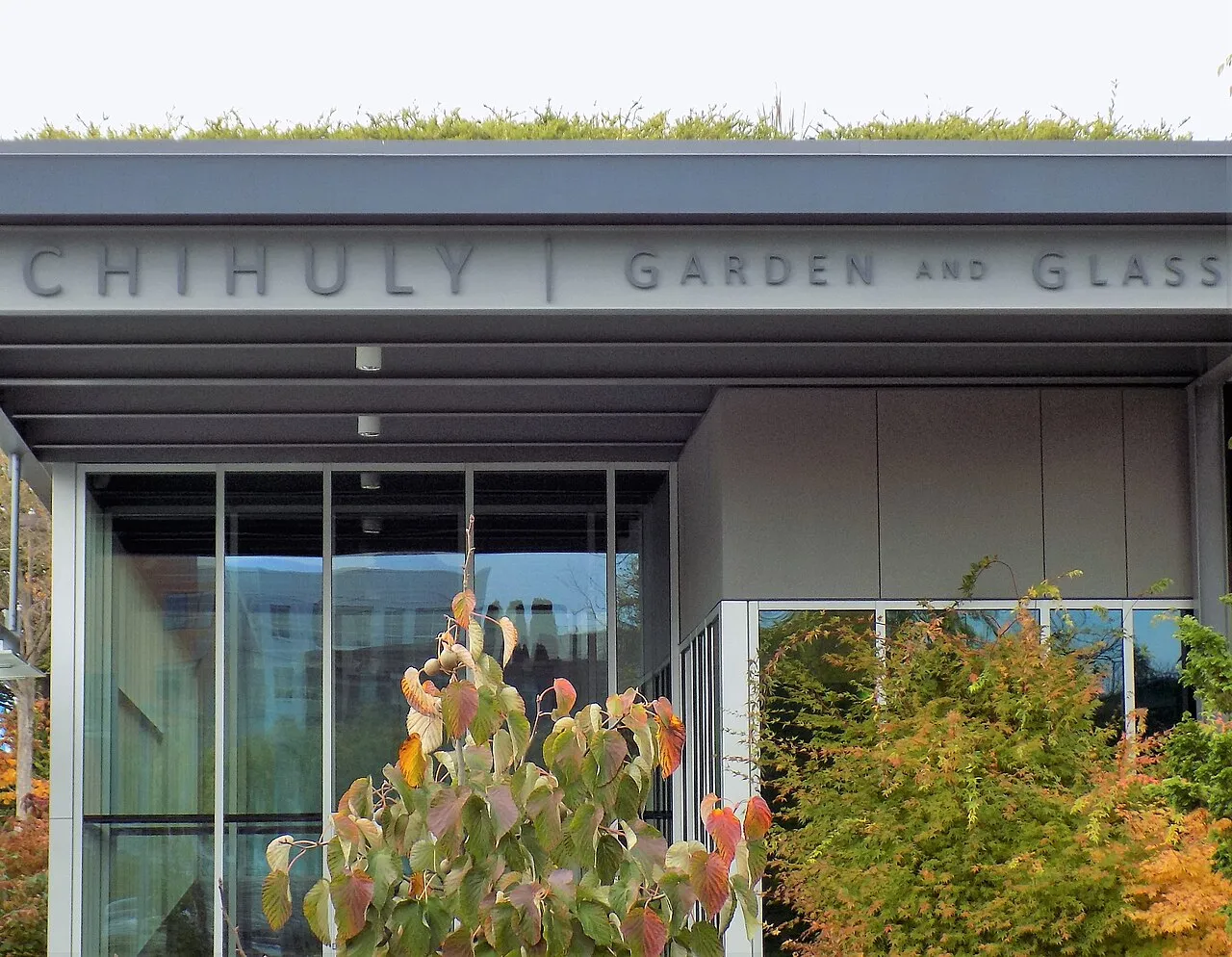
Dale Chihuly installation at Chihuly Garden and Glass, Seattle Center. Chihuly's large-scale installations, using hundreds of individual blown elements, represent the most widely seen studio glass work in the world. Image: CC BY-SA, via Wikimedia Commons
Dale Chihuly: Glass at Scale
Dale Chihuly (born 1941) is the most internationally recognised figure in studio glass art, and the person most responsible for bringing the medium to broad public attention. His trajectory changed permanently in 1976 when a car accident cost him the sight in his left eye, ending his ability to work hot glass directly. Rather than leaving the medium, he restructured his practice around collaborative team making, directing large groups of skilled glassblowers to execute work from his drawings and maquettes.
This collaborative model allowed Chihuly to work at a scale impossible for a solo practitioner. His signature series, the Seaforms, Macchia, Persians, Chandeliers, and Ikebana, involve hundreds of individual blown elements assembled into large-scale installations that fill rooms, hang from ceilings, and float in outdoor pools. The Chihuly Garden and Glass museum at Seattle Center, opened in 2012, is a purpose-built venue for his permanent installations and is among the most visited arts venues in the Pacific Northwest. A companion exhibition space, Chihuly Garden and Glass London, opened at the Kew Gardens site in 2019.
Critical opinion of Chihuly's work divides sharply. Admirers point to the genuine technical mastery his teams demonstrate, the direct sensory power of his large installations, and his role in popularising glass art for a broad public. Critics argue that the collaborative structure distances the artist too far from the material, that the work prioritises spectacle over formal rigour, and that its widespread commercial reproduction cheapens the medium. Both positions contain truth, and the argument they generate reflects real tensions about authorship, craft, and spectacle that run through all of contemporary art.
Glass Beyond Chihuly: The Wider Studio Field
The studio glass field is considerably wider and more diverse than Chihuly's dominance in public consciousness might suggest. Lino Tagliapietra (born 1934), who trained in the Murano tradition and came to Pilchuck in 1979, brought Venetian technical knowledge into the American studio glass world and influenced a generation of practitioners with his precise command of colour and form. His own work, particularly his Dinosaur series, represents one of the highest levels of technical achievement in the medium.
Dante Marioni, trained by Tagliapietra, makes tall, elegant vessels that distill the Venetian tradition into something lean and contemporary. Toots Zynsky makes vessels from pulled threads of glass (fused fine canes) that achieve extraordinary colour density and movement. Czech and Slovak glass traditions, including the engraved and sculptural work associated with Stanislav Libensky and Jaroslava Brychtova, developed in parallel with the American studio movement and bring a different aesthetic entirely to the medium.
By 2026, studio glass is made and collected worldwide. There are dedicated museums in Seattle (Museum of Glass), Tacoma (Museum of Glass), Kingswinford, England (Broadfield House Glass Museum), and Murano (Museo del Vetro). The international art glass market is active through galleries and auctions. The annual American Glass Guild conference and the biennial Glass Art Society conference are significant professional gatherings for a field that now includes thousands of working artists.
Cold Glass: Casting, Kiln Work, and Flameworking
Glassblowing is the most publicly visible glass technique, but it is not the only one. Cast glass, in which molten glass is poured into refractory moulds and cooled slowly over many days in a process called annealing, allows forms impossible to achieve by blowing. Kiln-formed glass, including fused glass (multiple layers melted together) and slumped glass (sheet glass softened over or into a mould), offers a quite different working process with its own formal possibilities.
Flameworking, or lampworking, uses a torch rather than a furnace to work borosilicate or soft glass at a smaller scale. It is the technique used for scientific glassblowing (laboratory equipment), for the production of glass beads with complex internal patterns, and for the detailed botanical glass sculptures made by artists working in the tradition of the Blaschka family's 19th century glass flowers, currently held at the Harvard Museum of Natural History.
Each of these cold glass techniques produces work with a different physical character and requires a different skill set from the practitioner. Together they make glass one of the most technically varied of all art media, a field in which a lifetime of specialisation in a single technique will not exhaust the possibilities. For the relationship between glass and architectural space, which is where the medium began its public career in medieval stained glass windows, the art and architecture guide provides broader context. For how installation art creates immersive experience similar to Chihuly's large environments, see the installation art guide. The ceramics guide covers another heat-based material with its own long history of moving between function and fine art.


