Whitney Museum of American Art: The Only Major US Museum That Only Shows American Art
The Whitney is the only major museum in the United States dedicated exclusively to American art. That sounds like a limitation until you realize it covers Edward Hopper, Alexander Calder, Jean-Michel Basquiat, Georgia O'Keeffe, Jasper Johns, Kara Walker, and the Whitney Biennial, which has been the most argued-about survey of American art since 1932. The collection holds over 26,000 works. Admission is $30, which is the same as the Met and MoMA. But the Whitney is now free every day for anyone 25 and under, free on Friday evenings from 5 to 10 PM, and free on the second Sunday of every month. If you are under 25 or flexible about when you visit, this is one of the most accessible major museums in New York.
Director Scott Rothkopf took over on November 1, 2023, replacing Adam D. Weinberg after his 20-year tenure. Rothkopf is a Whitney insider who joined as a curator in 2009 and rose to senior deputy director and chief curator. His appointment signaled continuity rather than disruption, and his first major programming move was the Whitney Biennial 2026, which opened March 8 and runs through August 23, 2026.
Whitney Biennial 2026: What Is Actually On
The 82nd Whitney Biennial features 56 artists, duos, and collectives across most of the museum's galleries. Co-organized by curators Marcela Guerrero and Drew Sawyer, the 2026 edition examines "various forms of relationality," including interspecies kinships, familial relations, geopolitical entanglements, technological affinities, shared mythologies, and infrastructural supports. That description is deliberately broad, which is typical of Biennial framing. What it means in practice is that the show spans painting, sculpture, video, performance, and installation, with a robust schedule of performances and public programs running through the exhibition's run.
The Biennial is the Whitney's biggest draw and its biggest lightning rod. Being selected is a career-defining moment for emerging American artists. The show reliably generates arguments about what "American art" means, who gets included, and whether the curators got it right. If you want to have an opinion about the current state of American contemporary art, you need to see this show. It runs through August 23, 2026, after which the galleries will be reinstalled with works from the permanent collection.
The Collection: Hopper and Beyond
The Whitney holds the largest collection of Edward Hopper's work in the world: over 3,000 paintings, watercolors, prints, and drawings, bequeathed by his widow Josephine Hopper in 1968. Hopper's paintings of urban isolation and American architecture are the Whitney's most reliable crowd-pleasers. Early Sunday Morning (1930) and A Woman in the Sun (1961) are frequently on view, though the specific Hopper works displayed rotate. If you are visiting specifically for Hopper, check the collection page before going.
Beyond Hopper, the collection spans the full range of 20th and 21st century American art. Alexander Calder's Circus, a miniature kinetic sculpture made of wire and found objects, is a perennial favorite and the work that director Rothkopf credits with sparking his childhood interest in the museum. The collection also includes significant holdings of Georgia O'Keeffe, Jasper Johns, Willem de Kooning, Andy Warhol, and increasingly, contemporary artists from backgrounds historically excluded from mainstream art narratives: women, artists of color, LGBTQ+ artists, and self-taught artists.
The Whitney has made a concerted effort under recent leadership to expand its acquisitions beyond the white, male, New York-centric canon that defined American art for most of the 20th century. This is visible in the rotating collection displays, which now mix canonical works with pieces by artists who were overlooked during their lifetimes.
The Renzo Piano Building
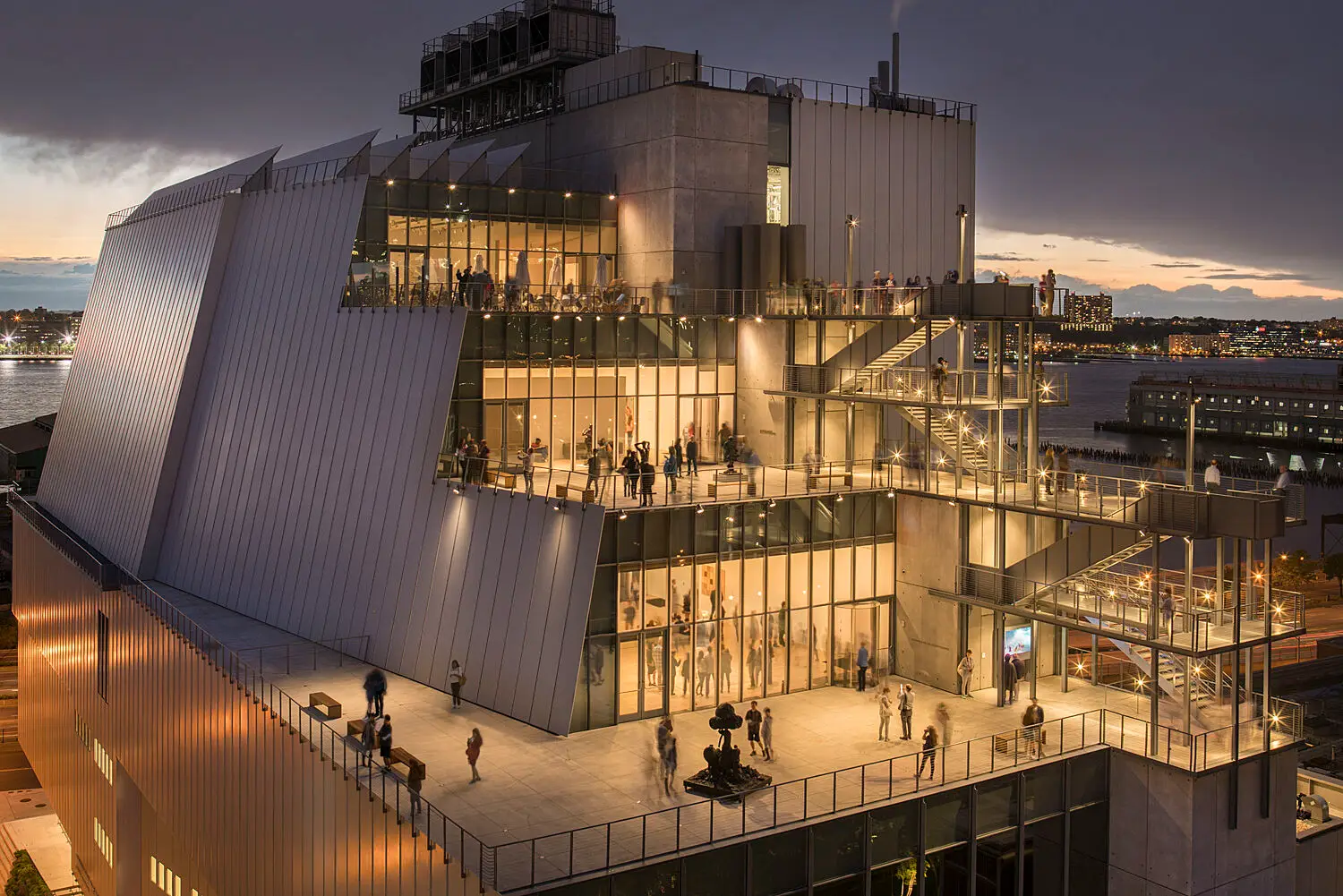
The Whitney's building, designed by Renzo Piano and opened in 2015, is the museum's fourth home and its best. The building sits at the southern end of the High Line in the Meatpacking District, with cantilevered outdoor terraces on multiple floors that offer some of the best views of the Hudson River and the Manhattan skyline in the city. The terraces function as outdoor gallery spaces, and the largest ones on the 5th and 7th floors are worth visiting even if you do not go inside.
The interior galleries are flexible, with varying ceiling heights and room sizes that accommodate everything from intimate photography shows to massive installations. The 18,000-square-foot column-free gallery on the 5th floor is the largest single exhibition space in the building and typically hosts the most ambitious Biennial installations.
The building's location connects the Whitney to the High Line elevated park, which extends north along Manhattan's West Side. The Meatpacking District surrounding the museum has restaurants, galleries, and retail that make the area worth exploring before or after a visit.
How It Compares
The Museum of Modern Art (MoMA) covers international modern and contemporary art. The Whitney covers only American art. If you want Picasso, Matisse, and the European modernists, go to MoMA. If you want Hopper, Calder, Basquiat, and the Biennial, go to the Whitney. Both charge $30. MoMA is larger and more comprehensive. The Whitney is more focused and more willing to take risks on emerging artists through the Biennial and its exhibition programming.
The Metropolitan Museum of Art covers 5,000 years of global art history. The Whitney covers roughly 100 years of American art. They are not competing institutions. The Met gives you context. The Whitney gives you a specific argument about what American art is right now.
The Guggenheim is closer in scale and focus to the Whitney but frames its mission around modern and contemporary art globally rather than American art specifically. The Guggenheim's Frank Lloyd Wright building is more architecturally iconic, but the Whitney's Piano building has better gallery spaces for actually looking at art.
Insider Tips
Go on Friday evening or the second Sunday. Free admission from 5 to 10 PM every Friday and all day on the second Sunday of every month. Advance tickets are recommended and are available up to five weeks ahead. The Friday evening slots have a social atmosphere with drinks and music, which some visitors love and others find distracting.
The ground floor is always free. The lobby, the Floor 1 gallery, the Whitney Shop, and Frenchette Bakery are accessible without a ticket. If you want to see the building and grab a meal without paying admission, you can.
Take the terraces. The outdoor terraces on floors 5, 6, 7, and 8 offer progressively better views of the Hudson and the city. The 8th floor terrace also has the Studio Bar, which serves drinks during museum hours. The views alone justify the trip, and the terraces are included in standard admission.
The High Line approach is the best entrance. Walking south along the High Line to the Whitney gives you a gradual reveal of the building and the Meatpacking District. The High Line entrance drops you directly at the museum's front door.
Summer hours are extended. From June 16 through August 18, 2026, the Whitney is open seven days a week (including Tuesdays, when it is normally closed). Weekday hours shift to 9 AM to 6 PM, with Tuesday closing at 3 PM. Plan accordingly if you are visiting in summer.
SNAP/EBT cardholders get free admission. One free admission per visit with presentation of your card. Children and teens 18 and under are always free.
Practical Information
Admission: $30 for adults, $24 for seniors and students, $18 for visitors with disabilities (one care partner free). Free for visitors 25 and under. Free on Friday evenings 5 to 10 PM and on the second Sunday of every month. Ground floor always free. Active military and veterans free (BlueStar Museums program runs May 16 through September 7, 2026).
Hours: Monday, Wednesday, Thursday, Saturday, and Sunday 10:30 AM to 6 PM. Friday 10:30 AM to 10 PM. Closed Tuesday (except during summer schedule, June 16 to August 18, 2026).
Getting there: 99 Gansevoort Street, at the southern end of the High Line in the Meatpacking District. Closest subway: 14th Street / 8th Avenue (A, C, E, L lines), a 10-minute walk. The L train 14th Street / 8th Avenue stop is the most convenient.
Book tickets: whitney.org/tickets
Final Verdict: Who Is This Actually For?
Anyone who wants to understand American art as an ongoing conversation rather than a closed historical chapter. The Whitney is not the biggest museum in New York or the most famous, but it is the one most willing to take positions. The Biennial is the clearest expression of that willingness: every two years, the museum bets on 50-some artists and invites the public to argue about whether it got it right. The Hopper collection alone is worth the visit, and the free admission policies make it accessible to anyone under 25 or anyone willing to come on a Friday evening. Skip it only if you have zero interest in American art or contemporary practice. But if that is the case, you are probably not reading this.