Uffizi Gallery: The Renaissance Painting Museum Every Other Museum Measures Itself Against
The Uffizi charges €25 for a same-day ticket, €29 if you pre-book, and €19 if you arrive between 8:15 and 8:55 AM during high season (January 1-9, February 21 through November 9, and December 21-31). That early-bird discount is the best deal in Florentine museum-going, and almost nobody uses it. Most tourists roll in at 11 AM, pay full price, and spend 45 minutes in a queue. You can walk in at 8:15 AM, pay €6 less, and have the Botticelli rooms nearly to yourself for 30 minutes. That sets the tone for everything that follows.
Director Simone Verde took over from Eike Schmidt in January 2024 and has made crowd reduction his primary mission. The Uffizi has been called "the museum of tourism" by its own director, and the description is accurate: 2 million visitors per year funnel through a building originally designed as administrative offices (uffizi means "offices" in Italian) for the Medici banking dynasty. The corridors are long, the rooms are not large, and the Botticelli gallery in particular reaches capacity by mid-morning. Verde has introduced timed-entry slots, the early-bird pricing, and a new PassePartout season pass (€40 for 5 days, €58 including the Vasari Corridor) to spread visitors across the day.
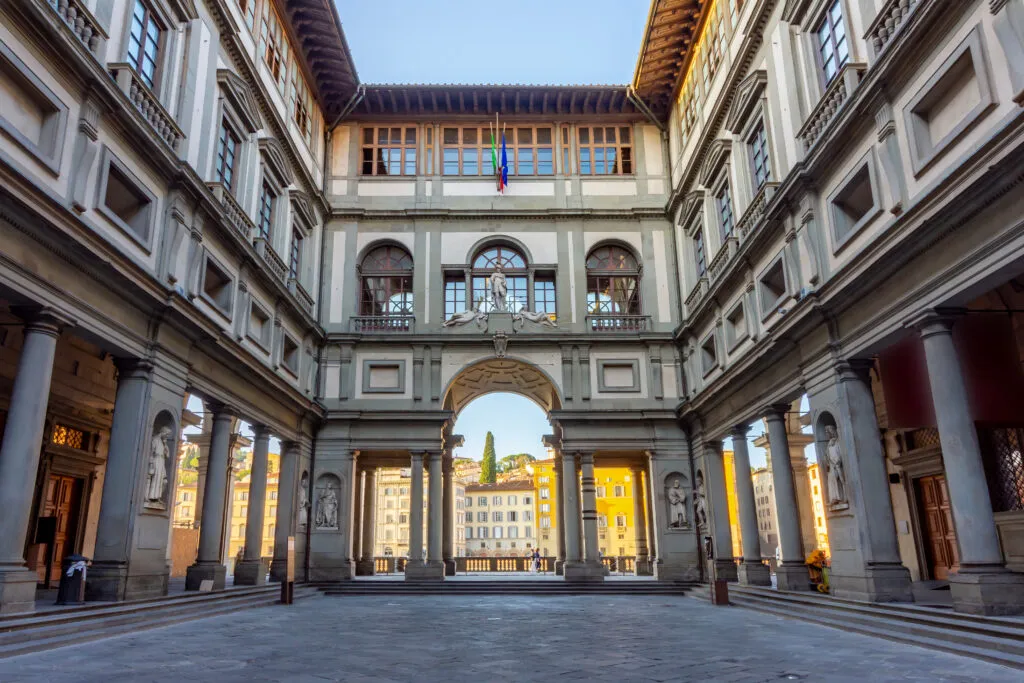
The building itself was constructed in the 16th century under Cosimo I de' Medici, designed by Giorgio Vasari as a government office block. The Medici began hanging art on the office walls, and by 1765, the collection was opened to the public, making the Uffizi one of the first public museums in the world. The collection is organized chronologically, walking you through the development of Italian painting from the 13th century to the 18th century.
The Masterpieces: What to Prioritize
Botticelli's The Birth of Venus is the painting most visitors come for. Venus emerges from the sea on a scallop shell, blown shoreward by wind gods. It is smaller in person than you expect, and the composition is more compressed. What reproductions miss is the surface: Botticelli applied tempera in thin, precise layers that give the skin a porcelain quality no photograph captures. The painting was controversial when it was created, not for the nudity but for its pagan subject matter in a Christian society.
Botticelli's Primavera hangs nearby. It is denser, more complex, and arguably the better painting. An allegorical spring scene with Venus at the center, surrounded by the Three Graces, Flora, Mercury, and Zephyrus. Every figure carries symbolic meaning, and scholars still debate the exact reading. The linear quality of Botticelli's draftsmanship is best appreciated here, where the drapery lines and figure contours are visible without glass glare.
Leonardo da Vinci's Adoration of the Magi is an unfinished panel that reveals Leonardo's working method more clearly than any finished work could. The underpainting shows his approach to composition, perspective, and human expression. It is brown, monochromatic, and visually unimpressive compared to the Botticellis nearby, but for anyone interested in how Leonardo thought, it is essential.
Michelangelo's Doni Tondo (Holy Family) is the only finished panel painting by Michelangelo that survives. The figures are arranged in a spiral composition, and the muscular bodies reflect his sculptural sensibility applied to paint. The color palette is unusual for Michelangelo, with bright blues and pinks that suggest he was engaging directly with the Florentine painting tradition he largely stood apart from.
The Venetian galleries hold works by Titian, Veronese, and Tintoretto. The contrast with the Florentine rooms is immediate: where Florentine painters emphasized line, drawing, and composition, Venetians led with color and light. Titian's Venus of Urbino is the standout, and the difference between Titian's warm, atmospheric flesh tones and the cooler Florentine approach to the human body is visible side by side.
The Baroque galleries include Caravaggio's Medusa (painted on a ceremonial shield) and Bacchus. Caravaggio's chiaroscuro, the extreme contrast between light and dark, changed European painting, and seeing these works in person makes clear why every Baroque painter who followed him was responding to his innovations.
The Vasari Corridor
The Vasari Corridor is an elevated passageway built by Vasari in 1565 for Cosimo I de' Medici to move between the Uffizi and the Pitti Palace across the Arno River without mixing with the public. It is approximately 1 kilometer long, passes through the Ponte Vecchio, and is lined with a collection of self-portraits by artists from Raphael to Chagall. Access requires a separate ticket (combined Uffizi + Vasari Corridor: €43 day-of, €47 pre-booked) and a reservation. The corridor has been closed for extended periods for restoration and accessibility upgrades. Check the Uffizi website for current availability before planning your visit.
What Is Currently Closed
The Uffizi is mid-renovation on its Levante wing, which will add approximately 15 galleries when complete. Verde has estimated the work could finish in roughly three years. Until then, the 17th and 18th century collections have reduced display space, and some works normally on view are in storage or appearing in temporary exhibitions like the current "Firenze e l'Europa: Arti del Settecento" show. Check which galleries are open before your visit if you are hoping to see specific periods.
The museum has also opened new ground-floor exhibition rooms in the west wing, currently hosting "Wax Upon a Time: The Medici and the Arts of Ceroplastics" (through April 12, 2026), the first exhibition dedicated to Renaissance wax sculpture. It is a niche subject, but the craftsmanship on display is remarkable, and the new rooms are worth seeing as an architectural addition in their own right.
How It Compares
The Uffizi is the best museum in the world for Italian Renaissance painting. That is not a controversial statement. The Louvre has a broader collection spanning more periods and cultures, but for the specific period 1300 to 1600 in Italy, the Uffizi is deeper. The National Gallery in London has stronger Northern Renaissance holdings but cannot match the Uffizi on Italian art. The Prado in Madrid is its closest peer in terms of single-national-school depth, with an equally strong Spanish collection.
Within Florence, the Uffizi and the Accademia Gallery complement each other perfectly. The Uffizi gives you painting. The Accademia gives you sculpture. If you have one full day in Florence, do both: the Uffizi in the morning (book the 8:15 AM slot), lunch, and the Accademia in the late afternoon (book the 5 PM slot).
Insider Tips
Book the early-bird ticket. €19 instead of €25 for entry between 8:15 and 8:55 AM. You save €6 and get 30 to 45 minutes of relative calm before the tour groups arrive. This is the single best value decision you can make at the Uffizi.
Friday evening is cheaper and quieter. Reduced-price tickets (€20 day-of, €24 pre-booked) are available for Friday evening entries. The museum is open until 6:50 PM, so a 4 PM entry gives you nearly three hours with fewer crowds.
The Botticelli rooms are the bottleneck. Rooms 10-14 (the Botticelli galleries) are the most visited spaces in the museum and the first to reach capacity. Go there immediately upon entry if you arrive early, or save them for the last hour before closing.
Groups of 11 or more pay a €70 surcharge. If you are traveling with a large group, factor this into your budget. Groups must also use whisper headphones to keep noise levels down.
Consider the PassePartout pass. If you are in Florence for 5 or more days and want to visit the Uffizi, Pitti Palace, and Boboli Gardens multiple times, the €40 pass (€58 with Vasari Corridor access) pays for itself after two visits. The annual pass (€80 individual, €120 family) is worth it for residents or frequent visitors.
The Uffizi Café on the loggia offers views of the Arno River and the Ponte Vecchio. It is overpriced, but the view is genuine. Better food options are in the streets around the museum.
Practical Information
Admission: €25 same-day, €29 pre-booked. Early-bird €19 (8:15-8:55 AM during high season). Friday evening €20 same-day, €24 pre-booked. EU citizens 18-25 pay €2. Under 18 free. Annual pass €80 (individual) or €120 (family). Vasari Corridor combined ticket €43 same-day, €47 pre-booked.
Hours: Tuesday through Sunday, 8:15 AM to 6:50 PM. Closed on Mondays, January 1, and December 25.
Getting there: The Uffizi is in the historic center of Florence, a 5-minute walk from the Ponte Vecchio and a 10-minute walk from the Duomo. The nearest tram stop is Santa Maria Novella, about 12 minutes on foot.
Book tickets: uffizi.it
Final Verdict: Who Is This Actually For?
Anyone with even a passing interest in Renaissance art. The Uffizi is not optional if you are in Florence. It is the reason most art-focused travelers come to the city in the first place. The crowding is real, the ticket prices have gone up, and the ongoing renovations mean parts of the collection are inaccessible. None of that changes the fact that the paintings on these walls defined Western art history. Budget 3 to 4 hours minimum, book the earliest slot you can, and go directly to the Botticelli rooms before the crowds catch up. If you only visit one art museum in Italy, this is the one.