Alte Pinakothek: 700 Old Masters and a Neighbor That Will Not Reopen Until 2029
The Alte Pinakothek in Munich holds 700 masterpieces of European painting from the 14th through 18th centuries. It has the world's most important collection of Albrecht Dürer, one of the largest Rubens collections anywhere, and major works by Leonardo da Vinci, Raphael, Titian, Rembrandt, and Bruegel. At €9 for adults and €1 on Sundays, it is one of the most affordable major art museums in Europe.
But the Alte Pinakothek is also doing double duty right now. The Neue Pinakothek, its sister museum dedicated to 19th-century art, has been closed for fundamental refurbishment since 2019 and is not expected to reopen until 2029. During the closure, selected masterworks from the Neue Pinakothek, including works by Caspar David Friedrich, Manet, Monet, Cézanne, and Van Gogh, are displayed on the ground floor of the Alte Pinakothek's East Wing under the title From Turner to Van Gogh. This means a visit to the Alte Pinakothek now covers roughly 600 years of European painting, from the early Renaissance through Post-Impressionism, in a single building.
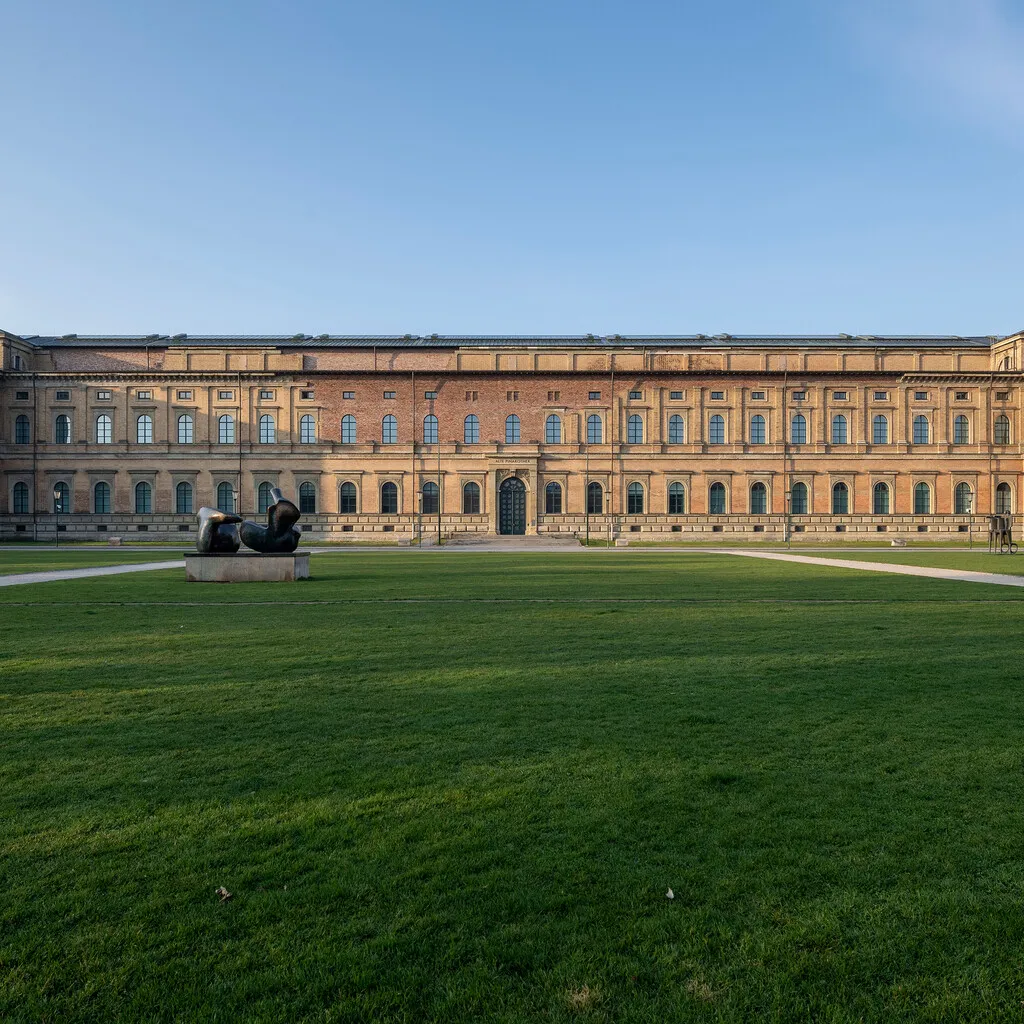
The museum was founded in 1836 by King Ludwig I of Bavaria and designed by architect Leo von Klenze as a purpose-built gallery for the Wittelsbach dynasty's royal art collection. Von Klenze's building was revolutionary: its long, naturally lit galleries arranged in an enfilade established the template for the modern art museum and influenced gallery design from the National Gallery in London to the Metropolitan Museum in New York. The building suffered severe damage in 1943 and 1944 during World War II and was reopened in 1957. Extensive renovation work completed in 2018 restored the galleries to their current condition.
What to See If You Only Have Two Hours
Start upstairs in the Upper Gallery with the Dürer rooms. The Alte Pinakothek holds the world's most important collection of paintings by Albrecht Dürer (1471-1528). Self-Portrait in a Fur-Collared Robe (1500) is the standout: a frontal, symmetrical self-portrait that deliberately echoes the iconography of Christ, making a revolutionary claim for the artist as a divinely inspired creator rather than a mere craftsman. The technical virtuosity in the rendering of fur and hair is matched by the intellectual audacity. Four Apostles (1526), Dürer's last major painting, presents monumental figures of Saints John, Peter, Mark, and Paul with a gravity and psychological intensity that shows the artist mastering Italian Renaissance principles through Northern European sensibility.
Move to the Rubens rooms. The museum holds over 70 paintings by Peter Paul Rubens, one of the largest collections in the world. The Great Last Judgment and The Fall of the Damned are monumental works of staggering ambition. More intimate works in the same rooms demonstrate Rubens's tenderness and psychological sensitivity, qualities that his reputation for bombast sometimes obscures.
Do not miss Pieter Bruegel the Elder's Land of Cockaigne (1567), a satirical depiction of a mythical land of plenty that combines humor, social commentary, and extraordinary observational detail. It is one of the artist's most famous works and is displayed in a room that also features other Flemish masters.
If time permits, descend to the ground floor East Wing for the From Turner to Van Gogh display. Highlights include Caspar David Friedrich's Romantic landscapes, French Impressionist works by Monet and Manet, and Van Gogh's paintings from the late 1880s. Newly exhibited works by Realists Ferdinand Georg Waldmüller and Adolph Menzel, not shown in previous years, have been added to the rotation.
Current Exhibitions in 2026
Proud Ostrich and Furious Tiger: Animal Bronzes of the 19th Century runs from March 24 to October 11, 2026, in the Upper Gallery. The exhibition explores the tradition of animal bronze sculpture, a genre that combined scientific observation with artistic ambition.
Images of People: Portrait and Genre Photographs from the Dietmar Siegert Collection opens October 13, 2026 and runs through January 31, 2027, bringing photography into a museum traditionally dedicated to painting.
How It Compares
The Alte Pinakothek is one of the great Old Master galleries of Europe, in the same tier as the Prado Museum in Madrid, the Rijksmuseum in Amsterdam, and the Louvre in Paris. It is smaller than the Louvre and less visited than the Prado, but its Dürer and Rubens holdings are unmatched by any of them.
Against the Kunsthistorisches Museum in Vienna, the Alte Pinakothek has a narrower chronological range (14th to 18th century versus the Kunsthistorisches's broader scope including antiquities) but a deeper collection of German painting specifically. The Kunsthistorisches has the better Bruegel collection; the Alte Pinakothek has the better Dürer.
The €1 Sunday admission is a remarkable deal that none of its peer museums offer. The Prado charges €15, the Rijksmuseum €22.50, the Louvre €22. On Sundays in Munich, you can see 700 Old Master paintings for less than the price of a coffee.
The Kunstareal: Munich's Art Quarter
The Alte Pinakothek sits in Munich's Kunstareal (Art Quarter), one of the densest concentrations of museums in Europe. Within walking distance: the Pinakothek der Moderne (20th and 21st-century art, €10 admission), the Museum Brandhorst (modern and contemporary art, €10 admission), and the Sammlung Schack (19th-century German painting, €3 admission). The Neue Pinakothek would normally be part of this circuit, but its closure until 2029 means the Alte Pinakothek is currently carrying the load for two centuries of art history.
A combined ticket for the Alte Pinakothek, Pinakothek der Moderne, Museum Brandhorst, and Sammlung Schack is available at the museum ticket office, valid for one day. This is the most cost-effective way to see the Kunstareal if you have the stamina for multiple museums in a single visit.
Insider Tips
Go on Sunday. Admission drops to €1. The museum is busier than weekdays, but €1 for one of the world's great Old Master collections is an extraordinary value. Arrive at 10 AM when the doors open for the quietest experience.
Tuesday and Wednesday have extended hours until 8 PM. These are the least crowded evening hours. The lighting in the Upper Gallery is particularly good in the late afternoon.
Start upstairs. The Upper Gallery contains the museum's most famous works: Dürer, Rubens, Raphael, Leonardo, Titian. The ground floor has the Italian, Spanish, and French collections, plus the temporary Neue Pinakothek selections. If you are short on time, prioritize the upper floor.
The Leonardo da Vinci is easy to miss. Madonna of the Carnation is one of the artist's earliest known paintings, displayed in the Italian Renaissance room. It is small and not always clearly labeled as a Leonardo. Ask at the information desk if you cannot find it.
Getting there: The museum is at Barer Straße 27, with the entrance on Theresienstraße. The nearest U-Bahn stations are Königsplatz (U2) and Theresienstraße (U2), both about a 5-minute walk. The Tram 27 line also stops nearby at Pinakotheken.
Practical Information
Admission: €9 adults, €6 reduced (students and seniors 65+), €1 on Sundays, free for children and young people under 18. Combined tickets for multiple Kunstareal museums available at the ticket office.
Hours: Daily 10 AM to 6 PM (Tuesday and Wednesday until 8 PM). Closed Mondays. Closed on Shrove Tuesday, Labor Day (May 1), Christmas Eve, Christmas Day, and New Year's Eve.
Book tickets: pinakothek.de
Final Verdict: Who Is This Actually For?
Anyone interested in European painting from the Renaissance through the 18th century, with the bonus of 19th-century highlights from the closed Neue Pinakothek. The Dürer and Rubens collections alone justify the trip. At €9 (or €1 on Sundays), it is the best value among Europe's major Old Master galleries. The building itself is a landmark in museum architecture, and the Kunstareal location means you can visit three or four world-class museums in a single afternoon. Skip it only if you have zero interest in pre-1900 European painting.