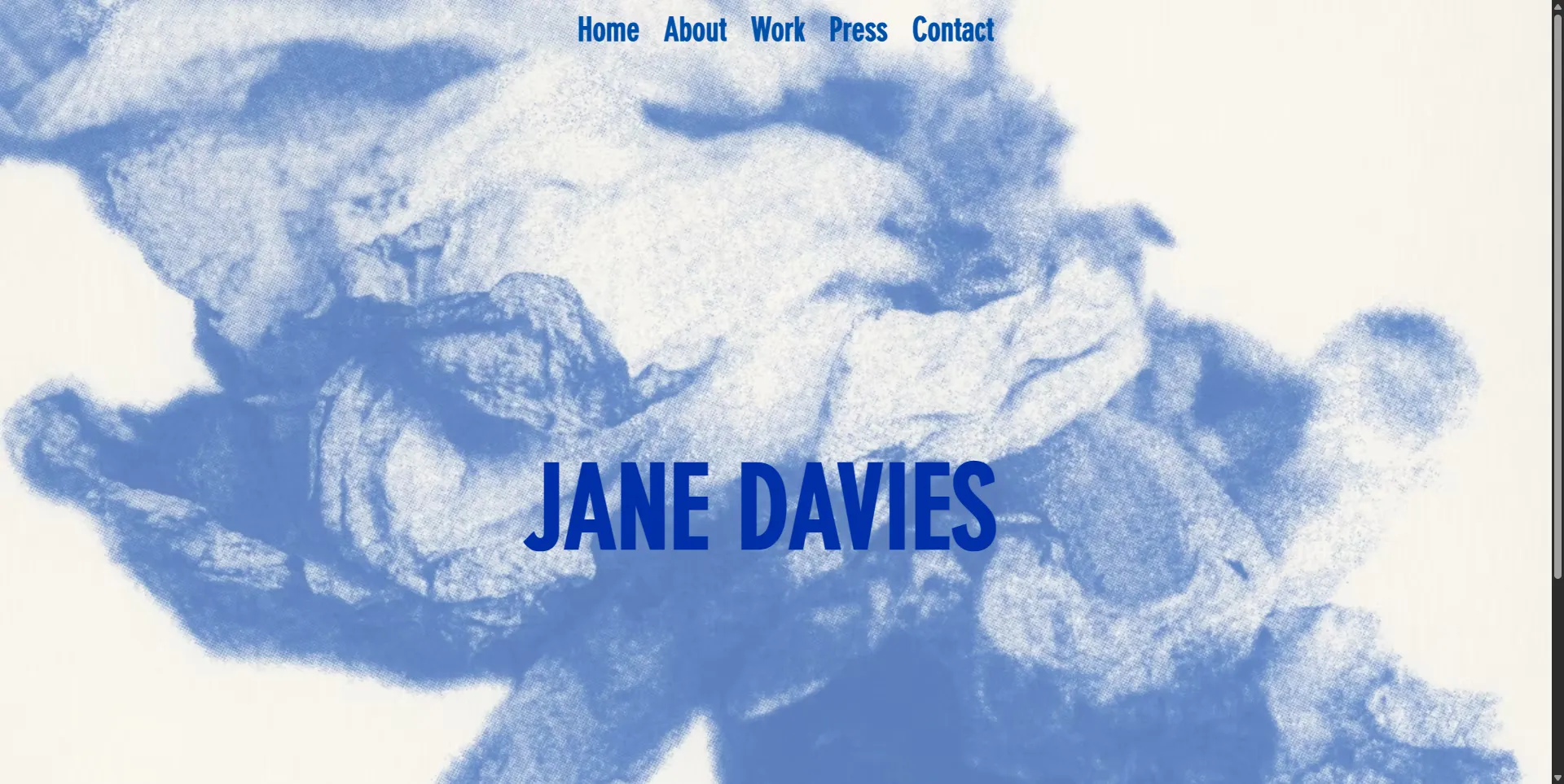
Jane Davies: The Anti-Tutorial Abstract Painting Teacher
Most online art instruction treats abstract painting like a recipe: follow these steps, use these colours, and you will get something that looks like art. Jane Davies rejects this approach so completely that her entire teaching philosophy can be summarized in one sentence she repeats across her blog and courses: you cannot paint someone else's painting. In a digital learning space saturated with step-by-step tutorials that produce identical results, Davies stands out as one of the few educators who teaches how to think in paint rather than what to paint.
Based in Vermont and working full-time as a painter and collage artist since 2010, Davies runs janedaviesstudios.wordpress.com, a blog that has been active since 2005 and has accumulated one of the most substantial free archives on abstract painting, colour theory, and mark-making available online. She is a Bennington College graduate who attended the School for American Crafts, began her career as a potter in the early nineties, and transitioned through freelance giftware and stationery design before committing to fine art and teaching. Her work is represented by Edgewater Gallery in Middlebury, Vermont, and she is the author of five instructional books plus The Elements of Visual Language.
Why Davies Matters in the Abstract Painting Education Space
The online abstract painting education market is crowded with instructors who teach technique but avoid the harder questions: How do you make compositional decisions without a subject? How do you know when a painting is finished? How do you develop a visual language that is recognizably yours rather than a derivative of whatever style is trending on Instagram?
Davies addresses these questions head-on. Her blog posts and courses focus on what she calls "visual language": the elements of shape, line, pattern, texture, colour, value, and scale, and how those elements function as the vocabulary of abstract painting. This is not colour wheel basics. It is an investigation into how colour temperature, value contrast, and mark quality create meaning on a surface without representational content.
Compared to instructors like Flora Bowley (whose intuitive painting approach is more expressive and less structured) or Nicholas Wilton (whose Art2Life curriculum covers similar territory with a more polished production style), Davies occupies a middle ground: rigorous enough to feel like a real education, exploratory enough to avoid rigidity. Her exercises are designed to build practical knowledge through direct engagement with materials rather than through theory alone.
The Blog: A Two-Decade Archive
The blog at janedaviesstudios.wordpress.com is the free entry point. Davies posts about her own studio practice, student work from her classes, specific exercises, and reflections on the creative process. The archive goes back to 2005, which means there are literally hundreds of posts covering colour mixing experiments, collage techniques, series development, and the ongoing challenge of finding your own voice in abstraction.
In early 2026, Davies announced on her blog that she is cutting back on social media (Facebook, Instagram, YouTube) to focus more time on painting and teaching. This is worth noting because it means the blog and her newsletter are now the primary channels for her content. If you have been following her on Instagram, you will need to subscribe to her newsletter to stay current.
The 2026 Year-Long Class: Everything Jane Davies
Davies launched her first year-long class in January 2026 through Carla Sonheim Presents. The class, titled "Everything Jane Davies," is a mixed media drawing, painting, and collage course structured as 10 recorded lessons plus 11 live Zoom sessions over the year. Each month focuses on a specific element of visual language: January covered working in series, February focused on pattern, March explored improvisational drawing including blind drawing and scribbling.
The class includes lifetime access to all videos and materials, a private community forum on the CLUSTER platform where students share work and Davies provides feedback, and monthly Zoom calls for live demos, slide shows, and Q&A. The structure is well-suited for artists who want sustained guidance over time rather than a weekend workshop, and the lifetime access means you can revisit the content at your own pace.
At the time of writing, you can join the class anytime and access all previously released content. This is a significant advantage over cohort-based courses that close enrollment after a start date.
The Workshops: In-Person with Direct Feedback
Davies teaches in-person workshops at her Vermont studio and at other locations nationally and internationally. An upcoming workshop, "Color and Composition with Jane Davies," is scheduled for October 14-19, 2026, through Lesley Riley's Red Thread Art Retreats. This intermediate-level workshop focuses on colour as it contributes to abstract composition, with students creating collage papers through colour mixing and then using those as building blocks for mixed media paintings.
The workshop format offers something the online courses cannot: Davies observing your work in real time and giving specific, responsive feedback. For artists who have been working through the blog and online courses on their own, an in-person workshop provides the kind of direct correction that can break through plateaus that self-directed study cannot.
Insider Tips for Getting the Most Out of Davies's Content
- Start with the blog archive. Before paying for any course, spend time reading through older posts. The archive contains enough material to keep you busy for months, and it will tell you quickly whether Davies's teaching style resonates with you.
- Subscribe to the newsletter. Davies announced in 2026 that she is stepping back from social media. The newsletter is now the most reliable way to hear about new classes, workshops, and blog posts.
- Do the exercises, not just the reading. Davies's instruction is designed to be practiced, not consumed passively. Her exercises involve making colour studies, creating collage papers, doing timed drawing exercises, and working in series. Reading about colour temperature is not the same as mixing a dozen variations of the same hue and observing the differences on paper.
- Try Sketchbook Revival first. Davies participates in Sketchbook Revival, a free multi-instructor event that runs annually (the 2026 session began April 11). Her session gives you a free sample of her teaching style before you commit to a paid course.
- Have the right materials. Davies works primarily in paint, paper, and drawing materials. Her exercises assume you have acrylic paint, collage papers, a sketchbook, and basic drawing supplies. You do not need expensive materials, but you do need more than a pencil and a pad of paper.
Who Is This For (and Who Should Look Elsewhere)
This is for you if: You are an abstract painter or mixed media artist who wants to develop a personal visual language rather than copy someone else's style. You respond to process-focused, exploratory teaching rather than step-by-step instruction. You are willing to sit with uncertainty and let your paintings evolve through experimentation.
This is not for you if: You want to learn how to paint realistic portraits, landscapes, or still lifes. Davies does not teach representational drawing or painting. You are looking for quick, technique-focused tutorials that produce a finished piece in an afternoon. You need a highly structured curriculum with graded assignments and external accountability.
Final Verdict: Who Is This Actually For?
Jane Davies is one of the best online educators for abstract painters who are past the beginner stage and serious about developing their own voice. The blog is a genuinely valuable free resource that has no equivalent elsewhere in the online art education space. The 2026 year-long class is well-structured for sustained growth, and the in-person workshops offer the kind of direct feedback that online learning cannot replicate.
For representational painters, digital artists, or anyone looking for quick technique tutorials, Davies is the wrong teacher. But for artists working in abstraction who want to understand why they make the choices they make on the canvas, her blog and courses are among the most intellectually honest resources available.
Next steps: Bookmark the blog, subscribe to the newsletter, and check out the year-long class on Carla Sonheim Presents if you want structured, long-form instruction. You can also explore our art courses directory for other online learning options and our YouTube channels directory for free video instruction from other abstract painting educators.