The Cooper Union: New York's Most Selective Art and Architecture College
The Cooper Union for the Advancement of Science and Art is one of the most unusual and historically significant educational institutions in the United States. Founded in 1859 by Peter Cooper, a self-educated inventor and industrialist who built his fortune in iron, steel, and railroads, the Cooper Union was established on a radical democratic principle: that education of the highest quality should be available to all people regardless of their economic circumstances. For most of its history, the school offered a full-tuition scholarship to every admitted student, making it genuinely free to attend. That tradition has been complicated in recent years, but the school's commitment to accessibility and its extraordinary selectivity remain defining features of its identity.
With an acceptance rate of approximately 13% and an enrollment of around 900 students across its three schools of Art, Architecture, and Engineering, Cooper Union is one of the smallest and most selective colleges in the United States. The School of Art accepts fewer than 70 students per year, which means that every student who gains admission is genuinely exceptional, and the community that forms around this small cohort is one of the most intellectually intense in American art education.
The History of Free Tuition and Its Recent Complications
Peter Cooper's founding vision was explicit: the school should be "open and free to all." For over 150 years, Cooper Union honored this vision by providing full-tuition scholarships to all admitted students. This made it unique among serious art and architecture schools, and it attracted students who might not otherwise have been able to afford a New York City art education.
In 2013, facing a severe financial crisis, the school's administration announced that it would begin charging tuition for the first time in its history. This decision provoked intense protests from students and alumni, a lawsuit, and an investigation by the New York State Attorney General. In 2018, the Attorney General brokered a plan to return the school to free tuition, and progress toward that goal has continued since. As of the 2025-26 academic year, tuition is $44,550, but the school provides substantial scholarship funding to admitted students, and in January 2026 the school reached a formal settlement with the U.S. Department of Education's Office for Civil Rights regarding a separate federal investigation. The path back to fully free tuition remains a central institutional priority.
The School of Art
The School of Art at Cooper Union offers the Bachelor of Fine Arts (BFA) as its sole undergraduate degree, with a curriculum that covers drawing, painting, sculpture, photography, printmaking, video, and digital media. The program is deliberately broad in its approach to media, reflecting a conviction that artists should develop fluency across disciplines rather than specializing prematurely.
The curriculum is organized around a Foundation year that provides all students with a common grounding in drawing, two-dimensional design, three-dimensional design, and critical thinking. This foundation year is taught by faculty who are among the most accomplished artists in New York, and it establishes the rigorous standards that define the entire program.
After the foundation year, students move into the upper-division curriculum, which combines studio practice with a substantial Humanities program that is unusual among art schools. Cooper Union requires art students to take a significant number of courses in the humanities, including art history, literature, philosophy, and social theory. This requirement reflects the school's conviction that serious artists need to be serious thinkers, and it produces graduates who can articulate their work in relation to broader intellectual and cultural contexts.
The Great Hall, Cooper Union's historic lecture hall, has hosted some of the most significant public addresses in American history, including Abraham Lincoln's 1860 "Right Makes Might" speech. This tradition of public engagement and civic discourse is part of the school's culture, and it shapes the way Cooper Union students think about the relationship between art and society.
Faculty and the New York Advantage
Cooper Union's faculty are working artists and architects whose studios and practices are embedded in the New York art world. The school's location in the East Village, one of the neighborhoods most closely associated with the history of New York's downtown art scene, places students at the center of a living creative community. The galleries of the Lower East Side, Chelsea, and Tribeca are accessible by subway, and the networks that students build during their time at Cooper extend throughout the New York art world.
Notable alumni of the School of Art include Milton Glaser, who designed the "I Love New York" logo and co-founded New York magazine; Eva Hesse, whose sculptural work is among the most significant of the 1960s; Lee Bontecou, whose welded steel and canvas reliefs are landmarks of postwar American art; and Hans Haacke, whose institutional critique work has shaped the discourse around art and politics for decades. Edward Hopper studied at Cooper Union before transferring to the New York School of Art, and Augustus Saint-Gaudens, one of the greatest American sculptors of the nineteenth century, also studied there.
The Architecture School
The Irwin S. Chanin School of Architecture at Cooper Union is one of the most respected architecture schools in the United States, offering the five-year Bachelor of Architecture (BArch) and the Master of Architecture (MArch). The program has a strong theoretical orientation, treating architecture as a form of critical practice rather than merely a technical discipline, and its graduates have gone on to significant careers in architecture, urban design, and academia.
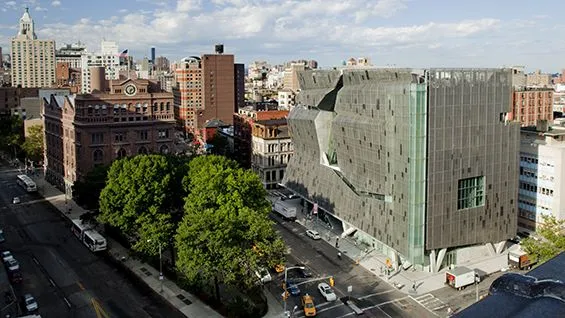
The architecture school's building, the 41 Cooper Square tower designed by Thom Mayne of Morphosis and completed in 2009, is itself a significant work of architecture, providing studios, workshops, and exhibition spaces in a building that embodies the school's commitment to architectural experimentation.
Admissions and What Cooper Looks For
Admission to the School of Art requires a portfolio, a personal statement, letters of recommendation, and academic transcripts. The portfolio is the central element of the application, and the admissions committee is looking for work that demonstrates genuine artistic intelligence, the capacity for self-direction, and the potential for significant development. Cooper does not look for students who have mastered a particular style; it looks for students who are genuinely curious, intellectually serious, and committed to developing their practice over the long term.
The school's small size means that the admissions process is genuinely individual, with each application receiving careful consideration from faculty who are themselves serious artists. This individualized attention continues throughout the program, with small class sizes and close relationships between students and faculty.
The Bottom Line
The Cooper Union is one of the most extraordinary art schools in the United States, combining exceptional selectivity, a distinguished faculty, a rigorous curriculum, and a location at the center of the New York art world. Its founding commitment to accessible education remains a defining part of its identity, even as the school navigates the financial challenges that have complicated that commitment in recent years. For artists who can gain admission, Cooper Union offers an education that is genuinely transformative, in a community of exceptional peers, in a city that is the center of the art world.