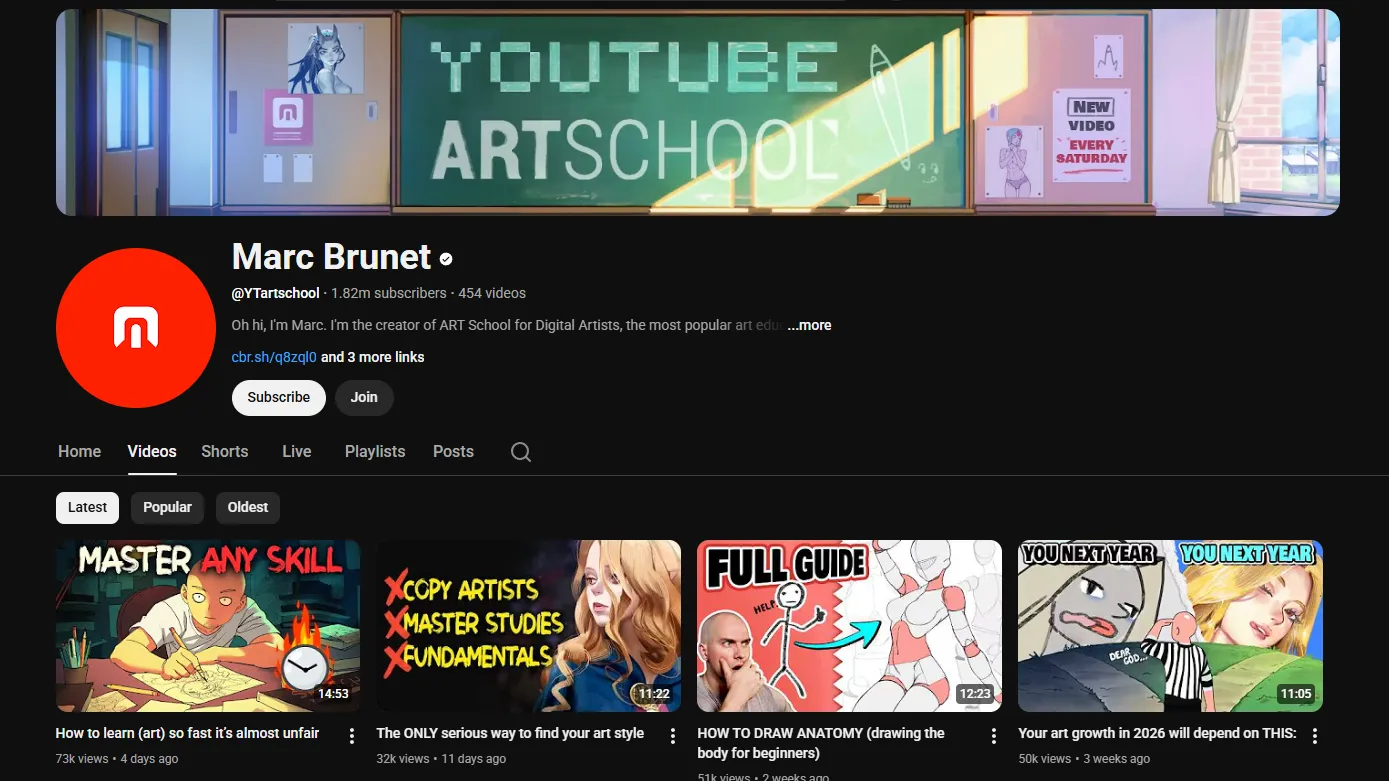
Marc Brunet: From Blizzard Senior Artist to YouTube's Top Digital Art Mentor
Breaking into the entertainment industry as a concept artist is notoriously difficult. The competition is fierce, the standards are exacting, and the path from hobbyist to professional is poorly documented. Marc Brunet has made it his mission to change that. A former Senior Character Artist at Blizzard Entertainment, where he contributed to franchises including Overwatch, Marc left the studio world to build what has become one of the most influential digital art education platforms on the internet.
With 1.87 million YouTube subscribers, over 132 million total views, and a catalog of more than 490 videos, Marc's channel has more than doubled in size since 2024. The growth reflects a gap in art education that he fills better than anyone else: the gap between knowing how to draw and knowing how to build a career as a working artist.
Industry Credentials That Matter
What gives Marc Brunet's advice particular weight is his professional background. He is not a self-taught YouTuber speculating about what the industry wants. He spent years working at Blizzard Entertainment, one of the most prestigious and competitive game studios in the world, producing character art for games played by millions of people.
This experience informs every aspect of his teaching. When Marc discusses portfolio construction, he speaks from the perspective of someone who has reviewed portfolios as a hiring manager. When he demonstrates a painting workflow, he is showing the actual techniques and shortcuts used in professional production environments where speed and consistency matter as much as artistic quality.
His professional credentials also include founding Cubebrush, a marketplace for digital art resources, brushes, tutorials, and 3D assets. This entrepreneurial experience gives him insight into the business side of the art world: freelancing, pricing, marketing, and building a sustainable creative career that purely academic instructors often lack.
ART School for Digital Artists
Marc's most significant contribution to art education is his comprehensive ART School for Digital Artists program, hosted on Cubebrush. This structured curriculum covers the complete range of skills needed to work as a professional digital artist, from foundational drawing and anatomy through advanced rendering, color theory, composition, and portfolio development. The program is organized into 10 terms, each building on the previous one.
The YouTube channel functions as both a standalone educational resource and a generous preview of the ART School curriculum. Free videos cover high-level concepts and techniques in enough depth to be genuinely useful, while the paid program provides the systematic progression, assignments, and detailed instruction that a structured learning path requires.
The curriculum is organized around the skills that actually matter in professional production environments. Rather than following the traditional art school sequence of drawing, then painting, then composition as separate disciplines, Marc integrates these skills in the way they are actually used in the industry: simultaneously and in service of specific production goals.
For comparison, KeshArt's Drawing Camp is a 100-day program aimed at beginners. Marc's ART School is a multi-term program aimed at intermediate and advanced artists who want to reach professional quality. Both are structured, but they serve different stages of the learning journey.
What the Channel Covers
Digital Painting Fundamentals
Marc's tutorials on digital painting cover the technical and artistic skills needed to produce professional-quality work in Photoshop, Clip Studio Paint, and other digital tools. Topics include brush selection and customization, layer management, blending techniques, value structure, edge control, and color mixing. His approach emphasizes efficiency: how to achieve professional results in the least amount of time, a skill that is essential in production environments where deadlines are constant.
Anatomy for Character Artists
The channel's anatomy content is specifically tailored for character designers rather than medical illustrators. Marc focuses on the muscle groups and proportional relationships that matter most for creating appealing, believable characters: the deltoids, pectorals, and abdominals that define a heroic silhouette, the facial muscles that communicate expression, the hand anatomy that makes gesture drawings feel alive.
His approach is practical rather than exhaustive. He teaches artists to understand enough anatomy to make informed creative decisions without getting lost in granular detail that is more relevant to medical illustration than entertainment design. For deeper anatomy instruction, Proko remains the gold standard, but Marc's anatomy content is more directly applicable to entertainment design.
Color Theory and Lighting
Marc's color theory tutorials cut through the abstract complexity that makes this subject intimidating for many artists. He teaches practical frameworks for choosing color palettes, understanding warm and cool relationships, using color temperature to create depth, and applying lighting scenarios that are common in game and film production: rim lighting, ambient occlusion, subsurface scattering, and environmental color bounce.
Marco Bucci covers color theory with more depth and precision, but Marc covers it with more direct industry application. Both are worth watching.
Career Advice and Industry Reality
Perhaps the most distinctive and valuable content on Marc's channel is not about drawing technique at all. It is about the business and psychology of being a professional artist. Marc regularly produces videos addressing topics that art schools rarely cover:
Portfolio construction is a recurring theme. Marc explains what art directors actually look for when reviewing portfolios, how to curate your work to demonstrate specific skills, and the common mistakes that cause portfolios to be rejected. His advice is specific and actionable.
The economics of art careers receives honest treatment. Marc discusses the financial realities of freelancing versus studio employment, how to price commission work, the actual salary ranges for different positions in the game industry, and whether expensive art school degrees provide sufficient return on investment compared to self-directed study.
Mental health and sustainability is another thread. Marc addresses burnout, imposter syndrome, the pressure of social media comparison, and the physical health consequences of spending long hours at a drawing tablet.
The Limitations
Marc's content is heavily oriented toward the commercial entertainment art aesthetic: the stylized, polished look common in AAA video games and animated films. Artists interested in fine art, abstract work, or non-commercial creative practices will find less directly applicable content here. James Gurney covers traditional painting and imaginative realism from a fine art perspective, and Tyler Edlin offers a different approach to fantasy art.
The pace of some tutorials assumes familiarity with digital painting tools and basic drawing concepts. Complete beginners may need to build foundational skills elsewhere before fully benefiting from Marc's more advanced instruction. KeshArt and Art with Flo are better starting points for absolute beginners.
The channel also functions partly as a marketing funnel for the ART School program. The free content is genuinely useful, but viewers should be aware that the full curriculum requires a paid subscription. This is not a criticism. The free content stands on its own. But the business model is worth understanding.
Final Verdict: Who Is This Actually For?
Aspiring concept artists targeting careers in the game, film, or animation industries will find Marc's channel directly aligned with their goals. The combination of technical instruction and career guidance provides a roadmap that is difficult to find elsewhere.
Digital painters working in Photoshop or Clip Studio Paint will benefit from Marc's production-tested techniques for efficient, high-quality digital painting.
Self-taught artists who lack the structure of formal education can use Marc's content as a curriculum framework, following his recommended learning sequence and practicing the skills he identifies as most important for professional development.
Art students currently enrolled in degree programs will find Marc's industry perspective a valuable complement to their academic training, particularly regarding portfolio development and career preparation.
If you want fine art, traditional media, or beginner-level instruction, look elsewhere. If you want to know what it takes to work as a concept artist in the entertainment industry, start with Marc's portfolio videos and work outward from there.