
In 1999, the Los Angeles County Museum of Art purchased a Roman marble portrait head for $150,000. The head appeared ancient, was aesthetically impressive, and had a plausible exhibition history. In 2006, Italian authorities contacted LACMA: the head had been illegally excavated from a Sicilian site in the late 1980s, trafficked through Switzerland, and laundered through a series of dealers before reaching the museum. LACMA returned it to Italy in 2010. The loss was not only financial; it was reputational, and it raised a question the museum now asks about every acquisition: where, exactly, did this come from?
That question is the heart of provenance. Provenance is the documented ownership history of an artwork, from its creation through every transaction, bequest, gift, theft, or transfer to its current location. The word comes from the French "provenir," to come from. In art commerce, scholarship, and law, provenance performs three distinct functions: it supports authentication (genuine works have verifiable histories), it establishes value (major works with distinguished provenance command significant premiums at auction), and it discloses ethical status (whether a work was legally acquired, legally exported, and is free from competing ownership claims). These functions are interconnected, and the weakness of provenance in any one area creates problems in all three.
In 2025 and 2026, provenance has moved from a specialist concern to a front-page news topic. Major restitution cases are reshaping museum collections across Europe and North America. New research tools are making it harder to hide problematic ownership histories. And the ethical questions are getting harder to avoid. If you care about art, you need to understand provenance. Not because it is a legal technicality, but because it is the record of every human decision and event that an artwork has survived.
Provenance and Authenticity
A work attributed to Vermeer with a documented history traceable to 17th-century Dutch collections is more likely to be genuine than one that "appeared" at auction in the 1970s with no earlier documentation. This is not an absolute rule: genuinely discovered lost works do surface, and long-standing family collections sometimes contain documented old works with no public exhibition history. But the correlation between weak provenance and questions of authenticity is strong enough that major auction houses, museums, and serious collectors treat unexplained gaps in ownership history as significant red flags.
The most sophisticated art forgery cases of the 20th century involved elaborate false provenances created alongside the forged works. Han van Meegeren, the Dutch forger whose Vermeer forgeries convinced leading scholars and sold for substantial prices in the late 1930s and early 1940s, constructed plausible invented ownership histories for his works to explain why they had not previously appeared in the scholarly literature. His "Supper at Emmaus," sold in 1937 to the prestigious Boijmans Museum in Rotterdam as a newly discovered Vermeer, was accompanied by a story of having been in a private Italian collection for decades, removed from scholarly view. Van Meegeren was exposed not by provenance research but by scientific analysis and his own confession in 1945, when he was accused of selling a Vermeer to Hermann Goring.
Nazi Looting: The Most Documented Case of Forced Transfer
The Nazi regime's systematic confiscation of art from Jewish owners across occupied Europe between 1933 and 1945 produced the most extensive and best-documented case of forced transfer in art history. An estimated 600,000 artworks were looted, seized under discriminatory legislation, or acquired under duress from Jewish collectors and dealers who were forced to sell below market value to emigrate or to avoid persecution. After the war, most of this art was not returned to its owners or their heirs; it was retained by German and Austrian national museums, sold quietly through commercial channels, or acquired in good faith by collectors and institutions who did not investigate its history.
The Washington Principles on Nazi-Confiscated Art, agreed at an international conference in 1998, established a framework for identifying and returning looted works. Forty-four governments, including the United States, most European nations, and Israel, agreed to research their museum collections for potential looted works, to publish their findings, and to seek "just and fair solutions" with heirs of original owners. Twenty-five years later, progress has been significant in some cases and almost nonexistent in others.
In 2024, the Netherlands established an independent advisory panel specifically for Nazi-looted art restitution claims, following criticism that existing procedures were too slow and too cautious. The panel has been processing claims more rapidly than its predecessor. In June 2025, the German government announced a new national provenance research center in Berlin, consolidating previously scattered databases and research efforts into a single institution. The center, which opened in early 2026, maintains a publicly searchable database of all known Nazi-confiscated artworks in German public collections. As The Art Newspaper reported, the center's launch was accompanied by the publication of 4,200 newly researched provenance records. You can read more at The Art Newspaper.
The Gurlitt collection, comprising approximately 1,500 works discovered in 2012 in a Munich apartment belonging to Cornelius Gurlitt (son of Hildebrand Gurlitt, a Nazi-era art dealer), remains among the most complex ongoing cases. A dedicated task force identified approximately 500 works as potentially looted, and restitutions are still being processed. In 2025, three additional works from the Gurlitt trove were returned to the heirs of their original Jewish owners, bringing the total number of restituted works from the collection to 23.
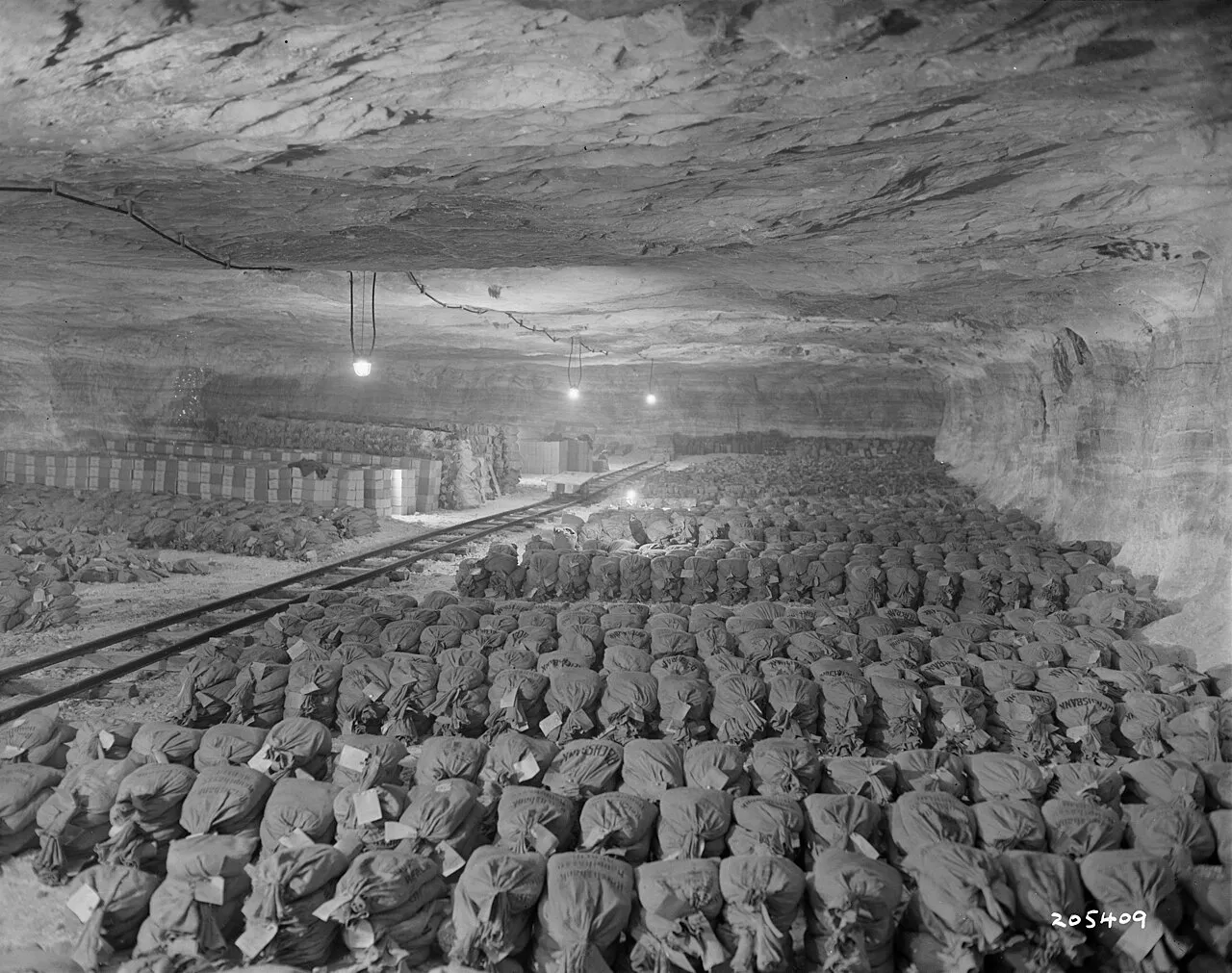
Allied soldiers examining looted artworks stored in the Merkers salt mine in Thuringia, Germany, April 1945. The salt mines held thousands of artworks confiscated from Jewish owners and taken from occupied territories across Europe. The recovery of these works and the subsequent task of identifying their original owners and heirs became one of the most complex provenance research challenges of the 20th century. Image: National Archives and Records Administration (NARA), Public domain, via Wikimedia Commons
Colonial Acquisition and the Restitution Debate
The provenance problem extends beyond the Nazi era to the longer history of colonial acquisition, which moved cultural property from colonised territories to European collections through a combination of purchase under duress, outright seizure, archaeological excavation conducted under colonial licence, and private collection during colonial administration. The British Museum holds approximately 8 million objects, the largest collection in the world, a significant portion acquired during the period of British imperial expansion.
The Parthenon Sculptures case is the most prominent, but it represents a pattern that extends to the Benin Bronzes held by multiple European and North American institutions, the Rosetta Stone in the British Museum (taken from Egypt by Napoleon's forces in 1799 and then transferred to Britain after the French defeat), Maori taonga (cultural treasures) held in various European collections, and thousands of other objects whose acquisition circumstances are being systematically re-examined under what has become a broad field of "provenance studies" focused on colonial-era collections.
In 2017, French President Emmanuel Macron commissioned a report on African cultural heritage held in French museums, resulting in the Sarr-Savoy report (2018), which recommended the restitution of all objects taken from Africa during the colonial period without consent. France subsequently returned 26 objects to Benin and has committed to further restitutions. Germany, the Netherlands, Belgium, and several other countries have made similar commitments.
In 2025, the restitution landscape accelerated significantly. In January 2025, the Smithsonian's National Museum of African Art in Washington, D.C., transferred 29 Benin Bronzes to Nigeria's National Commission for Museums and Monuments, completing a process begun in 2022. In March 2025, the Netherlands returned six colonial-era artifacts to Sri Lanka, including a cannon and ceremonial weapons taken during the Dutch colonial period. In June 2025, Germany returned 14 Benin Bronzes to Nigeria in a ceremony at the German Foreign Office, bringing Germany's total restitution of Benin Bronzes to 50. And in October 2025, Belgium transferred ownership of 84,000 Congolese cultural objects from the Royal Museum for Central Africa to the Democratic Republic of Congo, though the physical transfer of the objects continues in stages. As Artnet News reported, the Belgian transfer is the largest single restitution of cultural property in history. You can read the full report at Artnet News.
The British government's position, that the British Museum Act 1963 prevents the permanent transfer of objects in the national collection, has been challenged in Parliament repeatedly but has not yet changed as of 2026. The Parthenon Sculptures remain in London, despite growing international pressure and a 2025 UNESCO recommendation that the UK enter formal mediation with Greece on the matter.
What Provenance Research Actually Involves
Provenance research is the investigative process of documenting an artwork's complete ownership history. For works potentially implicated in Nazi looting, it typically involves searching German and Austrian wartime inventories and confiscation records, tracking auction catalogues and dealer records from 1933 to 1945, consulting databases maintained by the Commission for Looted Art in Europe and the Art Loss Register (the world's largest private database of stolen and looted art), and interviewing surviving family members and consulting family archives where they exist.
The Art Loss Register, established in 1991, holds records of over 700,000 stolen, looted, and missing artworks and checks items submitted by auction houses, dealers, and private parties against this database. Major auction houses including Christie's, Sotheby's, and Phillips conduct provenance searches on every item submitted for sale and decline to handle works where provenance raises unresolved concerns. The professional standard in the art market shifted significantly after a series of high-profile restitution cases in the late 1990s and early 2000s exposed multiple major institutions to legal liability and reputational damage.
New technology is changing the field. In 2026, the German provenance center launched an AI-assisted search tool that cross-references auction records, dealer inventories, and confiscation documents across multiple languages and databases simultaneously. The tool, developed in partnership with the Fraunhofer Institute, has already identified matches that human researchers missed, including a 17th-century painting in a Munich museum that was traced to a Jewish collector in Vienna who was forced to sell in 1938. The painting was returned to the collector's grandchildren in March 2026.
Practical Implications for Collectors
For anyone buying art, whether at auction, from a gallery, or directly from an artist, provenance documentation is a practical necessity alongside an ethical responsibility. For contemporary work sold directly from the artist's studio, provenance is typically straightforward: a certificate of authenticity, a receipt, and the artist's records establish the work's origin and authenticity definitively. For works with any age or complexity in their ownership history, more documentation is required.
The minimum provenance documentation for a work of any significance should include: the name of the artist and date of creation, the chain of ownership from creation to present with dates of each transfer, evidence of legal export from the country of origin if the work is not from the country of purchase, and the absence of any record in stolen art databases. For works made between 1933 and 1945, or acquired during the colonial period in territories under European control, additional scrutiny is appropriate and responsible.
The connection between provenance, collecting ethics, and the art market is explored in detail in our guide to art as investment, which covers the market structures through which provenance affects value as well as ethics. For how the institutional context in which art is displayed relates to the ownership history that provenance documents, our post on how context changes meaning covers the display dimension of these questions.
Final Thoughts
Provenance is where art history, law, ethics, and commerce meet. It is not a dry administrative concern; it is the record of every human decision and human event that an artwork has survived: which collector bought it and why, which war displaced it, which border it crossed legally or illegally, which family was forced to sell it and which institution bought it without asking enough questions. Reading provenance is reading history through the specific lens of a single object's journey through time.
The question "where did this come from?" is among the most important questions that can be asked about any artwork in any collection. Asking it, and expecting an honest answer, is not an obstacle to the enjoyment of art. It is a condition of the ethical engagement with it that the works themselves, and the people whose lives they passed through, deserve. And if you want to understand how art carries the memory of the people who owned it, our guide to why art matters explores the broader relationship between art, memory, and human experience.


