
The painting is ten feet wide and almost seven feet tall. At the Art Institute of Chicago, where it has lived since 1924, it takes up most of a wall. Standing close to it, you see not a landscape but a field of colored dots, thousands of tiny dabs of pure pigment applied one at a time over the course of two years. Step back fifteen feet and Paris materializes. A woman with a parasol. A man reclining in grass. A monkey on a leash. The Seine glittering behind the trees.
This is "A Sunday on La Grande Jatte," painted by Georges Seurat between 1884 and 1886, and it is the most technically premeditated painting of the nineteenth century. Every dot was placed according to a theory of visual perception that Seurat had assembled from his reading of color scientists. He was twenty-five when he started it and twenty-seven when he showed it at the eighth and final Impressionist exhibition in May 1886. He would be dead by thirty-one, from meningitis, having produced a body of work that permanently changed the direction of modern art.
This guide covers how the technique works, what is actually happening in the painting's strange social scene, why Seurat's scientific claims about color were only partially correct, and how the painting's influence traveled through Matisse, Fauvism, and into the twentieth century.
The Island and What Seurat Saw There
La Grande Jatte is a real island in the Seine about eight miles northwest of Paris, in what is now the suburb of Neuilly-sur-Seine. In the 1880s it was a popular Sunday destination for working-class and bourgeois Parisians who came to rent boats, walk along the bank, and sit in the grass. Seurat visited the island repeatedly over two years, making dozens of drawings and oil color studies from direct observation before composing the final canvas in his studio.
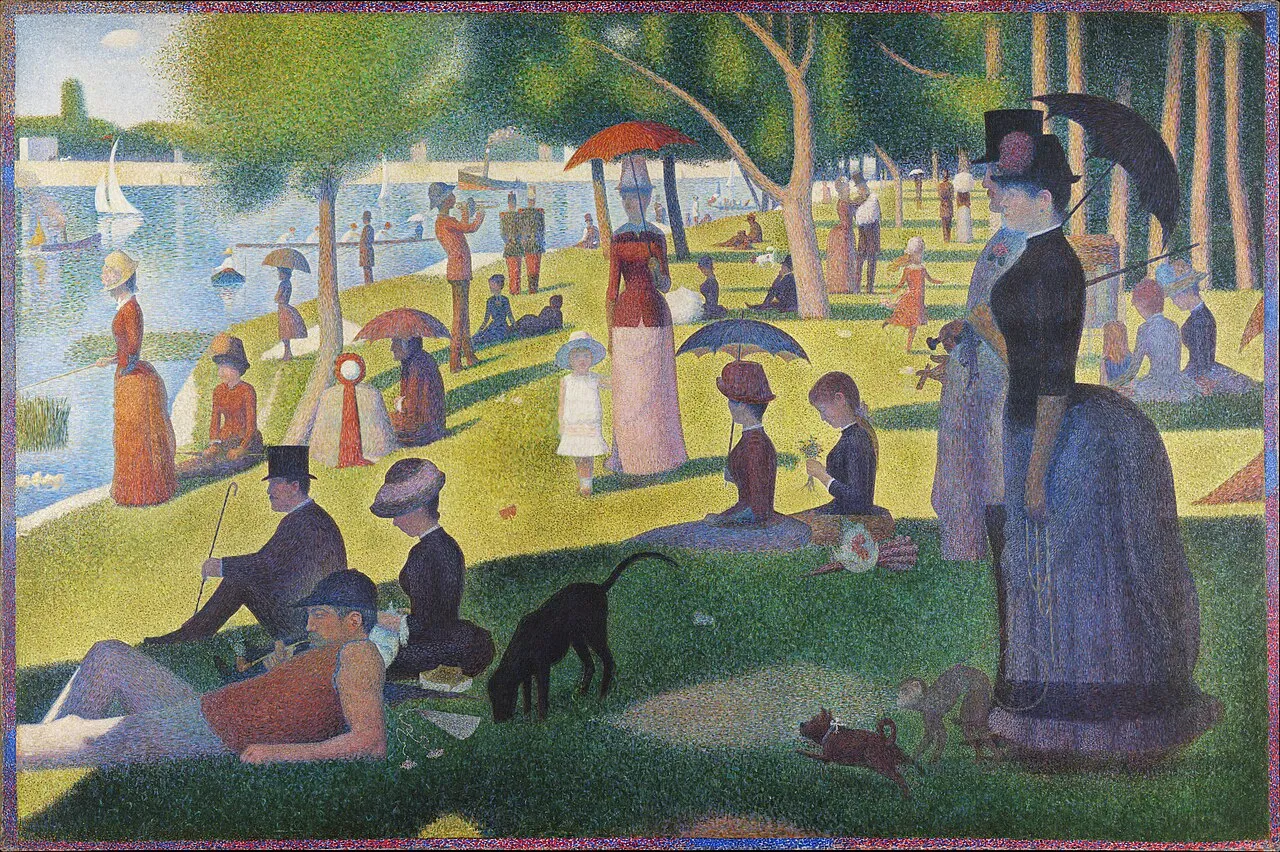
A Sunday on La Grande Jatte, Georges Seurat, 1886. Art Institute of Chicago. Wikimedia Commons.
The final painting has approximately forty-eight figures, three dogs, one monkey, several boats, and large alternating areas of shadow and sunlit grass. The composition is organized in strict horizontal bands: the river in the background, a bank of trees behind the figures, shadow in the middle ground, bright grass in the foreground. The figures are positioned with a geometric regularity that does not exist in nature. They are perpendicular to each other and to the picture plane, placed like pieces on a board rather than like people who have happened to sit down. The woman with the monkey wears an elaborate bustle dress and holds herself with such controlled posture that she barely seems to be breathing. Next to her, a man stands with a cane in the same frontal, non-communicating stance. No one in the painting is talking to anyone else.
The monkey, a fashionable exotic pet in bourgeois Parisian society at the time, appears to have attracted interpretive attention from art historians. Several scholars have noted that in French popular culture, monkeys carried associations with social pretension and sexual appetite, suggesting that Seurat's elegantly dressed woman with her monkey might contain a mild social satire.
Chromoluminarism: The Theory Behind the Dots
Seurat called his technique "chromoluminarism" or "divisionism." The word "pointillism" was invented by critics as a slightly mocking description and was not Seurat's preferred term. The technique was built on his study of three color theorists: Michel Eugène Chevreul, whose 1839 work on simultaneous contrast demonstrated that adjacent complementary colors intensify each other; Ogden Rood, whose 1879 work on optical color mixing argued that mixtures of colored light are more luminous than mixtures of pigment; and Charles Henry, a mathematician who studied the psychological effects of color direction and line.
Seurat's theory was that dots of pure, unmixed pigment placed next to each other would blend optically in the viewer's eye at a sufficient viewing distance, producing mixtures more luminous than physically mixed paint. The idea had genuine scientific roots. Mixing pigments together subtracts light, producing darker and muddier results with each additional color. Mixing colored light adds energy. By keeping pigments separate and letting the eye do the mixing, Seurat believed he could approximate the luminosity of light mixing rather than the dullness of pigment mixing.
The scientific claim was only partially correct, and subsequent vision science has been precise about why. Research published in the journal i-Perception analyzing pointillist color perception found that the dots do not blend in the eye the way Seurat theorized: at normal viewing distance, the surface reads as a shimmering field of distinct colored marks rather than a true color blend. The color transitions in pointillist work are achieved primarily through chromatic contrast rather than luminance contrast, which is a different mechanism than Seurat described. But the visual effect, even if not the mechanism, is real. The surface of La Grande Jatte has a quality of vibration and light that flat paint mixtures do not achieve. Looking at it is genuinely different from looking at a conventional painting.
The Strange Stillness and What It Means
The most unsettling quality of La Grande Jatte is its atmosphere of frozen social performance. This is supposed to be a leisure scene, a park full of people on a Sunday afternoon, and yet no one looks relaxed. The figures are rigid and silent. Children play but do not seem joyful. The man reclining in the foreground is positioned at an angle to everyone else, looking away. The couples do not engage. The fisherwomen stare at the water with the concentration of professionals.
This quality came from two sources. The first is technical: composing a canvas of this scale over two years from dozens of separate studies produced a synthetic quality quite unlike the spontaneous observation of Impressionist painting. Each figure was assembled, not observed. The second source is intentional. Seurat had studied Egyptian and Greek friezes and was specifically interested in achieving the permanence and dignity of ancient art through frontality and perpendicularity. He wanted his contemporary Sunday scene to have the timeless quality of a Greek procession.
What he produced instead, partly by accident, was a portrait of bourgeois performance: a crowd of people who are physically together and socially isolated, a leisure space that functions as a stage for the display of status rather than as a site of genuine rest. The art historian T.J. Clark, writing in "The Painting of Modern Life" (1984), read the painting as a document of the new bourgeois public, a class that had learned to present itself in public spaces according to strict codes of behavior that left no room for actual enjoyment. The painting is not satirical. It does not mock the people it shows. But it observes them with a sociological precision that makes their performance of leisure more visible than they might have wanted.
What Happened to Seurat's Method
Paul Signac became Seurat's closest collaborator and continued the divisionist method after Seurat's sudden death from meningitis in 1891. Through Signac's theoretical writings, collected in "D'Eugène Delacroix au néo-impressionnisme" (1899), divisionism reached a broader audience of painters. The most consequential reader was Henri Matisse, who spent the summer of 1904 painting with Signac in Saint-Tropez and produced "Luxe, Calme et Volupté" in Divisionist dots. The encounter with the technique changed Matisse's understanding of how pure color could operate at maximum intensity. He abandoned the dots within a year but kept the lesson, and the result was Fauvism.
Vincent van Gogh tried the technique briefly in Paris in 1886-87, applying dabs of complementary color in short parallel strokes that he then developed into his own distinctive broken brushwork. The technique gave him permission to use color more freely than his earlier dark-palette work had allowed. The influence traveled forward through his work into Expressionism and beyond.
The painting itself was purchased by the Art Institute of Chicago in 1924 and has been one of the museum's defining works since. Stephen Sondheim's 1984 musical "Sunday in the Park with George," which dramatizes Seurat's creation of the painting, introduced it to a generation of theater audiences and remains one of the more thoughtful engagements with the psychology of artistic creation in American popular culture. The musical won the Pulitzer Prize for Drama in 1985.
For a deeper look at the color theory that underpins the technique, the guide to color theory for art appreciation covers Chevreul's simultaneous contrast principle and how complementary pairs interact. For the broader context of Post-Impressionism and the directions it opened, see the complete guide to art movements.
How to Look at La Grande Jatte
If you see it in person at the Art Institute of Chicago, start close. Get within two or three feet and look at the surface. You will see the individual dots clearly: orange next to blue, green next to violet, yellow next to red. The complementary pairs vibrate. The dots are not all the same size. Seurat made larger dots in shadow areas and smaller ones in areas of bright light. The border of the painting has dots too, on the painted frame Seurat designed to extend the visual field of the work to its own edge.
Then step back to about fifteen feet. The scene resolves. The dots become atmospheric light. The figures acquire their strange, frozen dignity. Notice the horizontal structure: the painting is composed in stacked bands like an Egyptian frieze, with each band representing a different depth plane. Notice how few diagonal lines there are. Almost everything is horizontal or vertical. The effect is of a composition that has been imposed rather than observed, which is exactly what it is.
If you cannot see it in person, the Art Institute of Chicago's high-resolution digital image is detailed enough to examine the dot structure at the zoom levels that reveal what the actual surface looks like.
What draws you most to this painting? The technique, the social scene, or the peculiar stillness? Share your thoughts in the comments below.


