
In 1932, Diego Rivera stood inside the Garden Court of the Detroit Institute of Arts and told the museum's director that the two walls he had been commissioned to paint were not enough. He wanted all four walls. And the ceiling panels. And the subsidiary sections between the windows. Edsel Ford, who was funding the project, agreed, and Rivera ultimately covered nearly 450 square yards of wall with 27 fresco panels depicting the production of the V-8 automobile at Ford's River Rouge Complex. He later described this cycle, known as the Detroit Industry Murals, as the finest work of his lifetime. The DIA currently refers to the Rivera Court as "Detroit's Sistine Chapel," and the murals were designated a National Historic Landmark in 2014.
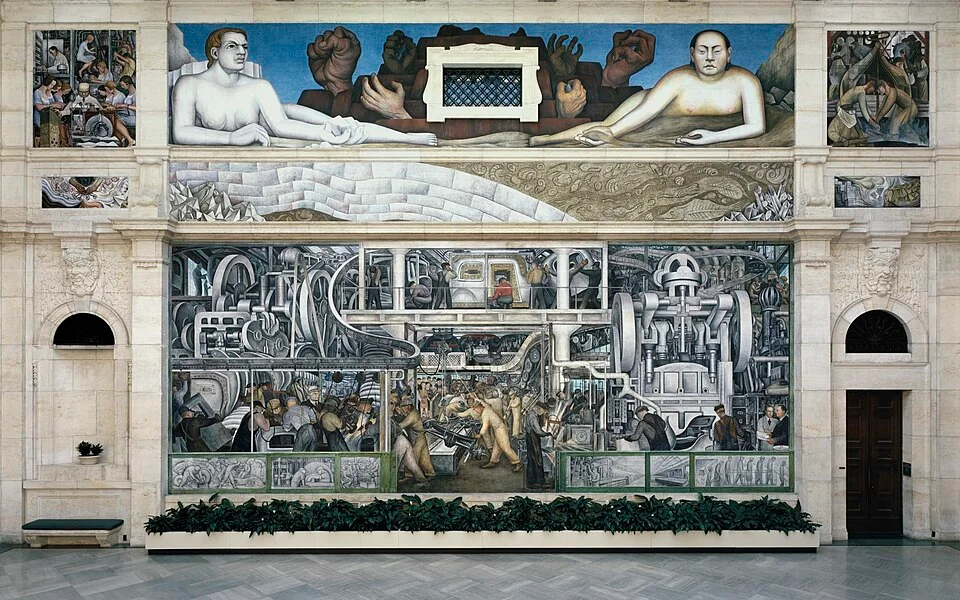
Diego Rivera, Detroit Industry Murals, South Wall (1932-33), Detroit Institute of Arts. Rivera covered nearly 450 square yards of wall with 27 fresco panels depicting the production of the V-8 automobile at Ford's River Rouge Complex. Image: public domain, via Wikimedia Commons
Rivera believed that great art should be visible to everyone, not just to those who could afford museum admissions or gallery invitations. His solution was the wall. Between the early 1920s and his death in 1957, Rivera covered thousands of square meters of public and institutional walls in Mexico and the United States with fresco paintings that told the history of Mexico's people from pre-Columbian civilization through the revolution, depicted the industrial labor of American workers with monumental dignity, and made the argument in paint that working people were the true subjects of history.
This guide covers how he developed as an artist, the major mural cycles he produced, the political controversies they generated, and why his work remains genuinely relevant to anyone thinking about what public art is for.
Formation: From Mexico City to Paris
Diego Rivera was born in Guanajuato, Mexico, in 1886 and showed exceptional artistic ability from childhood. He trained at the Academy of San Carlos in Mexico City and won a scholarship that took him to Europe in 1907. He spent the next decade in Spain, Paris, and Italy, absorbing the full range of European avant-garde practice. He worked in a Cubist style for several years, producing paintings that show genuine formal sophistication in the analysis of pictorial space and that were well received in Paris exhibitions.
But the Paris period ended with a decisive reorientation. In 1920, Rivera traveled to Italy specifically to study the Italian Renaissance fresco tradition, particularly the work of Giotto at the Scrovegni Chapel in Padua and the great 15th-century painters in Florence and Rome. He became convinced that fresco, pigment applied directly into wet plaster so that it becomes chemically bonded to the wall as it dries, was the medium most suited to large-scale public art. The technique is demanding: the artist must work in sections, painting each "giornata" (day's work) before the plaster sets, and corrections are very difficult once the plaster has dried. But the result is permanent in a way that oil on canvas is not. A true fresco, properly maintained, can last centuries.
Rivera returned to Mexico in 1921, abandoning Cubism entirely, and threw himself into the mural project that would define the rest of his career.
The Mexican Muralist Movement
Rivera returned to a Mexico that was consolidating the revolution of 1910-20 under a new government committed, at least rhetorically, to land reform, indigenous rights, education, and the creation of a national culture rooted in Mexico's pre-Columbian heritage rather than its Spanish colonial past. The Minister of Education, Jose Vasconcelos, commissioned Rivera and other artists including Jose Clemente Orozco and David Alfaro Siqueiros to decorate the walls of public buildings in Mexico City with murals celebrating Mexico's history and culture.
The three artists, known as "los tres grandes," had different styles and different political emphases, but they shared the conviction that mural painting was the appropriate art form for a revolutionary society. Rivera's murals at the Ministry of Education (1923-28) established the visual vocabulary of Mexican muralism: deep spatial recession from the fresco tradition combined with simplified, monumental figures drawn from both pre-Columbian and Italian Renaissance sources, crowded narrative compositions that could be read as unified wholes or broken down into individual episodes, and an explicitly political perspective that placed indigenous Mexicans at the center of their own history.
The National Palace Murals
The murals Rivera painted on the grand staircase and surrounding walls of the National Palace in Mexico City between 1929 and 1951 are the most ambitious and most celebrated of his public commissions. The central staircase wall depicts the entire sweep of Mexican history from the Aztec civilization through the Spanish conquest, colonial period, war of independence, reform movement, revolution, and contemporary politics. The scale is extraordinary: thousands of figures fill a space read from below, the composition organized so that the eye moves through time as it moves across the wall.
The pre-Columbian section is rendered with particular care and visual richness. Rivera had spent years studying Aztec, Maya, and other indigenous codices and artifacts, and the murals reflect this scholarship in the accuracy of the depicted rituals, costumes, and social arrangements. This was a deliberate political act: to paint indigenous Mexican civilization as sophisticated, complex, and visually beautiful was to challenge both the Spanish colonial dismissal of it as primitive barbarism and the post-independence tendency to treat it as historical curiosity rather than living heritage.
To visit the National Palace today is to understand why Rivera chose fresco for public work. The murals are inseparable from the walls they are painted on. They are not portable. They cannot be sold or moved. They belong to the building and to the people who use it, in a way that no gallery painting ever could.
The Detroit Industry Murals
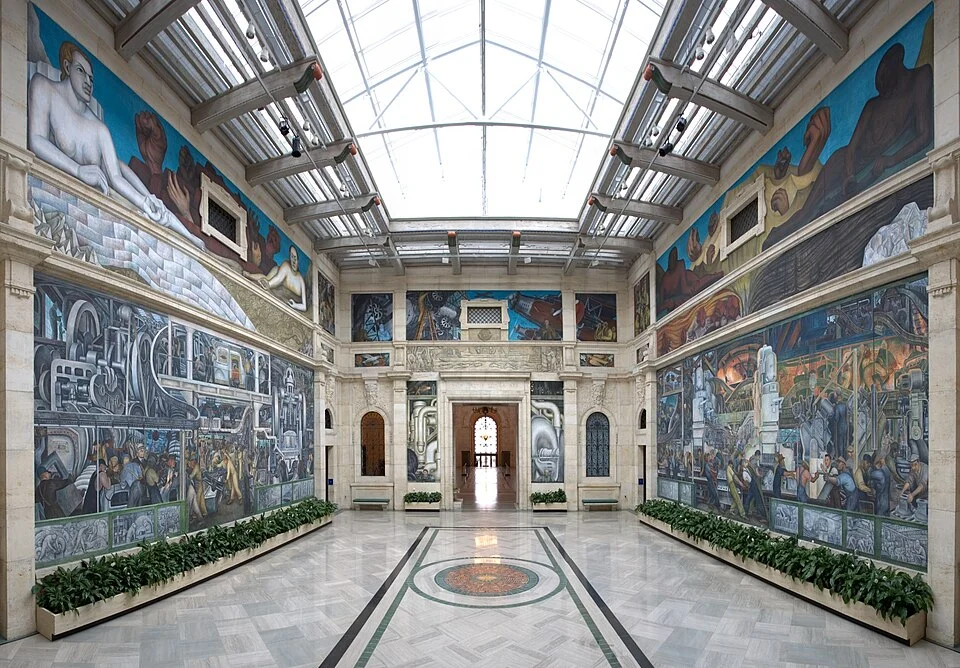
Diego Rivera, Detroit Industry Murals, West Wall (1932-33), Detroit Institute of Arts. The 27 panels show workers not as anonymous cogs in a machine but as skilled people engaged in work that is physically demanding and technically complex. Image: public domain, via Wikimedia Commons
Rivera's American commissions brought him into a different political and cultural context. The Detroit Industry Murals, painted in 1932-33, were commissioned by the DIA's director William Valentiner and funded by Edsel Ford at a cost of $20,889. Rivera insisted on researching the subject thoroughly before painting, spending months at the River Rouge Complex making hundreds of preparatory drawings on site. The resulting 27 panels show workers not as anonymous cogs in a machine but as skilled people engaged in work that is physically demanding and technically complex.
The murals include four panels at the top of the north and south walls showing figures representing the four human races in relation to the four elements, connecting the local industrial subject to a universal vision of human production. These panels drew on Rivera's engagement with the pre-Columbian concept of the four cardinal directions as a cosmic organizing principle, bringing together his Mexican intellectual formation and his American industrial subject in a synthesis that is entirely his own.
The DIA has recently undertaken a major conservation project to address surface dirt, minor paint losses, and structural concerns that have developed over more than 90 years. The project is being carried out in phases with the court remaining open to visitors, and the DIA has published detailed documentation of the conservation work as it proceeds. According to the DIA's own conservation records, the museum also holds a unique set of 8x10-inch nitrate photo negatives documenting the murals' creation day by day in 1932-33, commissioned by Edsel Ford and now being digitized for public access.
The Rockefeller Center Destruction
Rivera's most notorious American commission ended in deliberate destruction. In 1933, he was commissioned to paint a mural titled "Man at the Crossroads" in the lobby of the RCA Building at Rockefeller Center in New York. As the painting neared completion, Rivera included a portrait of Vladimir Lenin among the figures in the composition. Nelson Rockefeller asked him to remove it. Rivera refused. The painting was covered and eventually destroyed, Rivera was paid his fee and dismissed, and the incident became one of the most notorious episodes of political censorship in American art history.
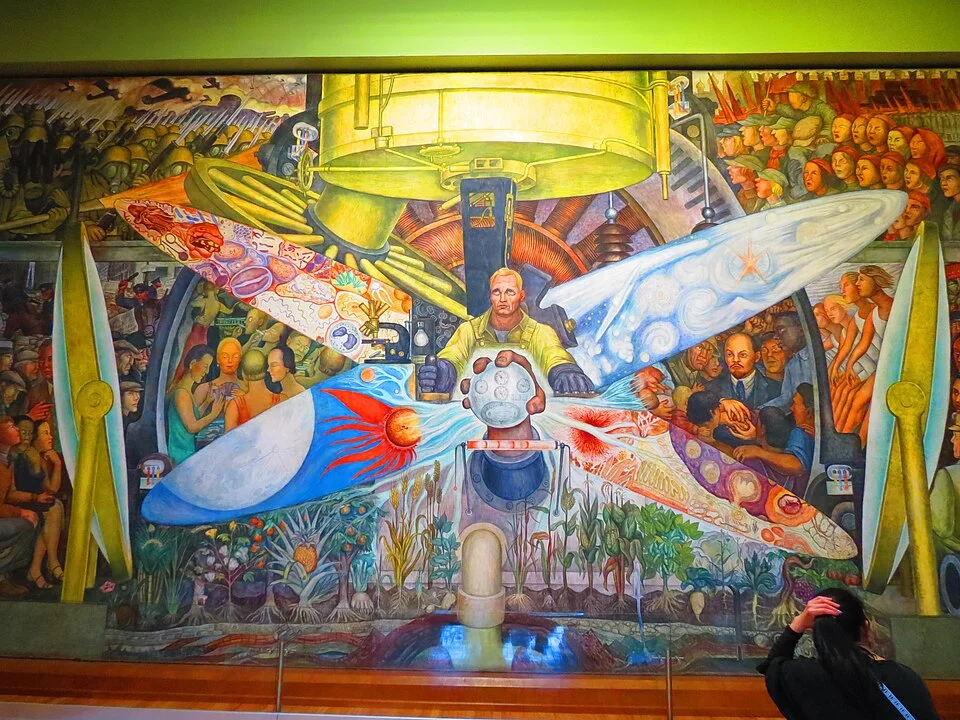
Diego Rivera, Man, Controller of the Universe (1934), Palace of Fine Arts, Mexico City. Rivera reconstructed the destroyed Rockefeller Center mural with an even more explicit portrait of Lenin. Image: public domain, via Wikimedia Commons
Rivera reconstructed the composition the following year at the Palace of Fine Arts in Mexico City, retitling it "Man, Controller of the Universe." The Mexico City version includes an even more explicit portrait of Lenin than the original, along with a portrait of Nelson Rockefeller among the figures of capitalism and decadence. It is worth seeing in person if you visit Mexico City: the reconstruction is a painting about the destruction of a painting, and Rivera made sure it said so.
Frida Kahlo and the Personal Life
Rivera's personal life was as turbulent and as publicly examined as his professional life. He was married four times, twice to the painter Frida Kahlo, whose work is covered in our guide to Frida Kahlo. Their relationship was one of the most famous artistic partnerships of the 20th century, marked by mutual admiration, repeated infidelity on both sides, and genuine intellectual and emotional connection. Rivera painted several portraits of Kahlo and spoke of her consistently as the greatest artist of her generation.
His political affiliations also created personal complications. A committed communist from the 1920s, he invited Leon Trotsky to live in Mexico after Trotsky's expulsion from the Soviet Union in 1937. The two men eventually had a falling out, but Rivera's willingness to shelter Trotsky at considerable personal risk reflects the seriousness of his political commitments. He was not, as some critics have argued, a dilettante radical who used Marxist imagery as artistic decoration. He was a genuine political thinker who happened to also be one of the most technically accomplished fresco painters of the 20th century.
Final Thoughts
Diego Rivera spent 40 years insisting that painting could be genuinely public: not a private object for private contemplation but a shared visual environment in which the meaning of common history could be debated and celebrated. The murals he left behind in Mexico City, Detroit, San Francisco, and New York are among the most ambitious political artworks of the 20th century and among the most accessible. You do not need a catalog or a theoretical framework to engage with them. You need only to stand in front of a wall and look at the evidence that a society tried to tell the truth about itself in paint, addressed to everyone who passed by.
For the broader context of Mexican modernism, the guide to Frida Kahlo provides the other essential perspective on this period. For the public art tradition Rivera helped establish, the guide to art and politics offers broader context. If you are in Detroit, the Rivera Court at the DIA is free with museum admission and is worth an extended visit. What do you think the murals say about the relationship between art and political power? Share your thoughts in the comments below.


