
On July 3, 2026, Ai Weiwei opened his largest ever site-specific exhibition, "Button Up!", at Aviva Studios in Manchester. The centerpiece of the show is "Eight-Nation Alliance Flags," eight enormous banners made from approximately four million buttons, representing the countries that invaded Qing-dynasty China during the Boxer Rebellion of 1899. He bought the buttons in 2015 from a closing factory in Croydon. His team in Shandong spent years constructing the flags. The effect in the warehouse-scale gallery, where each flag divides the space like a wall, is overwhelming in a way that photographs of the work cannot convey.
On July 3 and 4, he performed "Sewing a Button," a 24-hour durational work reenacting his 81-day detention by Chinese secret police in 2011. The detention, which followed his investigation of the deaths of schoolchildren in the 2008 Sichuan earthquake, was never explained with formal charges. He lost weight during those 81 days, and the button on his trousers came off. He asked his guards repeatedly to have it sewn back. After a month, soldiers sewed the button in front of cameras. "Even sewing a button can be subversive," he told journalists at the press preview, then added: "I use zippers now."
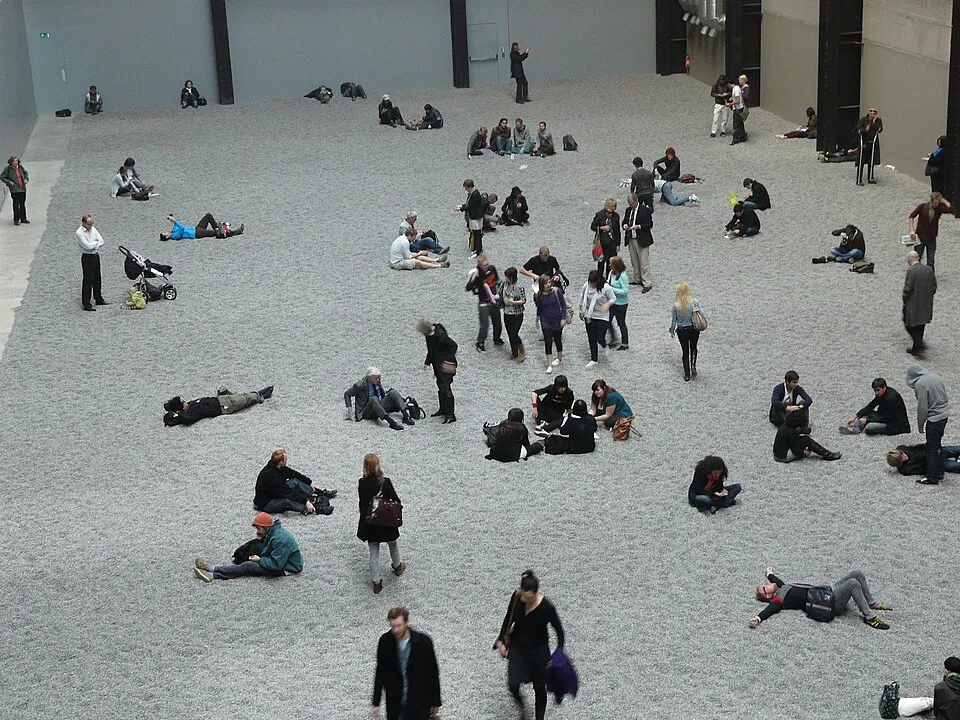
Ai Weiwei, "Sunflower Seeds" (2010), Tate Modern Turbine Hall. Approximately 100 million hand-crafted porcelain seeds covered the floor of the hall. Photo by blahflowers, 2010. Image: CC BY 2.0, via Wikimedia Commons
Ai Weiwei has spent his career doing something most artists only consider in theory: making work that costs him something real. The costs have included that eighty-one-day detention, four years under travel restriction, the demolition of his Shanghai studio by government order, and sustained surveillance. He has responded to each of these with more art, more public statement, and more documentation. Born in Beijing in 1957, he is the son of Ai Qing, one of China's most celebrated poets, who was persecuted during the Anti-Rightist Movement and spent twenty years in internal exile. Ai Weiwei grew up knowing what it means to live under a government that treats expression as a threat.
New York and the Formation of a Method
Ai Weiwei spent twelve years in New York, from 1981 to 1993, during an extraordinarily fertile period in the city's art scene. He encountered the work of Andy Warhol, Marcel Duchamp, and Jasper Johns, and absorbed the conceptual tradition that held that an artwork could be constituted by an idea rather than by a specific physical object. He photographed his New York years obsessively, a practice of documentation that would become central to his later practice. The photographs show a young Chinese artist navigating American culture with curiosity and humor, working odd jobs and making art in whatever space and time was available.
The influence of Duchamp's readymade concept is visible throughout Ai Weiwei's subsequent work. If an everyday object can be transformed into art by the decision of an artist to present it as such, the meaning of that act depends entirely on which objects are chosen and in what context. Ai Weiwei has consistently chosen objects that carry specific cultural weight: ancient Han dynasty urns that he dips in industrial paint and photographs, traditional Chinese wooden furniture disassembled and reassembled in new configurations, mass-produced goods of contemporary Chinese industry used to comment on the relationship between Chinese tradition and global capitalism. The choice is always purposeful. The context is always the point.
Sunflower Seeds
"Sunflower Seeds" (2010), installed in the Turbine Hall of the Tate Modern in London, consisted of approximately 100 million hand-crafted ceramic sunflower seeds covering the floor of the hall to a depth of about ten centimeters. Each seed was made and painted by one of 1,600 artisans in Jingdezhen, the city in Jiangxi Province that has been the center of Chinese porcelain production for over a thousand years. The installation took two and a half years to produce.
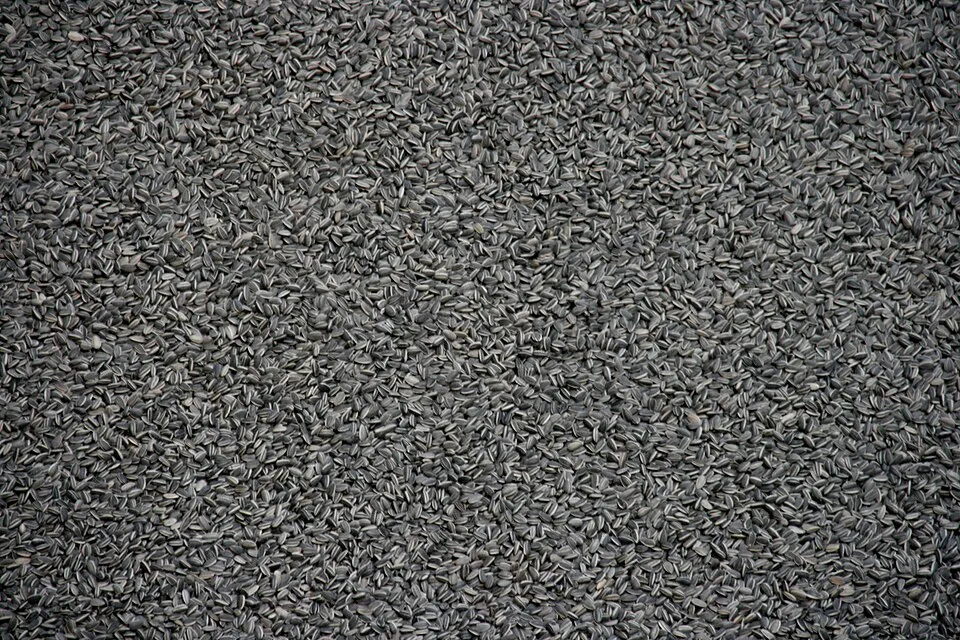
Visitors interacting with "Sunflower Seeds" at Tate Modern. The installation invited viewers to walk on the seeds until health concerns about porcelain dust led to restricted access. Photo by Mike Peel, 2010. Image: CC BY-SA 4.0, via Wikimedia Commons
The work operates on multiple levels simultaneously. It is a meditation on the relationship between the individual and the mass: each seed is unique, hand-made, bearing the specific trace of a specific artisan's touch, and yet the 100 million seeds together form an undifferentiated field in which individual identity is absorbed. The sunflower carries specific cultural resonance in China, where "sunflower seeds" referred to the Chinese people during the Maoist period because sunflowers turn toward the sun and the people should turn toward Mao. The work quotes and inverts this propaganda reference, honoring the artisanal labor that produced it while commenting on the relationship between the individual human being and the political collective.
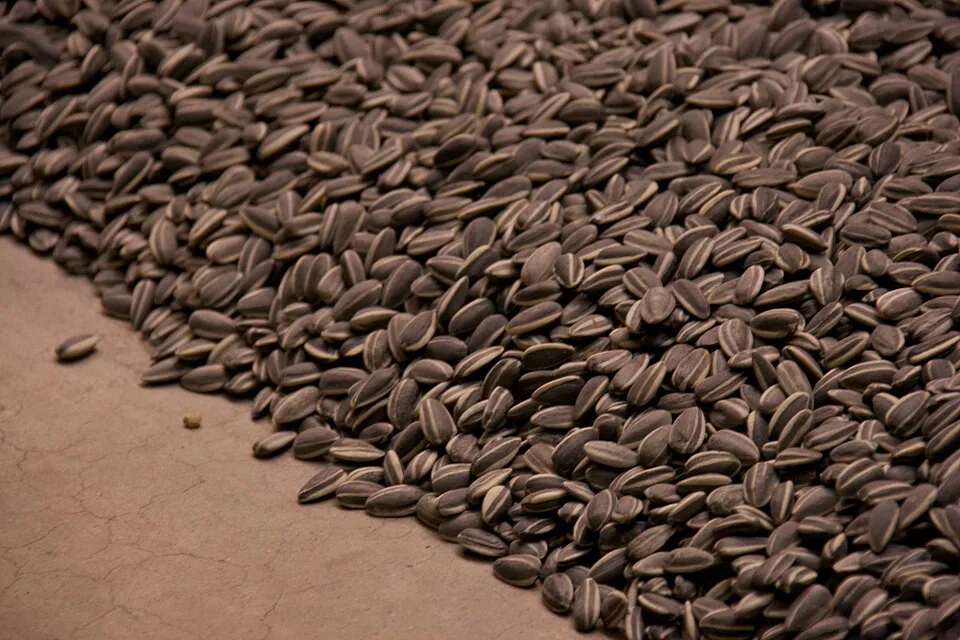
Detail of "Sunflower Seeds" at Tate Modern. Each seed was individually made and painted by artisans in Jingdezhen, the historic center of Chinese porcelain production. Photo by Mike Peel, 2010. Image: CC BY-SA 4.0, via Wikimedia Commons
The scale of the installation, and the knowledge that each of the 100 million seeds was individually made by human hands, produced in visitors a particular kind of contemplative awareness that large numbers in the abstract cannot generate. You are standing on 100 million objects made by 100 million human hours of labor. The weight of that fact, the sense of the accumulated labor it represents, is the work's primary experience.
The Earthquake Investigation
Following the Sichuan earthquake of May 2008, which killed approximately 70,000 people including thousands of children in schools that collapsed because of poor construction, Ai Weiwei organized a citizens' investigation to document the names of the dead children. The Chinese government had suppressed this documentation, and official tallies significantly undercounted the children who died. Ai Weiwei and his collaborators compiled a list of 5,196 student names through research, interviews, and citizen reporting.
The investigation and the work it generated, including the installation "Remembering" (2009), in which 9,000 children's backpacks were arranged on the facade of the Munich Haus der Kunst to spell out a phrase from a mother's statement about her daughter ("She lived happily for seven years in this world"), brought him into direct confrontation with the Chinese government. The earthquake investigation was one of the stated reasons for the demolition of his Shanghai studio in 2011 and for his subsequent detention.
The Detention and What Followed
On April 3, 2011, Ai Weiwei was detained at Beijing Capital International Airport and held for eighty-one days in an undisclosed location without formal charges. The Chinese government eventually accused him of tax evasion. He was released after payment of a fine that his supporters crowdfunded within days of his release. The detention provoked an international response from governments, arts institutions, and individuals worldwide, and transformed him from a nationally significant Chinese artist into a globally recognized figure whose work could not be discussed separately from the conditions under which it was made.
During his four years under travel restriction, which lasted until 2015, he continued to work in Beijing. His release allowed him to move first to Berlin, then to Cambridge, England. At the Manchester press preview for "Button Up!" in July 2026, he compared his detention by Chinese authorities to the imprisonment of Julian Assange by democratic governments, and noted that the distinction between authoritarian and democratic states in their treatment of political expression had become, in his experience, less clear than Western audiences prefer to believe. He lives in Europe but describes himself as having no fixed home, a condition that he has made into the subject of his work as much as any specific political cause.
Displacement, Refugees, and the Work Since 2015
Ai Weiwei's engagement with the global refugee crisis has produced some of his most formally compelling recent work. "Law of the Journey" (2017), a 49-foot inflatable black boat crowded with hundreds of faceless refugee figures, was first shown at the National Gallery in Prague. It appeared again at the 2026 Manchester exhibition alongside "Surfing" (2023), a Lego recreation of Hokusai's "The Great Wave" populated with refugee figures, and "History of Bombs," a 25-meter-wide mural made from 3.5 million Lego bricks depicting weapons of mass destruction. The three works together create an argument about the relationship between political violence and mass displacement that individual works could not make alone.
In July 2026, the Museum of Contemporary Art Australia announced that Ai Weiwei will create a major new public sculpture for the Tallawoladah Lawn overlooking Sydney Harbour, to be unveiled in September 2026 as part of the Neil Balnaves Tallawoladah Lawn Commission. The work is, as of this writing, undisclosed in its specific form. It will be free and publicly accessible, which has been a consistent aspect of his approach to large-scale public work.
His documentary film "Human Flow" (2017), filmed across forty countries with a crew of over thirty, follows refugee movement across borders and through camps with a scale and intimacy that documentary film rarely achieves. It remains one of the most serious attempts by any artist to address the refugee crisis as a global systemic condition rather than as a series of isolated national stories.
What the Work Is Actually Doing
Ai Weiwei's practice does not allow the comfortable separation between aesthetics and politics that many viewers prefer. The political content is not a theme applied to otherwise formally interesting objects. It is the work's primary substance, and the formal decisions serve the political purpose. Whether this prioritization makes his work more or less interesting as art is a question different people answer differently. The Manchester exhibition's "History of Bombs" mural is made from 3.5 million Lego bricks: the material is cheerful, the subject is weapons capable of mass civilian death, and the juxtaposition is doing something that neither element could do alone.
What is not debatable is that he has demonstrated, at considerable personal cost, that art made in direct engagement with power retains its capacity to matter in ways that purely formal work cannot. His work raises discomfort rather than resolving it, which is the appropriate response to its subjects. For the broader tradition of politically engaged art, the guide to art and politics provides essential context. For the conceptual tradition his work draws on, the guide to conceptual art covers the relevant background. Does his willingness to use spectacle and scale in service of political content make the work more or less effective? Share your thoughts in the comments.


