
Here is a number that should make any artist pay attention: Pinterest's visual search engine, Pinterest Lens, now processes 1.5 billion queries per month, a 40% increase from the previous year, according to Pinterest Engineering data from 2025. Those are not people casually scrolling. They are people pointing their phone cameras at a painting they saw in a restaurant, a print they spotted in a magazine, or a color palette they noticed on a walk, and actively searching for more work that looks like that. The artwork itself is the keyword.
That is a fundamentally different way of discovering art from anything that existed before. Google searches require words. Instagram requires following the right account first. But Pinterest lets a user start with a visual impression and find their way to the original artist without already knowing the artist's name. For painters, illustrators, photographers, and printmakers who make work that photographs well and has a recognizable visual identity, this matters a great deal.
This guide explains how Pinterest actually works as an art discovery platform, why its structure suits artists differently from other social platforms, what the current research says about how art finds audiences there, and what artists who are seeing real traffic growth are doing differently from those who are not.
Why Pinterest Is Not a Social Media Platform
The comparison to Instagram or TikTok is misleading. Pinterest does not reward recency the way social feeds do. A pin posted three years ago can generate more traffic today than one posted last week, because Pinterest functions as a search engine first and a social platform second. Users come to Pinterest with intent: they are looking for something specific, even if they cannot fully articulate what it is yet.
According to Pinterest's own data for 2026, 80% of searches on the platform start without a brand name. Users search by visual category, aesthetic, mood, or style rather than by artist name. This is good news for emerging artists: you do not need to already be famous for your work to be found. You need your work to be visually coherent, well-photographed, and connected to the language your audience is already using to search.
The platform also fields over 80 billion queries per month in total, and over 85% of traffic comes to Pinterest directly rather than from referrals. Users arrive with purpose. That intent-driven behavior is what makes Pinterest a different kind of channel than the feed-based platforms, where discovery is largely passive and driven by algorithm surfacing rather than active search.
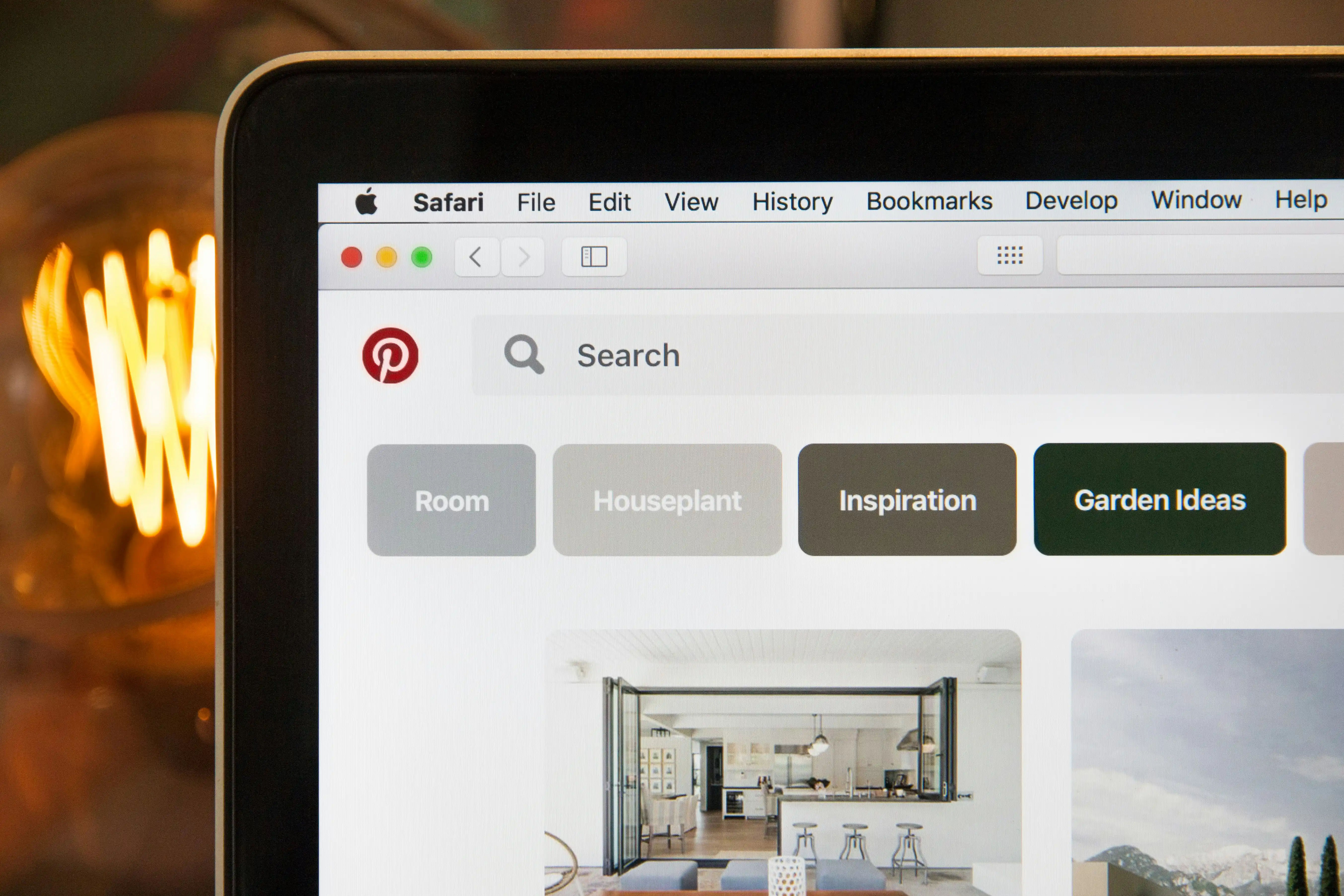
Pinterest functions more like a visual search engine than a social feed. Pins posted years ago continue generating traffic, unlike content on Instagram or TikTok that disappears from feeds within days.
How Visual Search Is Changing Art Discovery
Pinterest Lens, the platform's visual search technology, can now identify textures, color palettes, composition styles, and subject matter within an image without any text attached. A user who photographs a watercolor botanical they spotted at a gallery can find visually similar work across Pinterest without typing a single word. The artist who made that similar work gets a new viewer who arrived through pure visual recognition.
Pinterest has indexed 6 billion pins for visual search, making it one of the largest searchable visual databases in the world. Visual search on Pinterest converts at a rate 62% higher than text-based search, according to Pinterest's internal data from 2025. The gap exists because visual searchers have already identified what they want: they are matching a specific visual impression rather than working from a general keyword that might mean many different things to different people.
For artists, this has practical implications. The quality and accuracy of your pin images now carries more weight for discovery than caption length or hashtag use. A sharp, true-to-color photograph of a painting in natural light gives Pinterest's image recognition system the clearest possible signal about what the work looks like and who might be looking for it. Heavy filters, dark photography, or low-resolution images all reduce the system's ability to place your work in front of the right searches.
Evergreen Content and the Long Shelf Life of Pins
On Instagram, a post has a lifespan of roughly 24 to 48 hours before it stops receiving significant engagement. On TikTok, the window is even shorter. On Pinterest, a well-constructed pin can generate consistent traffic for years. Artists who pinned their work in 2021 and 2022 regularly report that those older pins still drive meaningful traffic to their websites in 2026, sometimes outperforming newer pins that never found traction.
This evergreen quality changes how artists should think about effort and investment. Time spent creating a high-quality pin, with accurate photography, a clear keyword-informed title, and a detailed description, pays dividends over a much longer horizon than equivalent effort on Instagram or TikTok. The work compounds rather than evaporating.
According to a 2023 report from Artsy, 52% of art enthusiasts aged 18 to 34 use Pinterest to discover art for home decoration, and 61% of those users save pins for a future purchase. This is not a passive audience. These are people who save work with intention and return to it when the time is right to buy.
What Artists Getting Real Traffic Are Doing
Artists seeing consistent, growing Pinterest traffic in 2026 share a few habits that are worth being specific about. These are not abstract best practices; they are observable patterns in what the platform's algorithm responds to.
Board Naming That Signals Context
Pinterest reads board names as signals about what type of work you make and who your audience is. A board named "My Art" tells the algorithm very little. A board named "Original Watercolor Botanicals" or "Expressive Abstract Acrylics" gives the platform's taste graph the information it needs to match your work to relevant searches. The more specific the board name, the more precisely Pinterest can route your work to people already searching in that direction.
Multiple Images of the Same Work
Pinterest's visual search indexes color, composition, and detail separately. A single image of a finished painting captures one angle. A close-up of a textural detail, a photograph of the work in a room setting, and a process shot all provide different entry points for different searchers. An artist showing all three versions of the same work is giving Pinterest's algorithm more surface area to work with. Any one of those images might be the one that matches a particular search query.
Consistency Over Volume
Pinning ten low-quality images in a day is less effective than pinning two well-photographed, clearly captioned images consistently over weeks. Pinterest's algorithm responds to accounts that pin regularly and receive consistent saves and clicks. Saves are weighted more heavily than views because they signal genuine intent: someone found the image compelling enough to want to return to it.
The Attribution Problem and How to Work Around It
Pinterest has a well-documented attribution problem. When an image gets repinned widely, the link back to the original artist's website sometimes gets broken or replaced. Paintings circulate on the platform without any connection to the person who made them, which benefits nobody except the people who saved the image. This is a real limitation, and it is worth being clear-eyed about it.
The most effective approach artists have found to protect attribution is to pin directly from their own website or portfolio, rather than allowing others to pin their work first. When the pin originates from your website, the link back to you is embedded in the pin's source. Watermarking images with your website URL, using your name as part of the pin description, and linking pins directly to specific product or portfolio pages rather than just your homepage all reduce the likelihood of your work circulating without connection to you.
Pinterest as Part of a Larger Discovery Ecosystem
Pinterest works best when it is part of a broader approach to visibility rather than a standalone strategy. It connects naturally with an artist's website, Etsy shop, or online gallery because its primary function is to drive traffic outward rather than to keep users on the platform. A Pinterest pin that links to a specific artwork page on your site gives you the visit, not just the impression.
The platform also complements other channels differently from how Instagram and TikTok interact. Instagram content can be shared to Pinterest, creating dual-platform presence with minimal extra effort. Pinterest's longer content lifespan means it can continue driving traffic long after an Instagram post has cycled out of feeds. Together, they reach different moments in the same audience's journey: Instagram for immediate connection, Pinterest for longer-term discovery and intent.
For artists interested in how digital platforms are reshaping who gets seen and how art moves through culture more broadly, the dynamics playing out on Pinterest connect to larger questions about how the art market works and the ways digital art and online platforms have changed the relationship between artists and audiences.
What It Actually Changes
The most significant thing Pinterest has shifted is the entry point for art discovery. Before platforms like this existed, most people encountered art through galleries, museums, publications, and word of mouth. Each of those channels carried implicit filters: you had to know what to look for, where to go, or whom to follow. Pinterest, at its best, removes those filters. A person with no art background who photographs a painting they find beautiful can arrive at the artist's work through pure visual resonance, without needing the vocabulary or the institutional access that traditional art discovery required.
That democratization of discovery is genuinely new, and it is worth taking seriously even if the platform has real limitations around attribution and algorithmic opacity. Art that used to need a gallery wall to be seen now needs a good photograph and a specific board name. That is a lower barrier, not a higher one.
If you are an artist thinking about how to build visibility for your work, read about how artists price their work alongside thinking about how it gets found. Visibility without pricing strategy solves only half the problem. And for the broader context of how artists build sustainable practices in a digital landscape, the guide to building an art portfolio covers the foundations that make any discovery channel worth investing in.


