Accademia Gallery Florence: Michelangelo's David and Not Much Else (But David Is Enough)
Let's be honest about the Galleria dell'Accademia. Most of the 1.7 million people who visit each year come for one object and one object only: Michelangelo's David. The museum holds around 550 works across its galleries, but the Tribune of David is where everyone gathers, and the average visit lasts about 90 minutes. That is not a criticism. David is a 5.17-meter marble colossus carved from a single block of Carrara marble that two previous sculptors abandoned as too flawed to work with. Michelangelo was 26 when he started it. It is the most famous sculpture in the world, and seeing it in person, at eye level from just a few meters away, is a different experience from any photograph you have seen.
The museum raised its ticket price from €16 to €20 on February 1, 2026, and added a €4 mandatory booking fee, bringing the total to €24 for a pre-booked adult ticket. That is not cheap for a 90-minute visit. But as of March 15, 2026, the Accademia is now part of a unified museum system with the Bargello Museums, and combined tickets are available: €26 for 48-hour access to the Accademia and the Bargello National Museum, or €38 for 72-hour access to all six museums in the institute (Accademia, Bargello, Medici Chapels, Orsanmichele, Palazzo Davanzati, and Michelangelo's Secret Room). If you plan to visit more than one, the combined ticket is the better deal.
Director General Andreina Contessa, who now oversees the unified Accademia and Bargello system, has framed the merger as a way to overcome institutional fragmentation and present Florence's sculptural heritage as a coherent narrative rather than a collection of disconnected sites.
Michelangelo's David: What You Actually See
The David was carved between 1501 and 1504 and was unveiled in the Piazza della Signoria in September 1504, where it stood outdoors for nearly 370 years before being moved to the Accademia in 1873 to protect it from weathering. A replica now stands in its original outdoor location, and another bronze copy sits at Piazzale Michelangelo overlooking the city.
What reproductions cannot convey is the scale. At 5.17 meters (17 feet), the figure is larger than you expect, and the proportion adjustments Michelangelo made to account for the viewer looking up at it from below (the head and hands are oversized relative to the body) are visible only in person. The contrapposto stance, with the weight on the right leg and the left leg relaxed, creates a torsion through the torso that you can trace from the ankle to the neck. The veins in the right hand are carved with a specificity that suggests Michelangelo studied anatomy from dissected cadavers, which he did.
The choice to depict David before the battle rather than after the victory is what separates this sculpture from earlier David depictions. David is not triumphant. He is tense, watchful, and coiled. The furrowed brow and the slight turn of the head suggest he has just spotted Goliath approaching. This psychological tension, combined with the physical stillness, is what makes the sculpture feel alive in a way that most Renaissance sculpture does not.
The Prisoners and St. Matthew
The gallery leading to the David contains four of Michelangelo's Prigioni (Prisoners), unfinished sculptures originally intended for the tomb of Pope Julius II. These figures emerge from rough marble in various stages of completion, their bodies partially carved and partially trapped in the stone. Whether Michelangelo left them unfinished deliberately or simply abandoned them is still debated by art historians. Either way, they provide a window into his working process that finished sculptures cannot. You can see where he started, how he blocked out forms from the raw block, and how he conceived of sculpture as the act of liberating a figure already present within the stone.
The St. Matthew (1505-1506), displayed nearby, is another unfinished work that demonstrates the same quality. The figure pushes forward from the marble with a force that makes the rough, uncarved portions feel like a physical constraint being resisted rather than an incomplete task.
The Paintings and the Musical Instruments
The Accademia's painting collection traces the development of Florentine art from the late medieval period through the early 16th century. Works by Giotto, Bernardo Daddi, and Orcagna show the transition from flat gold-ground medieval panels toward three-dimensional naturalism. 15th-century works by Botticelli, Filippino Lippi, Perugino, and Domenico Ghirlandaio demonstrate the full flowering of Florentine Renaissance painting: mastery of perspective, anatomy, and color.
Most visitors walk past these galleries on their way to or from the David. If you have an extra 20 minutes, the Museum of Musical Instruments on the ground floor is worth a stop. It holds instruments from the Medici and Lorraine grand-ducal collections, including violins by Antonio Stradivari and an early piano built by Bartolomeo Cristofori, the Florentine instrument maker who invented the piano around 1700. These are working instruments displayed as art objects, and the craftsmanship is extraordinary.
How It Compares
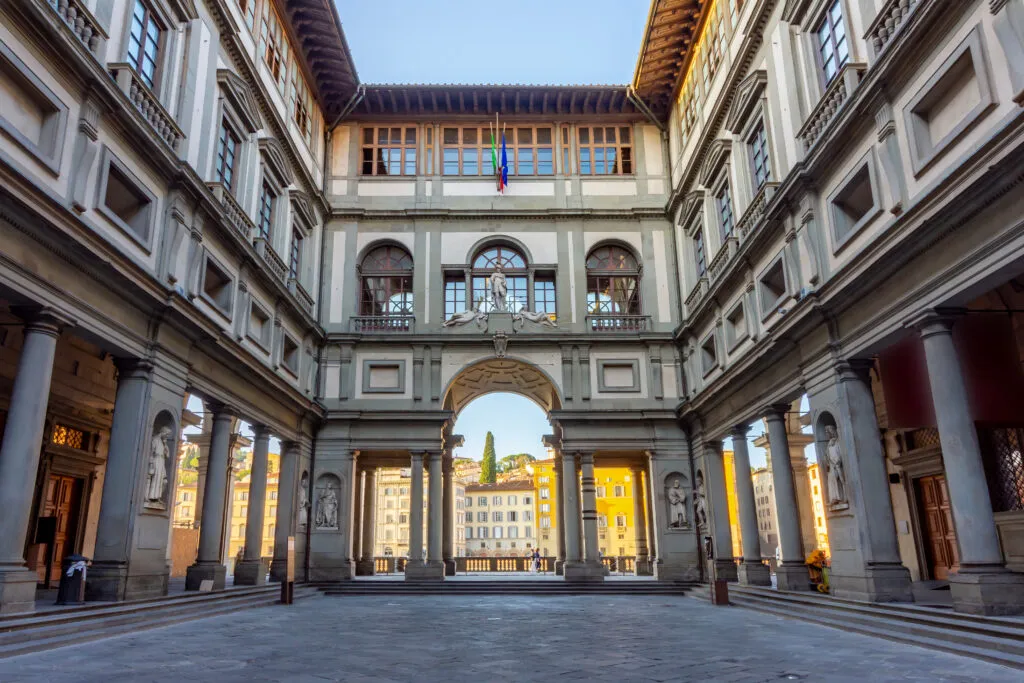
The Accademia is fundamentally a sculpture museum built around a single artist. The Uffizi Gallery, a 10-minute walk away, is a painting museum that covers the full breadth of Italian Renaissance art. If you only have time for one, the Uffizi offers more variety and a longer visit (3 to 4 hours versus 90 minutes). But the Accademia delivers an intensity the Uffizi cannot match. There is a difference between seeing Botticelli's Birth of Venus in a crowded gallery alongside dozens of other masterpieces and standing in front of David in a room designed specifically to display one object.
The Bargello National Museum, now part of the same institutional system, holds Florence's other great sculpture collection, including early Michelangelo works and Donatello's bronze David. The combined €26 ticket for both the Accademia and the Bargello is the smartest purchase for anyone serious about Renaissance sculpture.
Compared to the Vatican Museums in Rome, the Accademia is tiny and focused. The Vatican offers scale and breadth across centuries. The Accademia offers depth on a single moment in Florentine sculptural history.
Insider Tips
Book the 8:15 AM first slot. This is the single most important advice for visiting the Accademia. The first entry slot gets you into the Tribune of David before the crowds arrive. For the first 15 minutes, you may have the room nearly to yourself. By 10:30 AM, the Tribune can hold over 100 visitors simultaneously and feel cramped.
Avoid Tuesdays between 11 AM and 1 PM. School groups dominate the mid-morning slots on Tuesdays, and the noise and crowding significantly reduce the experience. Wednesdays and Thursdays are the quietest weekdays.
Late afternoon is the second-best option. Between 5 and 6 PM, tour groups have departed and the Tribune empties out. Last admission is at 6:20 PM, and closing procedures begin at 6:40 PM.
Do not buy tickets from third-party sellers. GetYourGuide, Viator, and Tiqets charge €25 to €35 for standalone tickets that cost €24 through the official booking portal. Use third-party platforms only if you are bundling a ticket with a guided tour.
Free admission days. The first Sunday of every month is free for everyone, but the booking service is not active, so you must wait in line. Free admission is also available on April 25, June 2, and November 4, 2026. Book months ahead for free Sundays, as these are the most crowded days of all.
Practical Information
Admission: €20 for adults, €2 for EU citizens aged 18 to 25, free for visitors under 18. A €4 booking fee applies to all pre-booked tickets. Combined tickets with the Bargello system are available (€26 for 48 hours, €38 for 72 hours across six museums).
Hours: Tuesday through Sunday, 8:15 AM to 6:50 PM. Last admission at 6:20 PM. Closed on Mondays, January 1, and December 25.
Getting there: The museum is on Via Ricasoli, a 10-minute walk from the Duomo and a 15-minute walk from the Uffizi Gallery. The nearest bus stops are on Via Cavour.
Book tickets: galleriaaccademiafirenze.it
Final Verdict: Who Is This Actually For?
Anyone visiting Florence who cares about sculpture, Michelangelo, or the Renaissance. The Accademia is expensive for its size, and the visit is short. But the David alone justifies the ticket price, and the Prisoners provide context that enriches your understanding of Michelangelo's process in a way that no other museum can. If you are on a tight budget or tight schedule and must choose between the Accademia and the Uffizi, choose the Uffizi for breadth. Choose the Accademia if you want to spend 90 minutes with the most famous sculpture in the world and actually have room to look at it. Just book the first slot.