Art Gallery of New South Wales: Two Buildings, One Unmissable Sydney Museum
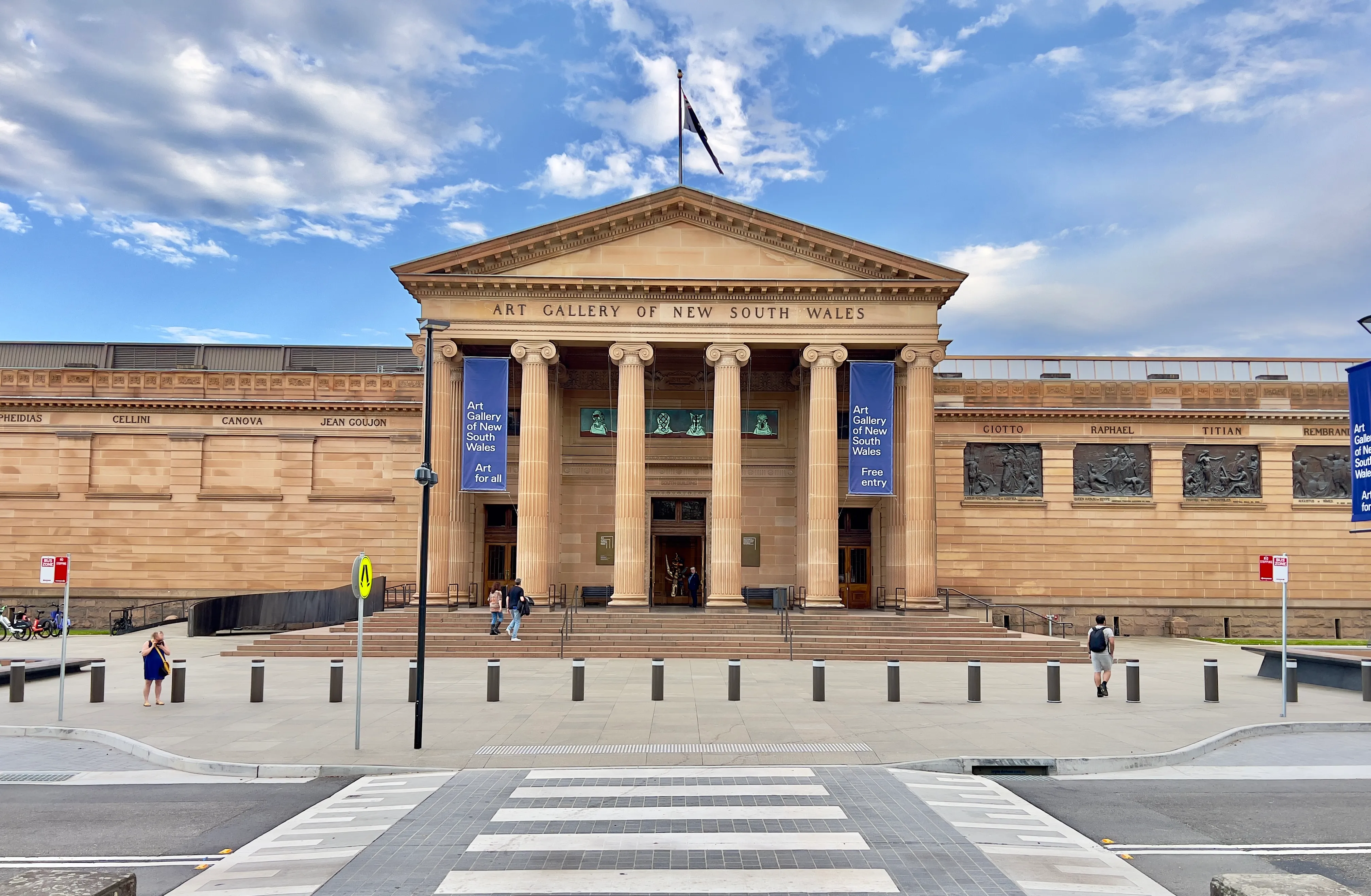
Walk through the original 19th-century entrance of the Art Gallery of New South Wales and you get neoclassical columns, colonial landscapes, and the kind of hushed reverence you expect from a 150-year-old institution. Then take the escalators down, cross through the landscaped art garden, and step into the Naala Badu building (the Sydney Modern expansion, opened 2022), where SANAA's glass-and-travertine pavilions cascade down the hillside toward Woolloomooloo Bay. The contrast is jarring in the best way possible. Few museums in the world pair old-world gravitas with contemporary architectural ambition this successfully.
The AGNSW holds over 30,000 works across Australian, Aboriginal, Asian, and European art. General admission is free, which makes it one of the most accessible major museums in the Asia-Pacific. But free does not mean lightweight. The gallery has been on a multi-year programming tear under director Maud Page, who took the helm and has pushed the institution toward a more globally connected, Asia-focused identity.
What to See If You Only Have Two Hours
Start in the original building's Australian galleries on the ground floor. The Heidelberg School works (Tom Roberts, Arthur Streeton) give you the foundation of Australian landscape painting, but the real draw is Sidney Nolan's Ned Kelly series. Nolan painted the outlaw bushranger in bold, simplified forms that turned a criminal into a national myth. If you have read any Australian literature or watched any Australian cinema, these paintings are the visual equivalent.
From there, head to the Aboriginal and Torres Strait Islander galleries in the Naala Badu building. This is where the AGNSW outperforms nearly every other museum in the country. The collection spans bark paintings from Arnhem Land, contemporary works by Emily Kame Kngwarreye and Rover Thomas, and ceremonial objects presented as living artistic traditions rather than ethnographic specimens. The dedicated gallery space in the new wing gives these works room to breathe that the old building never could.
If time permits, descend into the Nelson Packer Tank, a decommissioned WW2 naval oil tank buried beneath the new building that has been converted into a gallery for large-scale installations. The acoustics are strange, the atmosphere is subterranean, and the art installed here tends to be the most experimental in the entire museum. In late 2026, this space will host new commissions by Takashi Murakami as part of a major retrospective opening December 5, spanning 30 years and over 150 works across three gallery spaces.
The 2026 Program: Stronger Than Any Australian Museum This Year
The AGNSW's 2026 exhibition schedule is arguably the strongest of any Australian institution this year. Avatar: Forms of Vishnu (June 20 to October 5, 2026) brings together nearly 200 works spanning 1,500 years of South and Southeast Asian art, including a seventh-century sculpture of the horse-headed avatar Kalkin reunited with missing elements in 2024. New Delhi-based artist Sumakshi Singh contributed a large-scale woven installation inspired by the Sun Temple at Konark.
The Archibald, Wynne, and Sulman Prizes return in May 2026, with winners announced May 8 and works on display from May 9 to August 16. The Archibald Prize is Australia's most famous portraiture award and reliably generates national debate about what constitutes good art, good portraiture, and good taste. Love it or find it middlebrow, it is a cultural event that matters in Australia.
Looking ahead, Nolan: Origins (October 3, 2026 to February 7, 2027) surveys Sidney Nolan's formative years, from the Ned Kelly paintings to his epic portrayals of Central Australia. And the Takashi Murakami retrospective (December 5, 2026 to July 18, 2027) is a Sydney-exclusive blockbuster developed in collaboration with the artist, filling the Naala Badu building with paintings, sculptures, video, and large-scale installations.
In March 2026, the gallery's film program relaunches as Sydney Cinematheque, with weekly screenings, retrospectives, and live events in a dedicated cinema space.
How It Compares
Against other major Australian museums, the AGNSW sits comfortably ahead of the National Gallery of Victoria in Melbourne for depth of Aboriginal and Torres Strait Islander holdings, though the NGV's broader international collection gives it an edge in other areas. The Museum of New Zealand Te Papa Tongarewa takes a fundamentally different approach, integrating art with natural history and cultural narrative rather than presenting it as a standalone discipline.
Internationally, the AGNSW is closer in scale and ambition to the Art Gallery of Ontario in Toronto than to encyclopedic giants like the Metropolitan Museum of Art or the Louvre. Both the AGNSW and AGO are national-level museums with strong regional collections, ambitious contemporary programming, and recent architectural expansions that transformed their public identities.
Insider Tips
Wednesday is the best day to visit. The gallery stays open until 10 PM on Wednesdays as part of Art After Hours, with special programming, live music, and a noticeably calmer atmosphere than daytime weekends. The on-site restaurant and cafe also stay open late.
Do not skip the Brett Whiteley Studio. The AGNSW manages Whiteley's former studio in Surry Hills (2 Raper Street), which operates as a separate museum. It is a 15-minute walk from the main gallery and gives you a far more intimate sense of one of Australia's most distinctive painters than the gallery's holdings alone.
The Asian art collection is underrated. Most visitors rush through to get to the Australian and Aboriginal galleries, but the AGNSW holds one of the finest Asian art collections in the Southern Hemisphere, with particular strength in Japanese screens, Chinese ceramics, and Southeast Asian sculpture.
Eat at MOD Dining by Clayton Wells. The restaurant in the Naala Badu building is run by one of Sydney's most respected chefs and offers harbor views that rival any restaurant in the city. Book ahead.
Practical Information
Admission: Free for the permanent collection. Paid tickets required for major special exhibitions (Murakami, Avatar). Discounted 2-for-1 tickets available on Wednesday evenings for Art After Hours.
Hours: Daily 10 AM to 5 PM. Wednesdays 10 AM to 10 PM.
Getting there: The gallery is in The Domain, a 10-minute walk from Martin Place train station or a 15-minute walk from Circular Quay. The Sydney Opera House is a 20-minute walk along the harbor front.
Book tickets: artgallery.nsw.gov.au
Final Verdict: Who Is This Actually For?
Anyone visiting Sydney who wants to understand Australian visual identity. The Aboriginal and Torres Strait Islander galleries alone justify the visit, and the Sydney Modern expansion has given the institution a contemporary wing that can compete with any museum in the Asia-Pacific. If you are comparing Sydney's cultural offerings, the AGNSW is a stronger art destination than the Museum of Contemporary Art Australia across town, though the MCA has a better rooftop view. Skip it only if you have zero interest in art, and in that case, reconsider your priorities.