Proko: Stan Prokopenko Made Anatomy Fun, and That Is Why Everyone Buys This Course
Type "how to draw anatomy" into YouTube and the first results you will see are from Stan Prokopenko. His free figure drawing lessons have accumulated over 20 million views. The free content is genuinely useful. So why do people pay $150 for the premium version? Because the free videos are 5 hours of condensed instruction. The premium course is 15 hours, with extended demonstrations, critique videos, and downloadable resources. You are paying for three times the content plus the ability to watch offline.
Proko is not a subscription. It is a one-time purchase with lifetime access. You buy a course, you own it forever, including future updates. This is an increasingly rare model in online art education, and it is one of the reasons Proko has built such a loyal following.
What You Pay
Proko sells courses individually with one-time pricing and lifetime access:
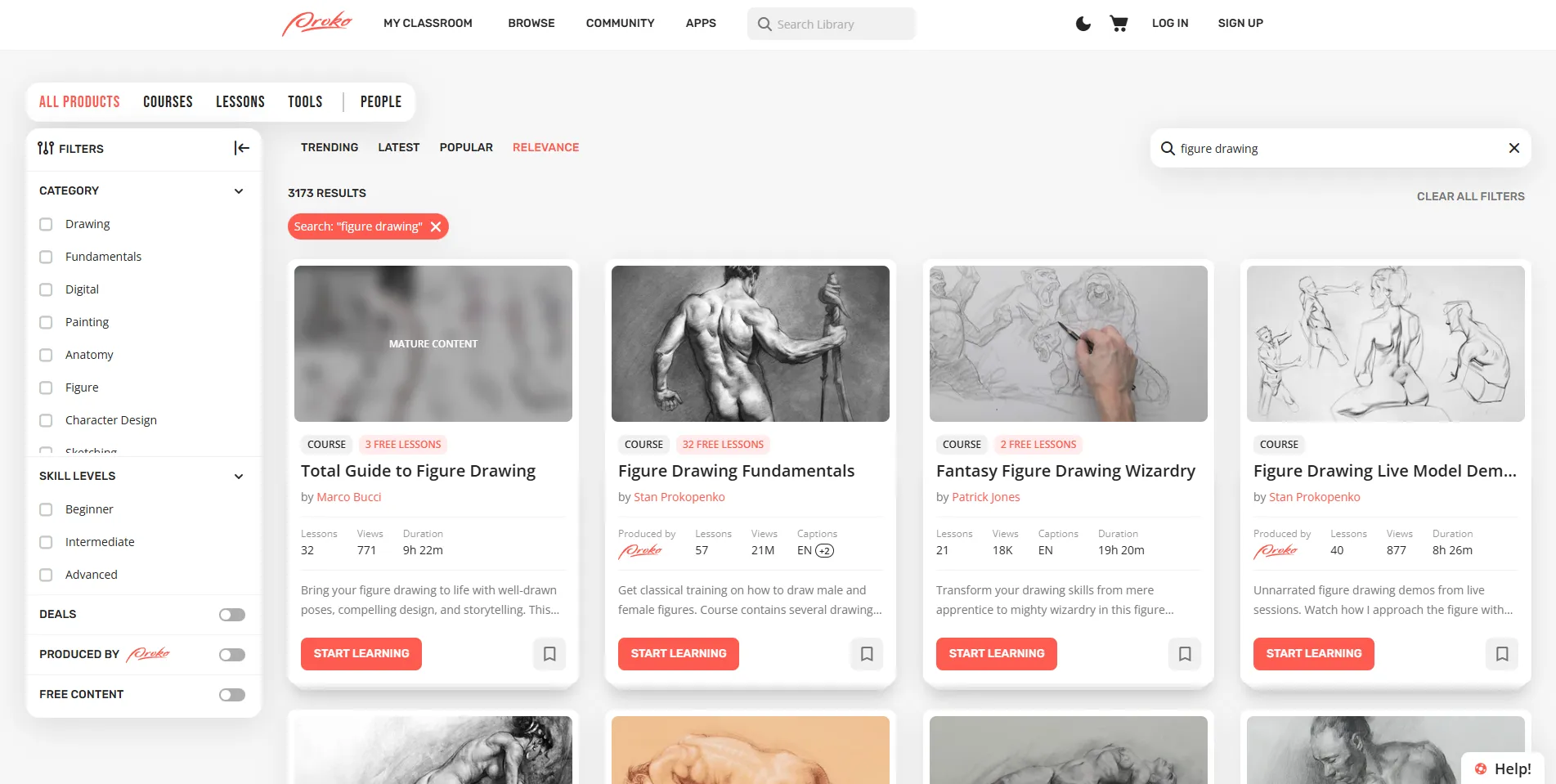
- Figure Drawing Fundamentals - $150 (57 lessons, 16h 44m, 32 free lessons available)
- Anatomy of the Human Body - $477 (371 lessons, 76h 59m, 115 free lessons available)
- Portrait Drawing Fundamentals - $150 (35 lessons, 8h+, 16 free lessons available)
- Drawing Basics - $150 (185 lessons, 82h 2m, 58 free lessons available)
- Introduction to Figure Construction by Michael Hampton - $125 (48 lessons, 5h+, 2 free lessons)
- Total Guide to Figure Drawing by Marco Bucci - $79 (32 lessons, 3 free lessons)
Bundle discounts: Each additional course in your cart adds 3% off, up to 15% off total. The Figure Drawing Bundle ($623.56, regularly $917) includes Figure Drawing Fundamentals, Reilly Figure Drawing (Watts Atelier), Anatomy of the Human Body, and How to Draw Fantasy Female Figures (Patrick Jones) across 450 lessons and 118 hours.
The Ultimate Proko Bundle includes 648 lessons across 4 courses for the full Proko curriculum by Stan Prokopenko.
Premium videos are downloadable as MP4 files at 720p. The free lessons on YouTube are a genuine subset of the premium content, not separate teaser material. If you watch the free lessons and want the extended versions, the premium course delivers exactly that.
Why Proko Works: Entertainment Meets Anatomy
Anatomy is the subject that intimidates more art students than any other. The human body has over 600 muscles and 200 bones, and understanding how they interact to create surface forms is genuinely complex. Most anatomy courses are dry, academic, and painful to sit through.
Stan Prokopenko's achievement is making anatomy instruction genuinely entertaining. He uses humor, mnemonic devices, visual analogies, and memorable demonstrations to make anatomical concepts stick. A lesson on the muscles of the back becomes a story about how the muscles interlock like fingers. A lesson on facial proportions becomes a memorable formula you can apply to any face.
This is not dumbing down. The content is technically rigorous. The entertainment serves the pedagogy: information that is enjoyable to learn is information that gets retained. Students consistently report that they remember Proko's anatomical explanations months after watching the lessons, which is more than can be said for most educational content.
The Course Structure: Inside-Out Anatomy
The Figure Drawing Fundamentals course is the starting point. It covers gesture drawing (capturing the movement and energy of a pose), the line of action, figure construction using simple geometric forms, proportional relationships, and shading. 57 lessons, 16 hours, with 32 available free on YouTube.
The Anatomy of the Human Body course is the deep dive. 371 lessons, 77 hours, covering every major region: torso, arms, legs, hands, feet, and head. Each region gets thorough treatment of skeletal structure, muscular anatomy, and surface form. This is anatomy for artists, not medical students. Stan focuses on the muscles that create visible surface forms, the bones that create palpable landmarks, and the mechanical relationships that determine how the body moves.
The anatomy course includes 3D model references that students can rotate and study from any angle, plus downloadable anatomy charts and reference sheets.
The Free-to-Premium Pipeline
Proko's free YouTube content is the best free art education available, period. The free lessons are not truncated teasers. They are complete, standalone lessons that teach real concepts. The premium versions are approximately 3x longer, with additional examples, extended demonstrations, and critique videos where Stan reviews student work.
This means you can try before you buy with zero risk. Watch the free gesture drawing lessons on YouTube. If Stan's teaching style works for you, the premium course gives you the full depth. If it does not, you have lost nothing.
The Instructor Ecosystem
Proko has expanded beyond Stan Prokopenko's own courses to host instruction from other artists. Michael Hampton (author of Figure Drawing: Design and Invention) teaches Introduction to Figure Construction. Marco Bucci teaches the Total Guide to Figure Drawing. Watts Atelier contributes Reilly Figure Drawing. Patrick Jones teaches How to Draw Fantasy Female Figures.
This transforms Proko from a single-instructor platform into a curated figure drawing library. The bundle pricing makes it cost-effective to buy multiple courses together.
How Proko Compares
Against New Masters Academy at $49/month, Proko is a one-time purchase with lifetime access. NMA gives you multiple instructors including Glenn Vilppu for as long as you subscribe. Proko gives you Stan's courses permanently. If you only want figure drawing and anatomy, Proko is more cost-effective over time. If you want breadth across traditional art disciplines, NMA wins.
Against Drawabox, which is free and focuses on construction drawing, Proko covers figure drawing and anatomy specifically. Drawabox teaches you to construct forms in space. Proko teaches you to construct the human form specifically. They complement each other well.
Against Marco Bucci, who teaches painting and color theory, Proko focuses on drawing and anatomy. Bucci teaches you to paint. Proko teaches you to draw the figure. Together they cover the full pipeline from drawing to painting.
What Is Missing
The courses are primarily video-based with assignments, but there is no structured feedback system included with the premium purchase. Critique videos in the premium content show Stan reviewing other students' work, which is valuable for learning by observation, but you do not get personal critique on your own assignments unless you participate in the community forums and receive peer feedback.
The Anatomy course at $477 is a significant investment. It is the most expensive single course in the Proko catalogue. For artists who only need figure drawing fundamentals, the $150 Figure Drawing course is sufficient. The Anatomy course is for artists who need professional-level anatomical knowledge.
Final Verdict: Who Is This Actually For?
Proko is for any artist who wants to draw the human figure convincingly. It is for beginners who need a structured, accessible introduction to figure drawing. It is for intermediate artists who need to fill gaps in their anatomical knowledge. And it is for advanced artists who want the systematic, inside-out understanding of anatomy that enables drawing from imagination.
It is not for artists looking for painting instruction (look at Marco Bucci instead). It is not for anyone who needs personalized feedback on every assignment. And it is not for artists on a tight budget who cannot afford $150, though the free YouTube lessons cover a substantial amount of the same material.
Start with the free YouTube lessons. Watch the gesture drawing series. If Stan's teaching style clicks for you, buy Figure Drawing Fundamentals at $150. If you want to go deeper into anatomy, add the Anatomy of the Human Body course. If you want the full curriculum, consider the Ultimate Proko Bundle for the best per-course value.