Gurney Journey: Nineteen Years of a Master Painter Thinking Out Loud
In February 2026, James Gurney published a Substack post about painting in the rain in Bennington, Vermont. He described how light rain and full humidity create the perfect conditions for a "milky-broth technique" that unifies a scene through misty, soft-edged colour. He was painting in gouache over a casein priming. This is a man who goes outside in a wet sponge of weather and sees it as a painting opportunity, not a problem.
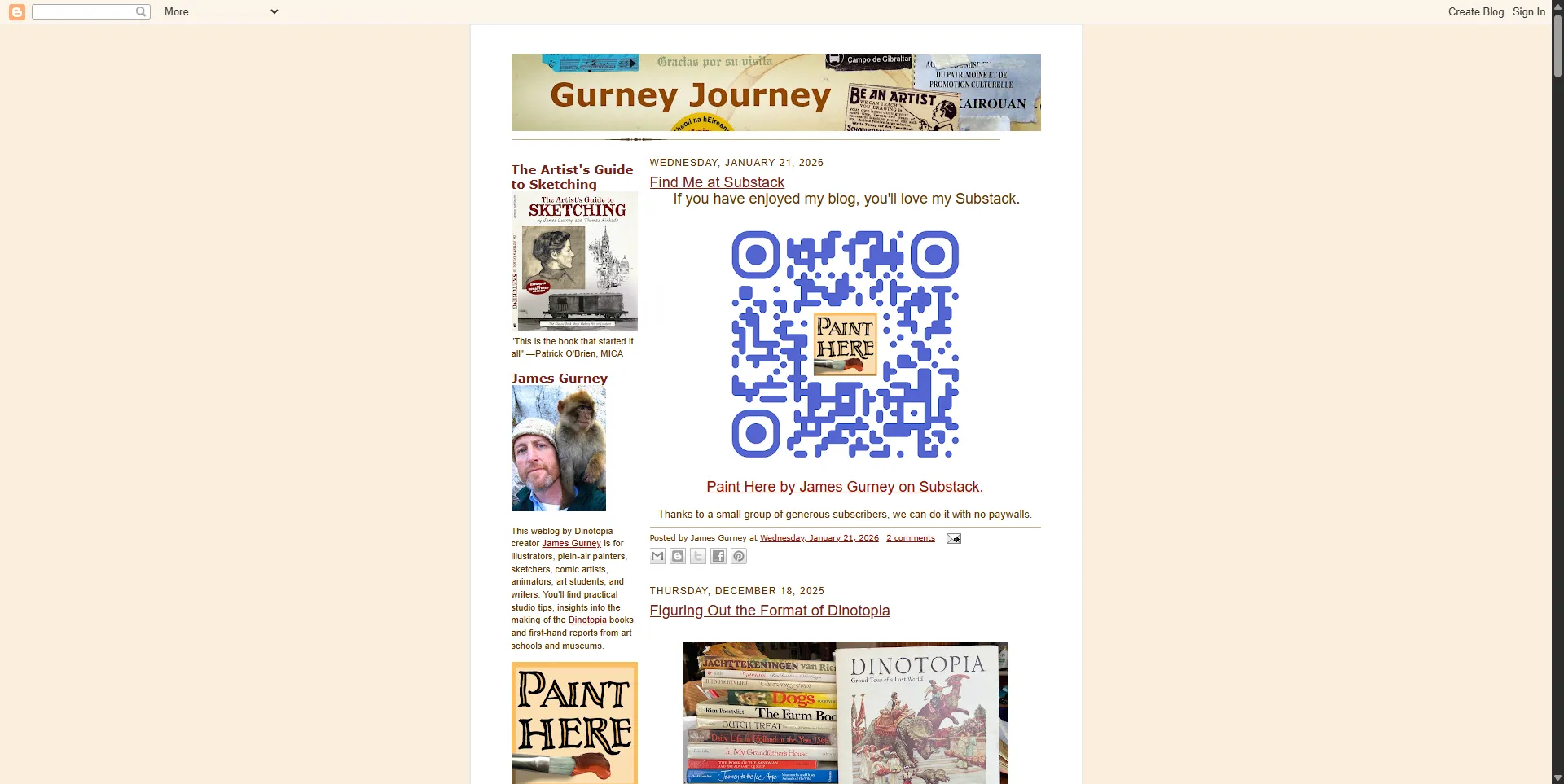
Gurney Journey has been publishing daily or near-daily since 2007. That is 19 years of posts covering plein air painting, colour science, art history, visual perception, and the creative process, written by a painter who is genuinely obsessed with understanding how visual phenomena work. The blog is hosted on Blogspot, which means it looks like it was designed in 2007, because it was. This is part of its charm.
Who Is James Gurney?
To the general public, Gurney is the creator of Dinotopia, the illustrated book series depicting a world where humans and dinosaurs coexist. The paintings in those books are extraordinary achievements in imaginative realism, built with the same observational rigour that Gurney applies to plein air landscapes. In a December 2025 blog post, he described how he first mocked up Dinotopia as a "Grand Tour of a Lost World," inspired by the lavishly illustrated books of Dutch artist Rien Poortvliet.
To the art education community, Gurney is the author of "Color and Light: A Guide for the Realist Painter" and "Imaginative Realism: How to Paint What Doesn't Exist". These two books have become standard references in art schools worldwide. "Color and Light" in particular is the single most recommended book on painting technique for representational painters. If you walk into any serious atelier or art school library, you will find a well-worn copy.
Gurney Journey brings together both identities: the working painter who goes outside every day to paint from observation, and the intellectually curious thinker who investigates the science, history, and theory behind what he sees.
The Scientific Approach to Painting
The defining characteristic of Gurney Journey is its scientific approach to visual phenomena. Gurney does not simply describe how things look. He investigates why they look that way, drawing on physics, biology, psychology, and art history.
Posts have covered the physics of light scattering in the atmosphere and its effect on sky colour, the biology of colour perception and how the human visual system processes colour information, the optics of reflected light and how it affects shadow colour, the mathematics of perspective in specific painting situations, and the chemistry of pigments and how it affects paint behaviour.
This scientific depth is not academic abstraction. Every investigation connects to practical painting decisions. Understanding why the sky is blue and how the colour changes toward the horizon helps painters mix more accurate sky colours. Understanding how reflected light works helps painters paint convincing shadows. Understanding the biology of colour perception helps painters understand why certain colour combinations create specific visual effects.
Insider tip: Use the blog's search function to find posts on specific topics. Searching "reflected light" returns dozens of posts with practical demonstrations. Searching "gouache" returns Gurney's extensive experiments with gouache over casein priming, a technique he has been refining and documenting in 2025 and 2026. The archive is a searchable reference library, not just a chronological feed.
Plein Air Painting Documentation
Gurney is one of the most accomplished plein air painters working today, and the blog documents his outdoor painting practice in exceptional detail. Posts regularly include photographs of the painting setup, the subject, and the finished painting, along with commentary on the specific challenges of each session.
He does not present an idealised version of outdoor painting. He documents real conditions: difficult light, weather changes, time pressure, and the practical challenges of working outdoors. A July 2025 post showed him painting a stranded sailboat in gouache over casein priming. A February 2026 post showed him painting in rain in Vermont. The message is consistent: go outside, paint what you see, and figure out how to handle whatever conditions you encounter.
Art History and Museum Analysis
The art history content approaches historical paintings as practical resources, not cultural monuments. Gurney's analysis of a Rembrandt portrait or a Sargent watercolour focuses on what the painter did and how, providing insights that are directly applicable to contemporary painting practice.
Museum visits are documented with the same analytical approach. Posts cover exhibitions and collections at major museums worldwide, often including observations about specific works that would not be apparent to a less experienced viewer. For readers who cannot visit these museums in person, Gurney's trained eye and extensive knowledge provide a guided tour that is worth more than most audio guides.
The Substack Expansion
In 2025 and 2026, Gurney expanded his online presence with a Substack newsletter called "Paint Here." The Substack complements the blog with longer-form posts, Q&A sessions, and interactive content. A February 2026 Q&A post answered the question "Why do you sketch?" with the response: "I sketch in order to see." He described how he and his college roommate Thomas Kinkade dropped out of school, hopped on a freight train, and set out to discover America with their sketchbooks.
The Substack is where Gurney is most active in 2026, while the Blogspot archive remains the deeper, searchable resource.
How It Compares
Against Painting Perceptions, which focuses on contemporary realist painters through interviews, Gurney Journey is more personal and more technically focused. Painting Perceptions gives you other painters' perspectives. Gurney Journey gives you one master painter's daily thinking.
Against Lines and Colors, which covers illustration, concept art, and fine art through curation and discovery, Gurney Journey is narrower in scope but deeper in technical analysis. Charley Parker shows you what great art looks like. James Gurney shows you how to understand why it works.
Against YouTube art instruction channels, Gurney's own YouTube channel provides video documentation of his plein air sessions, but the blog adds the written analysis and historical context that video cannot convey. The two together form one of the most comprehensive free art education resources from a single working artist.
The Limitations
The blog is on Blogspot. The design is dated. There is no modern content management system, no clean tagging system, no mobile-optimised reading experience. If you are used to Medium or Substack, the Gurney Journey interface will feel like visiting a museum exhibit from 2007.
The scope is also specific. Gurney writes about representational painting, plein air, imaginative realism, and the science of visual perception. If you are an abstract painter, a digital artist, or someone looking for content about contemporary art theory, Gurney Journey will not address your interests directly.
Who Should Read Gurney Journey?
Representational painters working in oils, watercolour, gouache, or casein will find the most directly applicable content. Gurney's technique discussions are grounded in traditional media and observational painting.
Illustrators and concept artists benefit from Gurney's imaginative realism expertise. The Dinotopia posts and his discussions of how to paint things that do not exist are directly relevant to fantasy and science fiction illustration.
Art students and self-taught painters get access to the thinking of a master painter for free. The archive is a 19-year course in painting, colour science, and art history, delivered in daily bite-sized posts.
Abstract and digital artists will find less directly applicable content, though the colour science posts are universally relevant to anyone working with colour.
Final Verdict: Who Is This Actually For?
Gurney Journey is the best free art education resource on the internet, if you are a representational painter. It is not the most modern, the most polished, or the most broadly scoped. It is one person's daily intellectual engagement with painting, accumulated over 19 years, and it is worth more than most paid art courses. Start with the search function, find posts on the topics you care about, and prepare to lose an afternoon.
Visit gurneyjourney.blogspot.com to explore the archive, and check out his Substack for newer content. For related resources, see our profiles on Painting Perceptions, Lines and Colors, and Muddy Colors.