The Art of Aaron Blaise: Disney Animation Credentials Applied to Wildlife Art
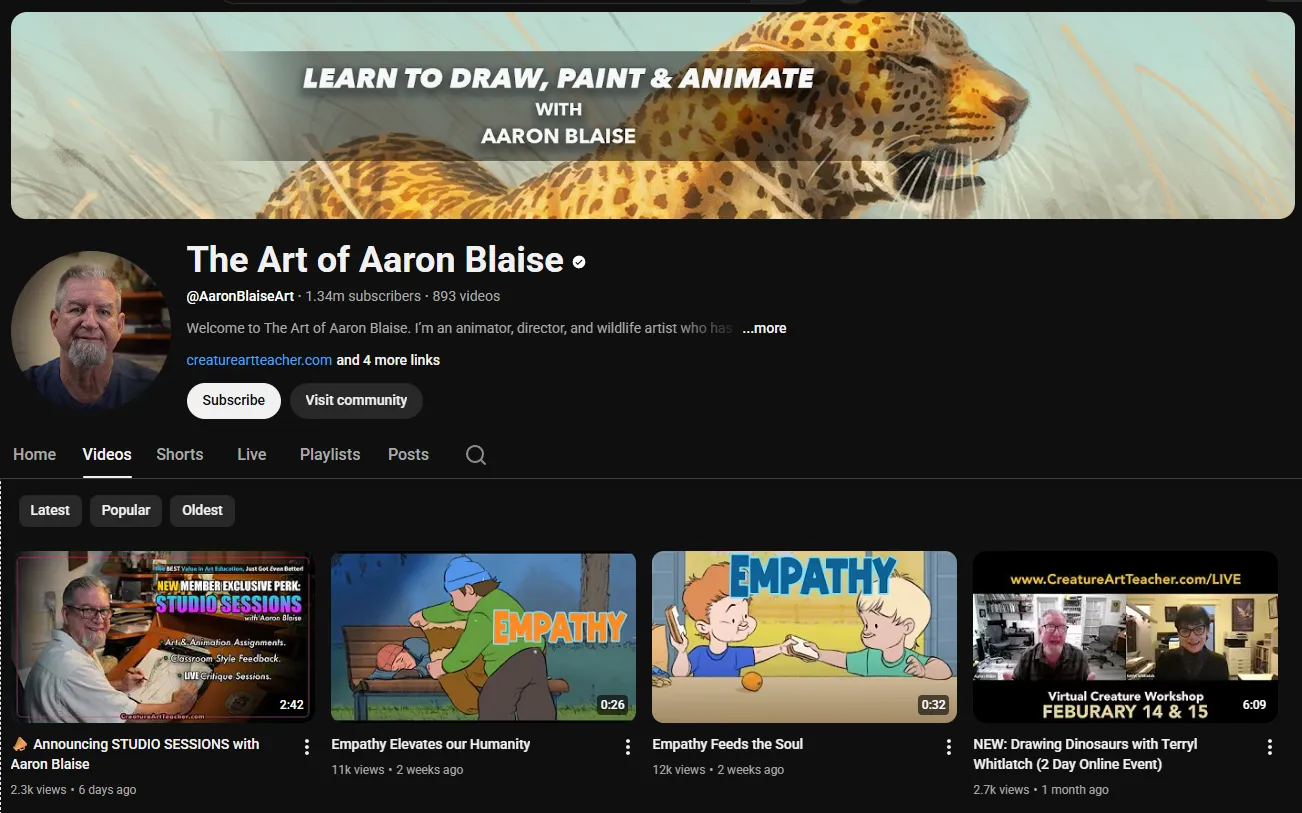
Aaron Blaise spent 21 years at Walt Disney Animation Studios. He animated on The Rescuers Down Under, Beauty and the Beast, Aladdin, The Lion King, Pocahontas, and Mulan. He co-directed Brother Bear, which earned an Academy Award nomination for Best Animated Feature. That career gives his YouTube channel a level of authority that no other art educator on the platform can claim. When Aaron Blaise explains how to design a character that feels alive, he is explaining it from the perspective of someone who drew Mufasa and Nala for a living.
His channel, started in 2012, has grown to 1.36 million subscribers and 56 million views across 940-plus videos. The content covers wildlife painting, character design, creature design, animation principles, and both digital and traditional painting techniques. His website, CreatureArtTeacher.com, offers structured paid courses that go deeper than the free YouTube content.
Wildlife Painting: The Signature Subject
Wildlife painting is where Aaron's personal passion and professional expertise converge. He has spent decades studying and painting animals, and his understanding of animal anatomy, movement, and behavior is thorough enough that his tutorials function as both art instruction and biology lessons. When he paints a bear, he explains how the scapula moves under the fur, how weight shifts during walking versus running, and how muscle groups create the surface forms visible in the final painting.
This is not surface-level instruction. Aaron's wildlife tutorials cover skeletal structure, muscle anatomy, fur rendering techniques, and the behavioral knowledge that makes animal paintings feel alive rather than static. His subjects range across big cats, bears, wolves, birds, and other wildlife, with each tutorial demonstrating both the painting technique and the anatomical understanding that makes the painting convincing.
For artists interested in wildlife art specifically, there is no better free resource on YouTube. For artists interested in creature design for games and film, the anatomical foundation Aaron teaches is directly applicable to designing fictional creatures that feel biologically plausible.
Character Design and Animation Principles
The character design content draws directly from Aaron's Disney experience. He covers the twelve principles of animation developed by Frank Thomas and Ollie Johnston, which remain the foundation of character animation in both traditional and digital media. His explanations come from having applied these principles on professional productions, not from having read about them in a book.
Creature design is another area of strength. Aaron's approach uses real animal anatomy as the foundation for fictional creatures, which produces designs that feel like they could exist. This is the same methodology used in professional visual effects and game design studios, and it distinguishes his creature design content from the more decorative, fantasy-oriented creature design tutorials common on YouTube.
Digital and Traditional Painting
Aaron works in both digital and traditional media. His primary digital tool is Photoshop, and his traditional work uses watercolour and gouache. The digital painting tutorials demonstrate professional-level techniques from initial sketch through value studies to final colour rendering, with detailed commentary on decision-making at each stage.
The traditional painting content is particularly valuable because watching a Disney-trained animator apply traditional painting techniques to wildlife subjects is genuinely instructive. His watercolour and gouache work reflects decades of practice, and his explanations are specific enough to apply immediately.
The Online School at CreatureArtTeacher.com
Beyond YouTube, Aaron operates CreatureArtTeacher.com, offering structured courses in wildlife painting, character design, creature design, and animation. The courses provide defined modules, practice assignments, and cumulative skill building that individual YouTube videos cannot match.
The school has become one of the most respected sources of professional-level art education in the animation and illustration industries. Students who have gone on to careers at major studios have cited Aaron's courses as significant in their development. The courses are not inexpensive, but they deliver the kind of instruction that was previously accessible only to people working inside major animation studios.
How Aaron Blaise Compares to Other Art Education Channels
Aaron occupies a specific niche that no other YouTube channel fills. Proko teaches human anatomy and figure drawing. Sinix Design teaches visual appeal and design thinking. Aaron teaches animal anatomy, wildlife painting, and the animation principles that Disney developed over decades of feature film production.
For character animation specifically, no other free YouTube resource matches Aaron's credentials. Trent Kaniuga covers concept art from a game development perspective, but his content is focused on illustration and design rather than animation principles. For environment art, Tyler Edlin is the better resource.
The Disney legacy is not just a credential. It is the source of the knowledge Aaron teaches. The principles of character design, animation, and visual storytelling refined at Disney over decades represent some of the most sophisticated thinking about visual communication ever developed, and Aaron's direct experience applying these principles gives his teaching a depth that educators without comparable experience cannot replicate.
Who Should Watch
Wildlife artists at intermediate and advanced levels will find Aaron's channel the best free resource available for animal anatomy, painting technique, and the behavioral knowledge that makes wildlife art convincing.
Character designers and animators benefit from the animation principles content, which comes from direct experience applying them on Disney productions. If you want to understand appeal, silhouette, and expression from someone who designed characters for films that defined a generation of animation, this is the channel.
Creature designers for games, film, and illustration get a methodology grounded in real anatomy, which produces creatures that feel biologically plausible rather than purely decorative.
Artists who want to understand the Disney approach to visual storytelling and character design get direct access to knowledge that was previously available only inside the studio.
Who Should Skip It
Beginners who are still learning basic drawing fundamentals will find much of the content assumes a baseline of drawing ability. Start with Proko for figure drawing fundamentals before moving to Aaron's more specialized content.
Abstract and conceptual artists will find little directly applicable content. Aaron's teaching is rooted in representational art, anatomical accuracy, and classical animation principles.
Digital-only artists who have no interest in traditional media or animation will find some content relevant, but the channel's unique value is in the areas where Aaron's Disney experience and wildlife expertise converge. If you only want digital painting technique, Ctrl Paint is more focused.
Insider Tips
- Start with his animal anatomy videos before attempting the full painting tutorials. Understanding the skeletal and muscular structure makes the painting demonstrations far more useful.
- The CreatureArtTeacher.com courses are worth the investment if you are serious about wildlife art or creature design. The free YouTube content is substantial, but the paid courses provide the structure and feedback that self-directed learning lacks.
- Aaron's hand-drawn short film Snow Bear is available on YouTube and demonstrates the animation and painting techniques he teaches in action. Watch it to understand the level his instruction is aimed at.
- His Patreon offers additional content and process videos. If the YouTube content resonates with you, the Patreon provides more of the same at greater depth.
Final Verdict: Who Is This Actually For?
Aaron Blaise offers something that no other YouTube art educator can: professional-level instruction in wildlife painting, creature design, and animation from someone who spent two decades at the highest level of the Disney animation studio. For artists who want to develop skills in these specific areas with the guidance of someone who has applied them professionally, Aaron's channel and his courses at CreatureArtTeacher.com are among the most valuable resources available anywhere. For general art education, you need to supplement with other channels. For wildlife, creature design, and Disney-quality character animation principles, this is the only place to start.
Start with his wildlife painting playlist and check out CreatureArtTeacher.com for structured courses if the free content leaves you wanting more.