Alphonso Dunn: The Only Pen and Ink Teacher You Need on YouTube
Ink is unforgiving. One wrong mark and the drawing is ruined, with no eraser to save you. That permanence scares most artists away from the medium entirely. Alphonso Dunn built a YouTube channel around the opposite proposition: ink is not scary if you understand what you are doing, and understanding comes from systematic, methodical practice guided by someone who knows the medium inside out.
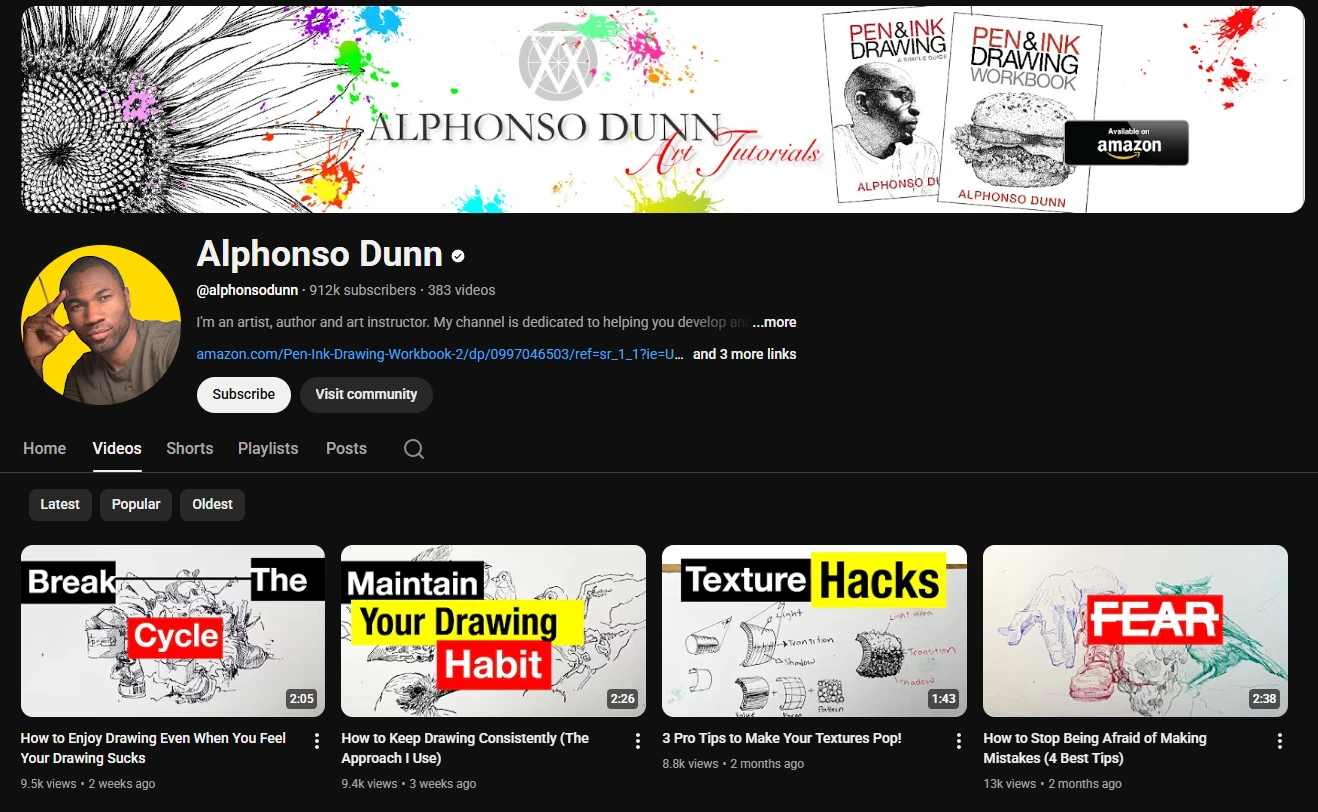
Based in New Jersey, Alphonso has accumulated 917,000 subscribers and 56 million views since launching his channel in 2012. His background as an anatomy instructor at Bergen and Passaic community colleges gives his teaching an academic rigor that most YouTube art channels lack. He is not a hobbyist sharing tips. He is a trained educator who happens to use YouTube as his classroom, and the difference shows in every video.
The Teaching Method: Building Blocks, Not Magic
Alphonso breaks pen and ink drawing into its fundamental components: hatching, cross-hatching, stippling, contour lines, and scribbling. Each technique gets its own dedicated treatment, not just a quick demonstration but a full explanation of when, where, and why you would use it. This systematic approach gives students a vocabulary of marks they can deploy intentionally rather than relying on instinct.
His texture studies are where the channel shines. He demonstrates how to render wood grain, fabric folds, metal surfaces, water, stone, hair, and dozens of other textures using nothing but ink lines. These studies teach you to observe the visual characteristics of a surface and translate them into specific marks, which is the skill that separates competent ink drawing from flat line work.
Every technique is demonstrated in the context of complete drawings, showing how individual marks combine to create finished artwork with depth and atmosphere. This matters because watching someone hatch in isolation teaches you nothing about how to use hatching in a real piece.
The Books: A Curriculum That Rivals Art School
Alphonso's bestselling book, Pen and Ink Drawing: A Simple Guide, has become one of the most widely recommended drawing instruction books of the past decade. It organizes the principles from his YouTube channel into a structured, progressive curriculum that takes readers from absolute fundamentals through advanced techniques.
A follow-up volume, the Pen and Ink Drawing Workbook, provides additional practice exercises and challenges that reinforce the principles from the first book. Together, the two volumes create a complete pen and ink education that complements the YouTube channel while standing on its own as a self-study resource. The books have been adopted by art schools, used in community education programs, and recommended by professional illustrators as essential references.
The publication of these books through traditional channels also validates what the YouTube channel demonstrates: Alphonso's teaching is not just popular. It is recognized by the educational and publishing establishment as genuinely authoritative.
The Anatomy Background
Alphonso's training as an anatomy instructor gives his figure drawing and natural form content a scientific precision that purely artistic instruction often lacks. When he draws a hand, the pen strokes follow the actual underlying bone and tendon structures. The result is forms that feel anatomically convincing even in highly stylized illustrations.
This anatomical knowledge also informs his teaching of observation and analysis, the cognitive skills that determine drawing quality more than any technical trick. He teaches students to look at subjects analytically, identifying the structural principles that determine how surfaces curve, how shadows form, and how textures repeat. This analytical approach transfers to every drawing medium, making his channel valuable even for artists who never pick up a pen.
Composition and Storytelling in Ink
Beyond technique, Alphonso addresses how to organize marks within a frame to create visual hierarchy. He covers how to use contrast and detail density to direct the viewer's eye, and how the unique qualities of ink (its permanence, its graphic boldness, its capacity for both delicacy and power) can create emotionally resonant imagery. These higher-level lessons transform ink drawing from a technical exercise into an expressive art form.
How He Compares to Other Ink Educators
There is virtually no direct competitor to Alphonso on YouTube when it comes to pen and ink instruction. Proko covers figure drawing and anatomy with similar academic rigor but focuses on pencil and digital media. Will Kemp Art School covers painting fundamentals but not ink specifically. The closest parallel might be Bob Ross in terms of teaching philosophy: both break a potentially intimidating medium into approachable, systematic steps that build real skill rather than just producing a single impressive demo.
The difference is that Alphonso's medium is less forgiving and his teaching is more academically structured. Where Bob Ross makes painting feel effortless through the wet-on-wet technique, Alphonso makes ink feel manageable through understanding and deliberate practice.
Who Benefits Most
Beginners who have never drawn with ink will find Alphonso's systematic progression ideal for building confidence. His foundational videos establish the basic vocabulary of ink marks before building toward complex applications, ensuring students develop solid habits from the start.
Intermediate artists who draw competently with pencil but struggle with ink will discover that his technique-focused approach addresses the specific challenges that make ink different from erasable media: the need for confident mark-making, the planning required by permanence, and tonal control through mark density rather than pressure variation.
Professional illustrators and comic artists who already work in ink will find advanced technique demonstrations, texture studies, and compositional strategies that refine and expand their existing capabilities. Even experienced ink artists regularly report gaining new understanding from his methodical approach.
Insider Tips
- Start with his earliest videos. Alphonso's channel is organized as a curriculum, not a content feed. The foundational videos on basic mark-making are prerequisites for the more advanced content, even if they look simple.
- Buy the book. The YouTube channel is excellent, but the book provides the structured, sequential progression that videos alone cannot deliver. Many viewers find that combining the two creates a more complete learning experience than either resource alone.
- His anatomy content is valuable even if you never touch a pen. The observational skills he teaches transfer directly to figure drawing courses and any representational art practice.
Final Verdict: Who Is This Actually For?
If you want to learn pen and ink drawing, Alphonso Dunn is not one of several options. He is the option. The combination of academic training, methodical teaching, bestselling instructional books, and a video library built over more than a decade creates a resource that has no real equivalent on YouTube. For artists working in other media, his lessons on observation, texture, and composition still apply.
Head to his YouTube channel to start with the basic mark-making videos, and consider picking up Pen and Ink Drawing: A Simple Guide if you want the full curriculum. For artists interested in broader drawing fundamentals, pair his content with Proko's figure drawing course or Ctrl+Paint's digital painting curriculum.