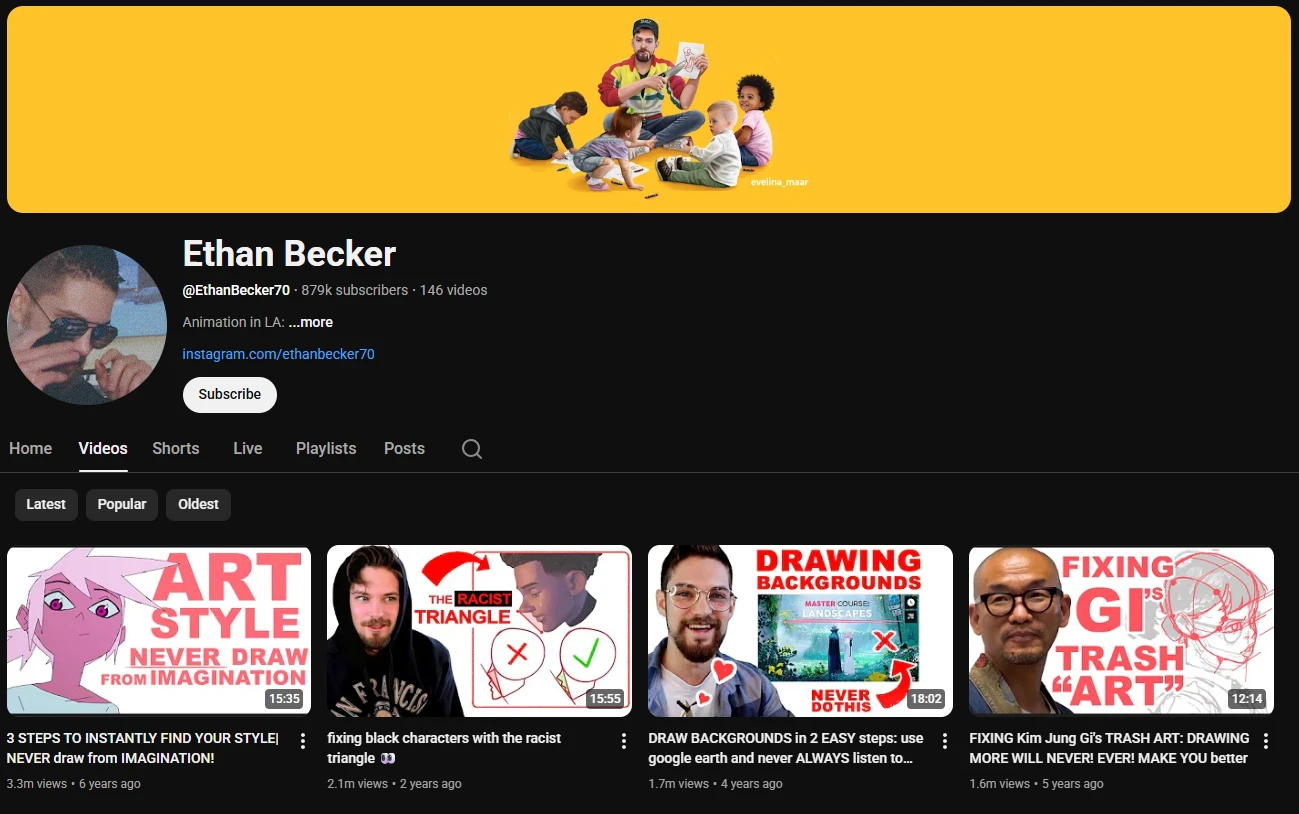
Ethan Becker: The Storyboard Artist Who Tells You the Truth About the Industry
Ethan Becker lived in his car in Los Angeles until he got a job at DreamWorks. That is not a marketing bio. That is what actually happened. He moved from Texas to California with no industry connections, slept in his vehicle, and eventually landed a position as a visual development revisionist on Voltron: Legendary Defender at DreamWorks TV. From there he built a career as a storyboard artist on Netflix's Dota: Dragon's Blood, Warner Bros' Batman: The Long Halloween, Netflix's Trese, and AMC's Pantheon, where he served as storyboard supervisor.
That resume matters because it gives his YouTube channel a credibility that most art education channels cannot claim. When Ethan tells you what art directors look for in portfolios, he is speaking from the hiring side of the desk. When he critiques your gesture drawing, he is evaluating it against the standards that actually apply in production. And when he says something is not good enough, he means it is not good enough for the industry he works in, not that it is bad in some abstract aesthetic sense.
The Content: What the Industry Actually Requires
Ethan's channel covers three main areas, all oriented toward a single goal: helping artists build the skills that entertainment studios actually hire for.
Gesture drawing and anatomy for animation is the technical core. His gesture drawing tutorials are not about drawing the figure accurately. They are about understanding how the body moves, how poses communicate emotion and intent, and how anatomical knowledge enables you to draw dynamic figures from imagination. This is the specific skill set that storyboard artists and character animators need, and it is different from the figure drawing skills taught by channels like Proko, which focus more on observational accuracy than on the expressive exaggeration that animation requires.
Portfolio critiques are among the most valuable content on the channel. Ethan reviews student and aspiring professional portfolios, providing specific, detailed feedback on what works, what does not, and what needs to change for professional-level competitiveness. These critiques are publicly available, which means you learn not just from your own feedback but from watching him evaluate dozens of other artists' work. The cumulative effect is a genuine education in what professional standards look like and how to assess your own work against them.
Career advice covers the practical realities of building an entertainment art career: whether art school is worth the cost, which skills to prioritize, how to network without being obnoxious, what a competitive portfolio looks like, and how to transition from student to professional. This advice comes from someone who made that transition himself through sheer persistence, not from someone who read about it in a career guide.
The Teaching Style: High Energy, No Apologies
Ethan's presentation style is high-energy, fast-paced, and deliberately provocative. He uses humor, hyperbole, and occasional profanity to make points memorable. His videos move quickly, pack dense information into short formats, and do not waste time on pleasantries. This approach can be jarring if you are accustomed to the gentle, encouraging tone of channels like Angela Anderson or Art with Flo. It is not jarring if you understand the audience: aspiring entertainment artists who need to hear hard truths about the gap between student work and professional standards.
Beneath the energetic delivery, the content is rigorously substantive. His gesture drawing demonstrations show genuine mastery of dynamic figure construction. His anatomy breakdowns reveal the structural understanding that separates professional-level character drawing from amateur work. The entertainment packaging serves the educational content rather than replacing it.
The "Do This, Not That" Format
One of Ethan's most effective content formats directly compares common amateur mistakes with professional solutions. He shows the specific drawing habits, conceptual misunderstandings, and workflow inefficiencies that hold artists back, then demonstrates the corrections that lead to professional-quality work. This before-and-after format makes improvement tangible and specific, giving viewers concrete actions to take rather than vague encouragement to "practice more."
These comparison videos address the specific gap between amateur and professional work that many artists struggle to identify on their own. When you know your work is not professional quality but cannot pinpoint why, Ethan's direct identification of specific problems and specific solutions provides the clarity needed for targeted improvement.
How He Compares to Other Entertainment Art Educators
Ethan is not the only professional artist sharing industry knowledge on YouTube, but his combination of storyboard credits, high-energy delivery, and willingness to be brutally honest creates a unique offering. Bobby Chiu covers concept art and creature design with a more measured, inspirational tone and a broader educational ecosystem through Schoolism. Marc Brunet offers more structured, art-school-style education with a similar professional background. Trent Kaniuga covers concept art with a more entertainment-industry focus.
The key difference is Ethan's focus on the animation pipeline specifically. Bobby Chiu teaches you how to design creatures. Marc Brunet teaches you how to paint. Ethan Becker teaches you how to draw figures that move, emote, and tell stories, which is the specific skill set that storyboard artists and animators need. If your goal is concept art or illustration, other channels may serve you better. If your goal is animation, games, or storyboard work, Ethan's content is more directly relevant.
The Origin Story and Why It Matters
Ethan was raised by his grandparents in Texas, who instilled in him a strong work ethic. He attended a high school arts program, won a scholarship to a community college, and later studied briefly at the Concept Design Academy in Pasadena. He credits artist Feng Zhu as a major influence. He moved to California with no industry connections and lived in his car until he landed the DreamWorks position.
This origin story is not just inspirational. It informs his teaching. He knows what it is like to have no money, no connections, and no formal art school degree, and he knows exactly how hard it is to break into the industry from that position. His advice is specifically calibrated for artists in similar situations: people without access to expensive education or professional networks who need to build professional-level skills on their own.
Who Should Watch
Aspiring animation and storyboard artists are the primary audience. If you want to work in TV animation, feature animation, or game cinematics, Ethan's content is directly aligned with the skills you need.
Artists who want honest critique rather than encouragement. If you are tired of hearing "that looks great!" from friends and online communities and want someone to tell you exactly what is wrong with your work and how to fix it, this is the channel for you.
Artists considering art school should watch his career advice videos before spending money on tuition. He has publicly discussed the gap between what art schools teach and what the entertainment industry actually requires, and his perspective is worth hearing before making a financial commitment.
The Honest Limitations
Ethan's channel is not for everyone. The high-energy, profanity-laced delivery will alienate some viewers, particularly older artists or those who prefer a more measured instructional tone. The content assumes a baseline of drawing skill. Complete beginners will struggle to follow the gesture drawing and anatomy content without first building fundamental drawing skills through channels like Ctrl+Paint or Alphonso Dunn.
The channel also publishes relatively infrequently, and the content is more curated than systematic. If you need a structured, start-to-finish curriculum, you are better served by Schoolism or Ctrl+Paint. Ethan's channel is best used as a supplement to structured learning, providing industry context and honest critique that formal curricula cannot offer.
Insider Tips
- Watch his portfolio critique videos even if the portfolio being reviewed is not yours. The feedback he gives to other artists reveals patterns and common mistakes that almost certainly apply to your own work.
- His IMDb page lists his full animation credits. Reviewing the shows he has worked on gives you context for the standards he applies in his critiques.
- His Playgrounds Festival appearance and other industry talks are worth seeking out for longer-form discussions of his career and approach.
- He credits Feng Zhu as a major influence. If you enjoy Ethan's approach to industry-focused art education, Feng Zhu's FZD School content covers similar territory from a concept art perspective.
Final Verdict: Who Is This Actually For?
Ethan Becker's channel is for artists who are serious about working in animation or entertainment art and want to know exactly what that requires. If you need gentle encouragement, look elsewhere. If you want someone to tell you the truth about your work and the industry you are trying to enter, this is the channel. His professional credits, high-energy delivery, and willingness to be brutally honest make him one of the most valuable voices on YouTube for aspiring entertainment artists.
Start with his YouTube channel and watch a portfolio critique video to calibrate your expectations. For complementary education, see Bobby Chiu for concept art and creature design, Ctrl+Paint for digital painting fundamentals, and Proko for figure drawing and anatomy.