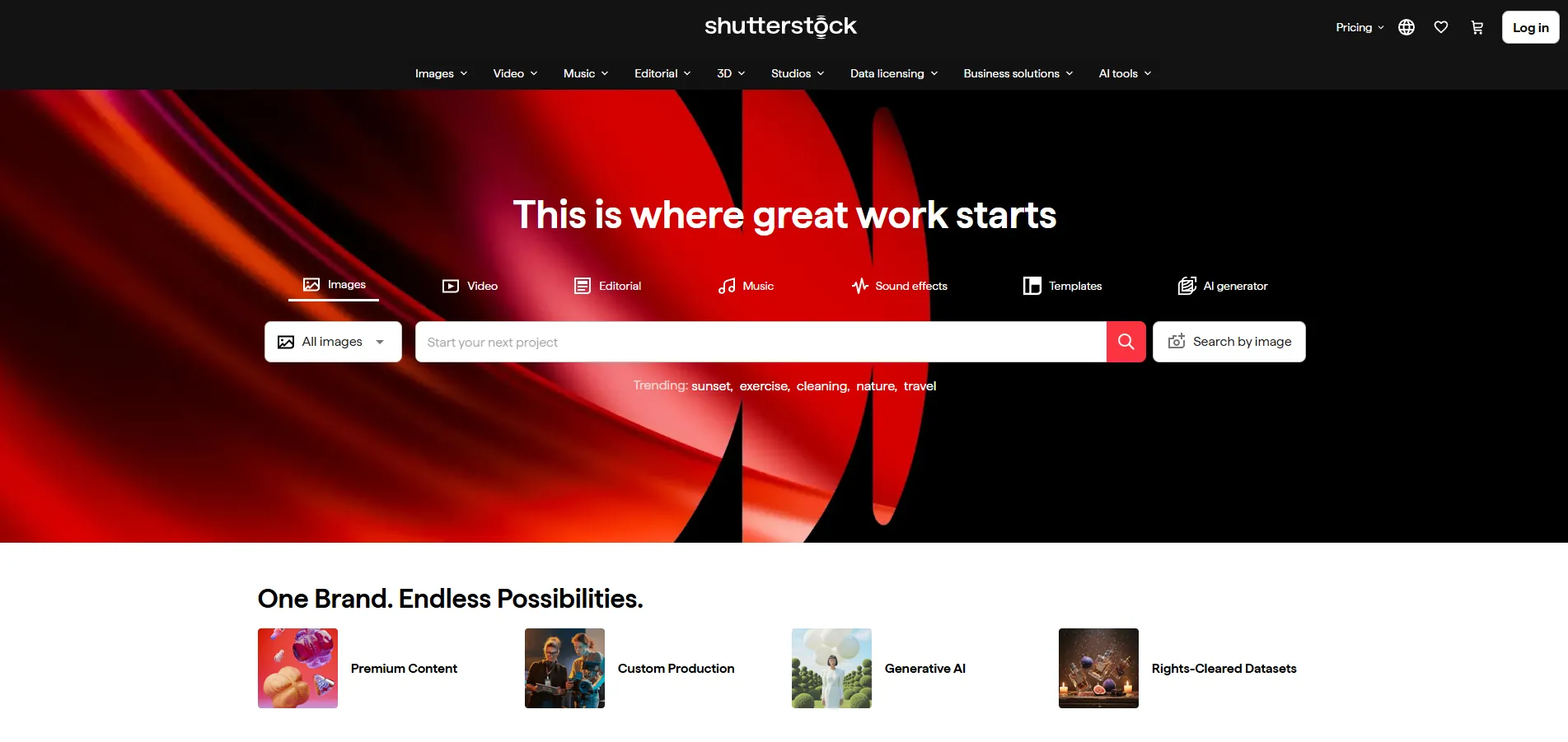
Shutterstock: From Stock Giant to AI-Powered Creative Platform
When you think "stock photos," you probably think Shutterstock. Founded in 2003 by Jon Oringer, a programmer who photographed his own initial library of 30,000 images, Shutterstock has grown into the largest stock media marketplace on the planet. With over 500 million assets spanning photography, video, music, vectors, 3D models, and editorial content, it remains the single most comprehensive creative resource available to professionals.
But in a world where Unsplash and Pexels offer free photography, and Midjourney and DALL-E generate images from text prompts, is Shutterstock still worth paying for? In June 2026, Shutterstock unveiled its evolution from a stock library into a "human-led, AI-powered creative platform," blending its authentic content library with inline AI editing tools. For businesses and agencies, the answer is still yes. For individuals, the calculus is more complicated.
The Scale of the Library
The sheer volume of content on Shutterstock is staggering. The platform adds hundreds of thousands of new assets every single day, contributed by a global network of over one million photographers, videographers, illustrators, and musicians. This means that no matter how niche or specific your creative brief, Shutterstock almost certainly has something that fits.
The library covers every conceivable category. Nature and landscapes, business and technology, food and lifestyle, abstract textures, medical imagery, industrial scenes, cultural events. The breadth is unmatched. For creative professionals who work across diverse industries and clients, this eliminates the need to juggle multiple subscriptions across different platforms.
Beyond still photography, Shutterstock offers a robust collection of 4K and HD video footage (40 million+ clips), making it a viable option for video editors and motion designers who need B-roll, time-lapses, or aerial drone shots. The music and sound effects library provides 43,000+ royalty-free audio tracks suitable for commercials, podcasts, YouTube videos, and corporate presentations. There are also vector illustrations and EPS files for graphic designers, and a growing collection of 3D models ready for augmented reality, virtual reality, and product visualization workflows.
Why Professionals Pay for Shutterstock
Shutterstock is not just selling images. It is selling legal safety, reliability, and workflow efficiency.
Legal Protection and Indemnification
This is the primary reason agencies and enterprise clients choose Shutterstock over free alternatives. Every asset on the platform is vetted for intellectual property compliance. Model releases and property releases are on file for commercial content. If you are designing a billboard for a Fortune 500 company, producing a national television advertisement, or creating packaging for a consumer product, you cannot afford the legal risk of using an image with unclear licensing.
Shutterstock offers $10,000 in legal indemnification on its standard license, meaning the company will legally defend you and cover damages if a copyright or intellectual property claim arises from properly licensed content. Enhanced licensing raises that to $250,000, and enterprise Premier licensing offers unlimited indemnification. This protection extends to AI-generated images created through their platform, an industry first that sets Shutterstock apart from standalone AI image generators with uncertain legal standing.
Advanced Search and Filtering
Finding the right image among 500 million options requires powerful search tools. Shutterstock's search engine now supports conversational AI search, allowing natural language queries alongside traditional keyword search. You can filter by orientation, color, number of people, age, ethnicity, and image style. You can specifically exclude AI-generated content if you prefer human-created photography, or filter exclusively for editorial content when working on news and journalism projects.
The platform also offers curated collections organized by theme, trend, and season, which saves time when you need inspiration or want to browse rather than search for something specific.
Ethical AI: Image and Video Generation
Shutterstock has positioned itself as a leader in ethical AI. Their AI Image Generator runs on models from OpenAI, Google, and others, trained exclusively on content from Shutterstock's own licensed library. The company established a Contributor Fund that compensates the photographers and artists whose work was used to train the AI models. This approach addresses one of the most contentious issues in the creative industry: the use of copyrighted work to train generative AI without consent or compensation.
In April 2026, Shutterstock launched its AI Video Generator, combining text-to-video and image-to-video models from Google, Runway, and other providers in a single tool. Users can start from a text prompt, animate a static image, or build on existing Shutterstock library assets. Two free generations are included for new users to test the tool.
The June 2026 platform evolution added Model Match technology, which automatically connects prompts with the AI model best suited for the creative task, removing the guesswork from model selection. A Shutterstock app is also available within ChatGPT, allowing users to generate and license images without leaving the AI assistant.
Because the training data is properly licensed, AI-generated images from Shutterstock are commercially safe to use. The company extends its standard indemnification to these generated images, giving businesses confidence to use them in advertising, marketing materials, and product design without legal uncertainty.
Pricing and Plans
Shutterstock's 2026 pricing structure is built around four models: image subscriptions, video subscriptions, on-demand packs, and the Unlimited plan. Here is the breakdown:
Image subscriptions start at $29/month (annual billing) for 10 downloads. The Professional plan costs $199/month for 350 downloads, and the High-Volume plan costs $249/month (or $1,999/year) for 750 downloads. Month-to-month plans cost 30 to 50 percent more per download. On-demand image packs start at $29 for two downloads, valid for one year.
The Unlimited plan at $69/month (billed yearly) bundles images, video, music, sound effects, and 100 AI generation credits under a single subscription. It provides access to 80 million+ curated assets with a fair use cap of 100 downloads per day. This is the best value for creators who work across multiple content formats.
The standalone AI Image Generator plan costs $15/month (annual) for 100 generations, with access to models from Google, OpenAI, and Runway. The AI Video Generator includes two free generations for testing, with paid generation through subscription credits.
Video subscriptions start at $59/month (annual) for 5 clips. Individual 4K clips cost $79 to $179 each on-demand, so if you need more than two clips per month, the subscription pays for itself.
Music costs $35/month (annual) for unlimited royalty-free tracks. The catalog is not as deep as dedicated services like Epidemic Sound or Artlist, but for teams that need background audio alongside image downloads, it avoids a second subscription.
Team plans start at $489/month for up to 10 users with shared download allocations and centralized billing. Enterprise plans offer custom pricing with dedicated account managers and unlimited indemnification.
The Rollover Problem
The most common pricing complaint: unused downloads do not roll over. You pay for 10 images per month, use 6, and the other 4 vanish at month's end. If your creative output fluctuates month to month, this adds up. Set a calendar reminder 30 days before annual plan renewal, as plans auto-renew and mid-term cancellations charge a fee equal to 50 percent of the remaining balance.
Editorial Content
Shutterstock maintains one of the largest editorial content libraries in the world. This includes news photography, celebrity images, sports coverage, red carpet events, and historical archives. Editorial content is licensed strictly for illustrative, educational, and journalistic purposes, not for commercial advertising, but it is an essential resource for publishers, news organizations, and media companies.
The editorial library is updated in near real-time, with photographers covering major global events and uploading content within hours. This makes Shutterstock a practical alternative to wire services like AP or Reuters for smaller publications that need affordable access to current event imagery.
Shutterstock vs. Adobe Stock vs. Free Alternatives
Adobe Stock makes the most sense if your team lives in Creative Cloud, since images drop directly into Photoshop and Illustrator compositions. The library is comparable in size, pricing is similar, and Adobe's AI tools are integrated into the same workflow. Outside Adobe's ecosystem, Shutterstock's standalone editor, AI tools, and broader media types give it an edge.
Against free platforms like Unsplash and Pexels, the comparison comes down to legal safety and library depth. Free platforms are adequate for blogs, social media, and low-stakes projects. But for any commercial work where a copyright claim could cost thousands in legal fees, Shutterstock's indemnification and model release verification are worth the subscription cost.
For AI-generated content specifically, Midjourney and DALL-E produce impressive visuals, but commercial licensing remains legally ambiguous. Shutterstock's licensed generation with indemnification is the safer path for business use.
Insider Tips
If you only need images occasionally, skip the subscription and buy on-demand packs. Two credits cost $29, five cost $99, and twenty-five cost $229. These do not expire for a year, and you avoid the monthly rollover trap. For teams that need images, video, and music, the Unlimited plan at $69/month is significantly better value than separate subscriptions for each media type.
When searching, use the "Exclude AI-generated" filter if you need authentic photography for client work. AI-generated content is increasingly mixed into results, and while it is commercially safe, some clients specifically request human-created imagery.
Final Verdict: Who Is This Actually For?
Shutterstock remains the industry standard for professional stock media. Its combination of library scale (500 million+ assets), legal protection ($10,000 indemnification on every download), ethical AI tools with commercial licensing, and comprehensive asset types makes it the safest and most reliable choice for businesses and creative professionals who need guaranteed quality and commercial safety.
Marketing agencies benefit from the massive library and legal protections. When a client needs a very specific image, Shutterstock's search tools and library depth make it possible to find exactly that in minutes.
Corporate communications teams rely on the indemnification and consistent quality for annual reports, investor presentations, and brand campaigns.
Video producers appreciate the combined access to footage, music, and sound effects within a single platform, plus the new AI Video Generator for rapid prototyping.
Editorial publishers depend on the editorial archive for news coverage, feature articles, and magazine layouts.
For individual freelancers, hobbyists, and students, the cost is difficult to justify when Unsplash, Pexels, and Pixabay offer free alternatives. But for anyone whose livelihood depends on having the right image at the right time with the right license, Shutterstock eliminates risk and maximizes efficiency.
Explore plans and pricing at shutterstock.com, or try the AI Image Generator with two free generations.