David Rumsey Map Collection: 149,000 Historical Maps with AI Search and VR Globes
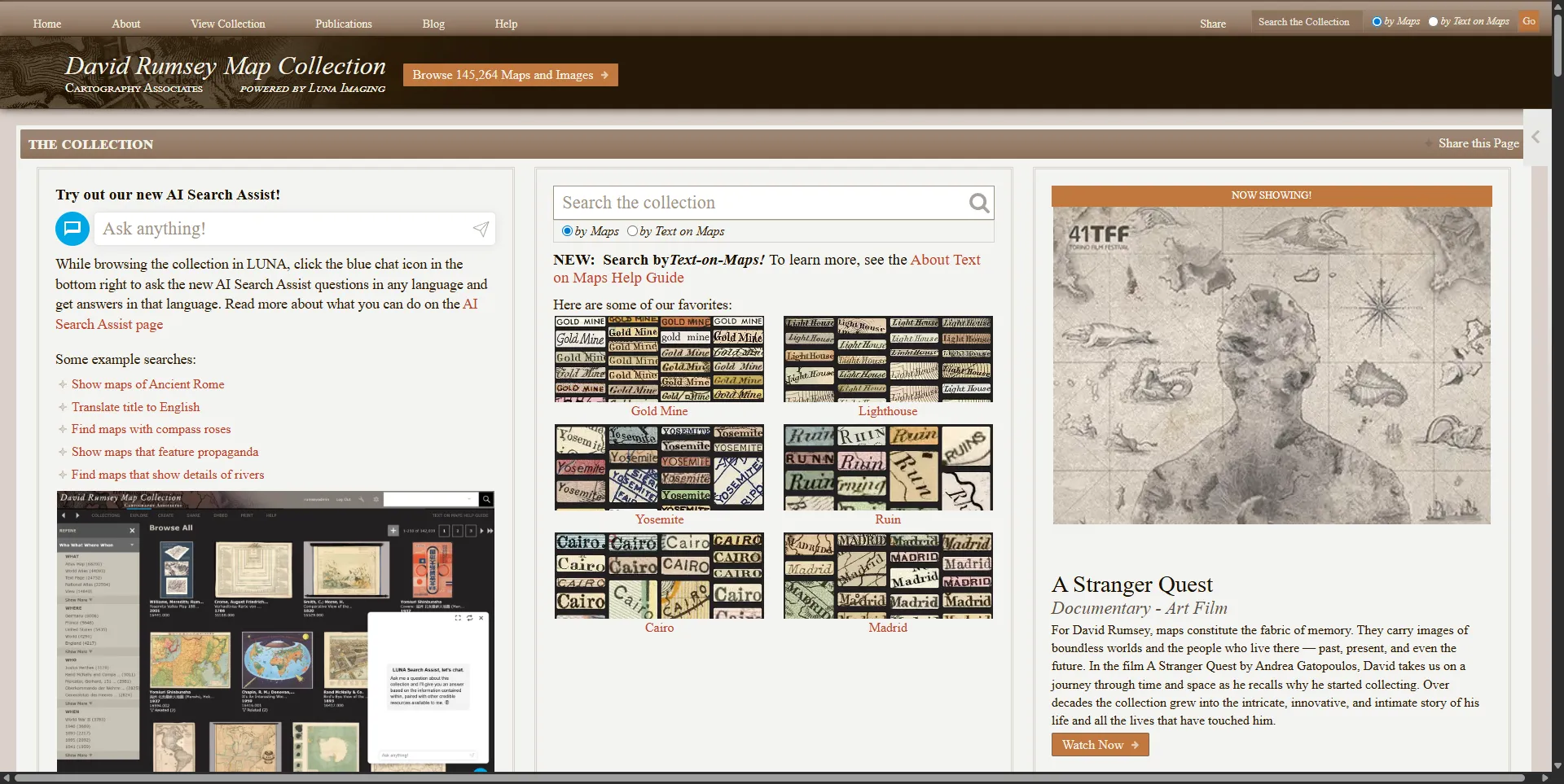
David Rumsey started collecting maps in 1980. By 1996, he began digitizing them. Today, the online collection holds over 149,000 maps and related images, scanned at 300 to 800 DPI, with average file sizes of 250 megabytes. The largest maps generate files approaching 5 gigabytes. This is not a museum database with compressed JPEGs. These are archival-quality scans that let you read the smallest text on a 200-year-old chart.
In 2016, Rumsey donated his entire physical and digital collection to Stanford University, where the David Rumsey Map Center opened as a dedicated space integrating historical materials with digital technologies. The center recently celebrated its 10th anniversary and continues to innovate with virtual reality, interactive map walls, and experimental mapping methodologies.
What makes this collection relevant in 2026 is not just the maps themselves but the tools Rumsey has built around them. A new conversational AI has been added to the LUNA database, letting you ask questions about the collection in natural language. A Globes app for Apple Vision Pro lets you explore historical globes in 3D. And Georeferencer v4 lets you overlay historic maps on modern geography to reveal how landscapes have changed.
The Collection
The collection spans the 16th through 21st centuries, with particular strength in 18th and 19th century maps of North and South America. It includes atlases, globes, wall maps, school geographies, pocket maps, books of exploration, maritime charts, and a variety of cartographic materials.
Notable items include the 1816 Melish Map of the United States (the first map showing the US extending to the Pacific), the 1733 Popple Map of North America, rare Japanese maps like the 1710 Nanzenbushu bankoku shoka, and atlases by Abraham Ortelius, John Arrowsmith, and the Colton Family.
The physical collection at Stanford houses hundreds of thousands of cartographic objects, with the online database representing the digitized portion. New items are added regularly.
The Viewing Tools
LUNA Viewer
The primary interface for browsing the collection. It supports deep zoom, image comparison, and workspace views where you can examine multiple maps simultaneously. The interface is functional but shows its age compared to modern web applications. If you are used to the smooth pan-and-zoom of Google Maps, LUNA feels clunky. But it handles enormous files efficiently, which is what matters for archival map viewing.
Georeferencer v4
The improved georeferencing tool lets you overlay historic maps on modern maps or other historic maps. This reveals changes over time and enables comparative analysis. You can georeference your own maps by searching LUNA and using the "Georeference This Map" button, or help georeference the entire library through the Random Map link.
The first pilot project targets 6,000 maps of major cities and regions. Users who georeference the most maps are recognized on leaderboards. Recently georeferenced maps can be viewed by image or by location.
MapRank Search
MapRank enables geographical searching through a Google Maps interface. Pan and zoom to the area you want maps of, and results appear as a scrollable list ranked by coverage. Mousing over any map shows its coverage as a light red rectangle on the Google Map. You can filter results with a timeline, keyword search, map scale, and place name.
This is genuinely the fastest way to find maps of a specific region. If you need historical maps of, say, the Caribbean, you zoom to the Caribbean in MapRank and get a ranked list of every map in the collection that covers that area.
Random Browse
New on the site: Random Browse shows 250 images at a time. Refresh to see 250 more. The site describes it as a way to "get pleasurably lost" in the collection. Available on desktop and tablet only.
Conversational AI
The most recent addition to the LUNA database is conversational AI, which lets you ask questions about the collection in natural language. Instead of constructing Boolean searches with field codes, you can simply ask "show me maps of Paris from the 18th century" and get relevant results. This is a significant usability improvement for non-specialists who find traditional catalog search interfaces intimidating.
Globes App for Apple Vision Pro
The collection includes historical globes, and the new Globes app for Apple Vision Pro lets you explore them in 3D spatial computing. This is one of the few cultural heritage applications taking advantage of Apple's spatial computing platform, and it points to how historical collections might be experienced in the future.
Licensing and Copyright
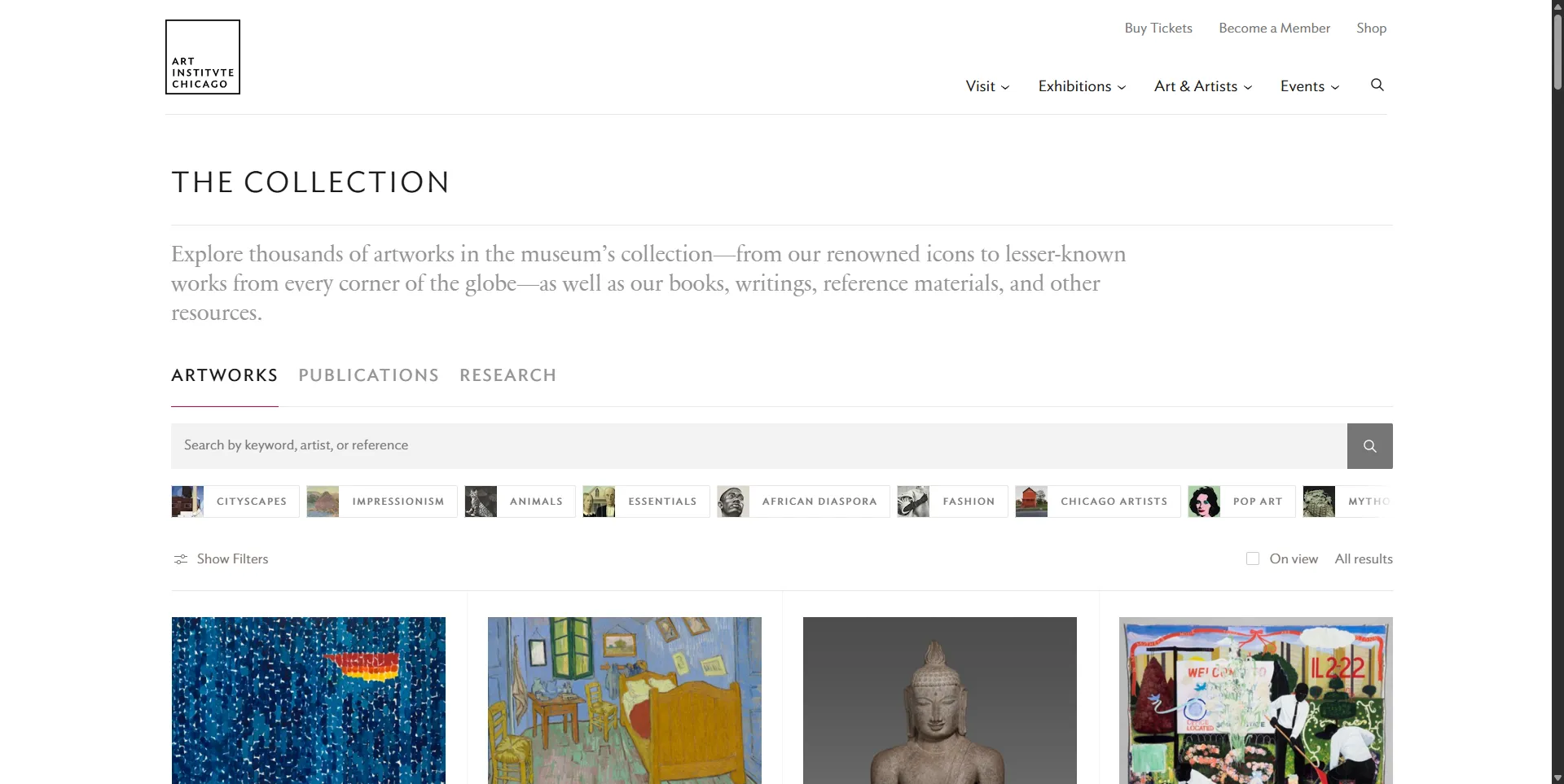
This is where the Rumsey collection requires attention. Unlike the Art Institute of Chicago or the Cleveland Museum of Art, which release images under CC0, the David Rumsey collection has copyright restrictions. The website states that images are free to use for personal, educational, and research purposes, but commercial use requires permission.
If you need historical maps for commercial projects (packaging, merchandise, advertising), you need to contact Cartography Associates for licensing. For noncommercial use, the images are freely accessible.
How It Compares
Compared to the British Library Flickr Commons, which has 50,000-plus georeferenced maps, the Rumsey collection has roughly three times as many maps (149,000+) with far better viewing tools. The British Library maps are on Flickr with no dedicated cartographic interface. Rumsey offers Georeferencer, MapRank, and LUNA.
Compared to Openverse, the Rumsey collection is a single specialized source. Openverse indexes content from dozens of sources but does not offer the specialized cartographic tools that Rumsey provides.
Compared to the Biodiversity Heritage Library, which contains some maps within its digitized books, the Rumsey collection is dedicated entirely to cartographic materials and offers far more sophisticated map-specific tools.
Practical Uses for Artists and Designers
Fantasy illustrators and worldbuilders can study historical cartographic conventions: decorative cartouches, compass roses, sea monsters, and elaborate border designs. The high-resolution scans let you examine these decorative elements in detail.
Designers working with vintage or historical aesthetics can source map imagery for backgrounds, textures, and decorative elements. Check the copyright restrictions before using images commercially.
Historians and researchers can use the Georeferencer to compare historical maps with modern geography, revealing how coastlines, city boundaries, and land use have changed over centuries.
Educators can use the maps freely in teaching materials about the history of cartography, geography, and exploration.
VR/AR developers can explore the Globes app for Apple Vision Pro as a model for how cultural heritage content might be presented in spatial computing environments.
Insider Tips
- Use MapRank for geographic search. It is the fastest way to find maps of a specific region.
- Use Random Browse if you are looking for inspiration rather than a specific map. 250 images at a time, refresh for more.
- Try the conversational AI if you find LUNA's traditional search interface intimidating. Natural language queries work well for exploratory searching.
- The average file size is 250 MB. Plan your downloads accordingly. The largest files approach 5 GB.
- Check the David Rumsey Map Center at Stanford for physical access. The center hosts exhibitions, conferences, and instructional workshops, including an annual student map competition.
- Old Maps Online is a separate project that integrates with the Rumsey collection and other map archives, providing a unified geographic search across multiple historical map sources.
Final Verdict: Who Is This Actually For?
The David Rumsey Map Collection is the best online resource for historical maps, period. No other digital collection comes close in terms of size, scan quality, and specialized viewing tools. The addition of conversational AI search and the Apple Vision Pro Globes app in 2026 shows that the collection continues to innovate.
It is not for someone who needs CC0-licensed imagery for unrestricted commercial use. The copyright restrictions mean you need permission for commercial projects. If you need public domain maps without restrictions, look at the British Library Flickr Commons or Wikimedia Commons instead.
For researchers, illustrators, designers, and anyone who loves historical cartography, the Rumsey collection is essential. Start exploring at davidrumsey.com and check our review of the British Library Flickr Commons for public domain map alternatives.