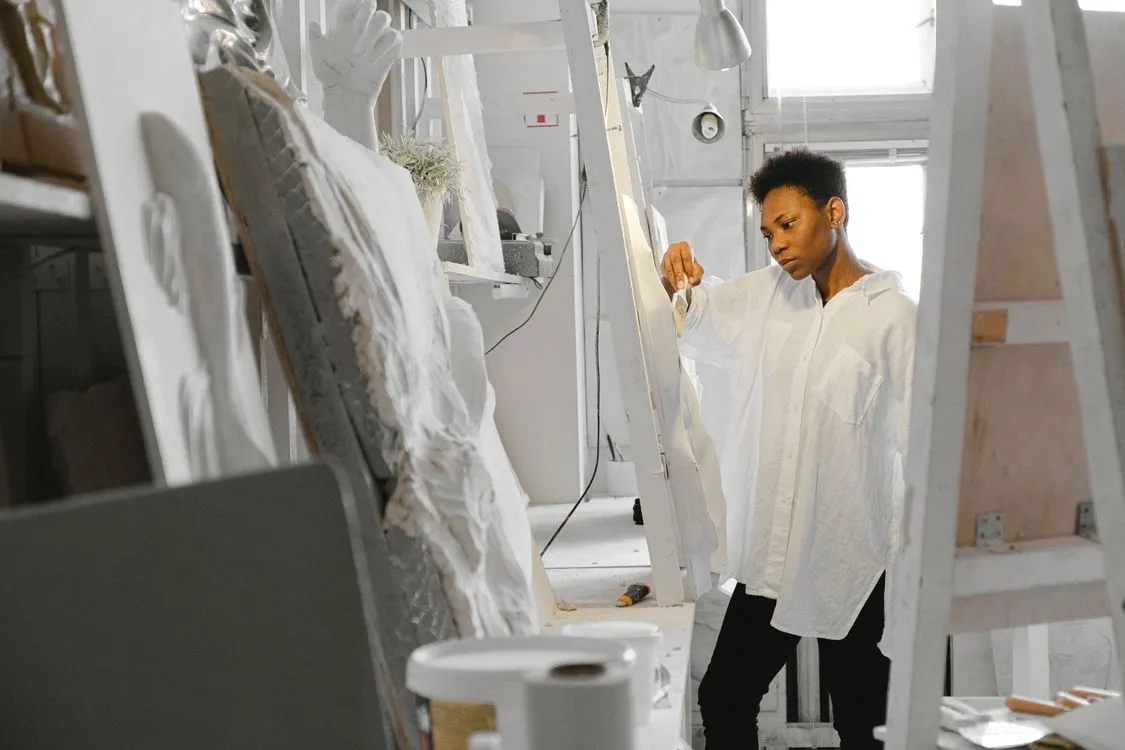
You have spent three weeks making a painting. You know how much you paid for materials. You have a rough sense of how many hours went into it. You have no idea what to charge. You look at what other artists are charging, feel either that your prices are too high or embarrassingly low, and arrive at a number by guessing. Then someone asks you whether you offer discounts, and you have no idea what to say.
This is the experience of the majority of working artists at some point in their careers, and it leads to pricing decisions that are inconsistent, undervalue labor, and make career growth harder than it needs to be. Pricing is not a purely commercial decision. It is also a signal. The price you charge for your work communicates something about where you position yourself in the market and what kind of collector relationship you are seeking. Getting it right, or at least getting it logical and defensible, matters.

The Gallery of 19th-century Art at the National Museum in Warsaw. The gallery context that gives artwork its institutional value and pricing framework. Image: CC BY 3.0, via Wikimedia Commons
This guide covers the main pricing approaches used by working artists, when each is appropriate, and how to think about price increases over time. The figures here reflect current market conditions as of 2025-2026, informed by the Art Basel and UBS Global Art Market Report 2026, which found that the global art market returned to growth in 2025 with total sales reaching $59.6 billion after two years of contraction.
The Three Main Pricing Models
The Formula Method: Size-Based Pricing
The most widely used pricing formula for paintings and works on canvas is a per-square-inch or per-linear-inch rate. You set a rate, multiply by the dimensions of the work, and add material costs on top. For new artists without exhibition history, a starting rate of $1 to $2 per square inch is typical. Mid-career artists with gallery representation commonly work in the $3 to $8 range. Established artists with museum acquisition history and strong secondary market results may be at $15 per square inch or above.
For a 20 x 24 inch canvas at $2 per square inch: 480 square inches times $2 equals $960, plus perhaps $60 in materials, gives you a retail price around $1,020. At $4 per square inch, the same work becomes $1,980. The formula works because it is consistent and scalable. Two works by the same artist of roughly equivalent media and quality sell at prices that make sense relative to each other. This prevents the situation where a small, intensively worked piece is priced lower than a large, quickly made one simply because the artist priced them separately by feel.
The limitation of the formula method is that it does not account for complexity, time investment, or the relative importance of different works within a practice. A small, highly finished drawing might be worth considerably more than a large quick study. Most artists use the formula as a baseline and adjust upward for works they judge to be especially strong or technically demanding.
The Hourly Rate Method
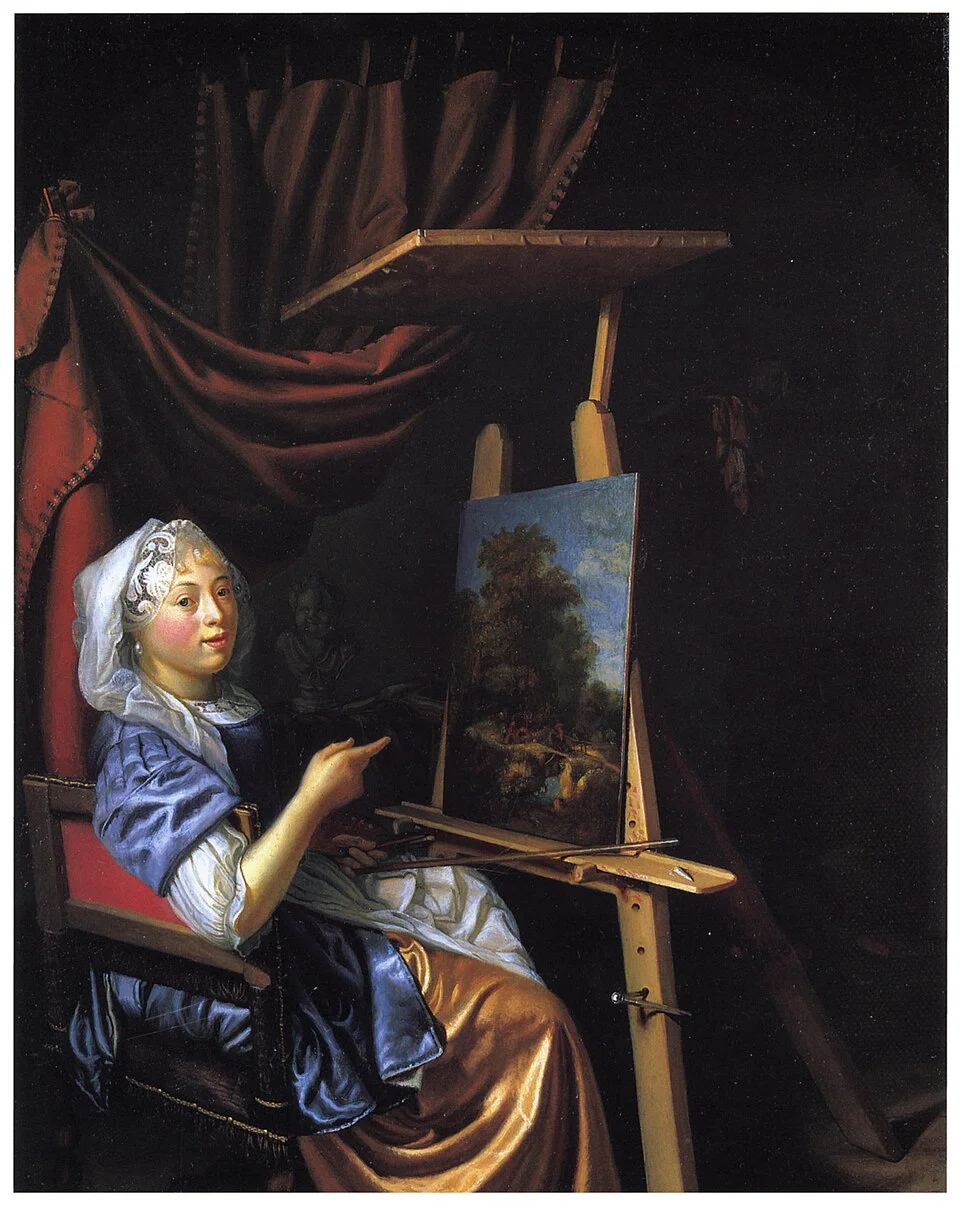
Maria Schalcken, self-portrait at her easel. The working artist's relationship to time, labor, and materials has always been the foundation of pricing, even when the market around it changes. Image: public domain, via Wikimedia Commons
An alternative calculates price based on the time invested. Set a minimum hourly rate for your labor, multiply by the hours spent on the work, and add material costs. The professional graphic design rate in most US markets runs $60 to $120 per hour as a starting reference point. Fine art can and should command more once an artist has an established market.
For an artist who values their time at $60 per hour and spends 20 hours on a piece with $80 in materials: 20 times $60 plus $80 equals $1,280. This is the floor below which selling the work makes no economic sense. The hourly method is useful as a check on the formula method. If your per-square-inch formula produces prices below your true labor cost, your formula rate is too low and will be financially unsustainable over time. The two methods together define a sensible range.
Market-Referenced Pricing
The third approach, which works alongside both formula and hourly methods, is to look at what comparable artists are charging. Comparable here means similar career stage, similar exhibition history, similar medium and scale, and similar collector context, not just similar subject matter or visual style.
Research involves looking at artist websites and gallery price sheets, talking to gallerists about what work in your bracket sells for, and using platforms like Artsy to see current asking prices. Be honest with yourself about where your career stage genuinely sits. Pricing at the level of artists ten years further into their careers than you does not make your work worth more. It makes it unsaleable at those prices, which is worse.
What Should Be Consistent in Your Pricing
The most important principle in artist pricing is consistency. A collector who bought a painting from you last year should not be able to find equivalent work for significantly less at your next open studio. Dealers and galleries reselling your work should not encounter prices that conflict with what they charge.
Never price work lower to a specific buyer because you like them, need the sale, or think they cannot afford the full price. If you want to make a work accessible to someone, offer a payment plan or give them the work as a gift. Discounting undermines your pricing structure and creates resentment among collectors who paid full price.
Keep records of every sale: buyer, work, price, date. This is essential for insurance, for managing your market, and for understanding your pricing history when it comes time to raise prices. Prices should only go up, not down. The exception is a genuine market correction after a period of overpricing, which requires a planned, transparent approach rather than a quiet rollback.
Working with Galleries
When you sell through a gallery that takes a 50 percent commission, the retail price must be set at double what you need to net. If your hourly calculation says a work should net you $800 minimum, the gallery retail price must be at least $1,600. This is not negotiating room to absorb the gallery cut. It is the minimum. Many artists, particularly early in their careers, set prices that do not account for the gallery commission and end up effectively working for well below minimum wage once the split happens.
Your gallery price and your direct price should be the same. Offering lower prices to collectors who approach you directly than you charge through your gallery is a serious breach of the dealer relationship and will end most gallery partnerships if discovered. The gallery's commission is the cost of the network, context, and institutional work they do on your behalf. See the full overview of how the art market works for more on gallery economics.
Raising Prices Over Time

The main gallery of the Amon Carter Museum of American Art, Fort Worth, Texas. The institutional gallery context that provides the market validation artists need to justify price increases over time. Image: CC BY-SA 4.0, via Wikimedia Commons
Price increases should be gradual, predictable, and tied to measurable career milestones. Doubling prices overnight because you had a good show is a mistake that drives away collectors who have been loyal at lower price levels and creates instability in your market.
Appropriate triggers for a price increase: a gallery show at a well-regarded venue, work entering a significant public collection, strong secondary market auction results, sustained sellout shows over two or more exhibitions, or significant critical attention in respected publications. Any of these provides external validation that the market will support a higher price point.
A reasonable pace for price increases is 10 to 20 percent per year for an artist on a clear upward trajectory, implemented at natural moments such as the beginning of a new gallery relationship or following a major exhibition. More aggressive increases are possible but require genuinely exceptional market conditions to be sustainable. The 2026 Art Basel report found the strongest price resilience in the mid-market segment ($50,000 to $1 million), with dealers in that bracket more optimistic about 2025 than those at either the top or bottom of the market. For emerging artists, this matters: the path toward the lower end of that segment is where career price growth is most predictable.
Works on Paper, Editions, and Multiples
Works on paper are typically priced below oil paintings of equivalent size, reflecting the material hierarchy that still operates in much of the market. This is partly conventional and partly practical, since paper works are often quicker to make. Many artists price drawings at 50 to 70 percent of their equivalent oil or acrylic prices.
Print editions, whether screenprint, etching, lithography, or digital output, are priced based on edition size, paper quality, and whether they are signed and numbered. A small edition (under 25) of a signed print by an artist with a gallery market commands meaningfully more than a large open edition. The relationship between print editions and unique works matters for your market: if you produce large editions at accessible prices, it can attract new collectors and build demand for your unique work. If you produce unlimited editions that compete with your unique work on price, it can depress the market for originals.
For collectors trying to understand the pricing they encounter in galleries and online platforms, and for artists looking to position their pricing in the broader market context, the guide on building an art collection on a budget shows the market from the buyer's side, which is useful context for artists setting prices.
Common Pricing Mistakes to Avoid
The most common mistake new artists make is pricing emotionally rather than systematically. Work that took a long time to make feels like it should cost more, which is correct in terms of the hourly method but which has no direct relationship to what the market will pay. A buyer does not know or care how long a piece took. What they respond to is quality, scale, and the artist's market position.
The second common mistake is inconsistency across platforms. If your Etsy shop shows work at $300 and your gallery shows equivalent work at $900, the first person to notice this in the gallery will either feel cheated on behalf of other buyers or conclude your pricing means nothing. Online pricing and gallery pricing must align.
The third mistake is stopping price growth too early out of anxiety about losing collectors. The collectors who will support your career over a decade are not the ones who will leave when prices increase by 15 percent after a successful show. Price increases, when they happen in response to genuine market milestones, are part of what makes a collection of your work more interesting to hold over time.
Final Thoughts
Pricing is one of the few areas of an artist's practice that rewards systematic thinking over intuition. Your work deserves prices that reflect its genuine value, your labor, and your position in the market, and arriving at those prices through a defensible method gives you confidence in every sale conversation.
Start with the formula method as your baseline, check it against the hourly method as a floor, and reference comparable artists to calibrate against the broader market. Review your pricing at least once a year, and raise prices in response to real career milestones rather than hope. The artists who build sustainable markets are the ones who treat pricing as a skill to develop rather than a problem to avoid.
For a broader understanding of the commercial environment your pricing exists within, read our guide to how the art market actually works. And for artists thinking about the portfolio context in which your priced work will be presented, the guide on building an art portfolio from scratch covers the professional presentation side of the equation.