
Every technology for making images has brought with it the same two questions. The first is technical: what can this new thing do? The second is cultural: does what it produces count as art? Photography faced both questions in the 1840s. Cinema faced them in the 1890s. Digital art faced them beginning in the 1960s, and in some quarters the debate has not entirely ended even now. The history of digital art is in large part the history of that debate playing out across six decades while artists kept working regardless of how it was settled.
That history is longer, richer, and more contentious than most people who have discovered the field recently realize. The practices grouped today under "digital art," from AI image generation to NFTs to immersive installations, did not arrive fully formed. They emerged from a lineage of experiments, arguments, institutional battles, and technical breakthroughs that stretches back to the earliest days of the digital computer. Understanding that lineage changes how you see the current moment.
What Counts as Digital Art?
For the purposes of this history, digital art is any visual art in which the computer plays a central role in the making. This encompasses art generated by code or algorithm, art made using digital painting or drawing tools, art that exists as digital files rather than physical objects, and art that uses digital technology in its presentation or distribution. It does not include art that merely uses a computer as an administrative tool, such as using word processing software to write an artist statement.
This definition is deliberately broad. The practices it covers are varied enough that "digital art" as a category sometimes obscures more than it reveals. A plotter drawing from 1969 and an AI-generated image from 2023 are both digital art in this sense, but they come from entirely different conceptual traditions and technical contexts. The history helps to keep that variety intelligible.
The 1960s: When Computers Began to Draw
The first computer-generated artworks appeared in the early 1960s, made by scientists and engineers who had access to the mainframe computers of that era. Georg Nees, a German engineer at Siemens, created plotter drawings using a computer and pen plotter in 1963. He exhibited these works at the Technische Hochschule Stuttgart in February 1965, which is widely considered the first exhibition of computer-generated art. The show sparked a public debate about whether a machine could produce art and whether a scientist who programmed it was an artist.
Frieder Nake, also German, was exhibiting computer drawings the same year. So was Michael Noll at Bell Labs in New Jersey, who programmed a computer to generate visual approximations of Piet Mondrian's paintings as an experiment in computational aesthetics. Noll's work was not shown publicly at the time, but his analysis of his own computer art in relation to the original Mondrian asked questions about visual perception and originality that are still relevant in discussions of AI art today.
Vera Molnár arrived at computer art in 1968 in Paris, after a decade of making what she called "imaginary machine" drawings: systematic visual explorations produced by hand using methods that anticipated computational logic. When she finally got access to a computer, the transition felt natural to her. She described the ability to modify a single parameter and see its effect across hundreds of variations as transformative. Her plotter works from the late 1960s and 1970s, with their controlled geometric systems and carefully calibrated degrees of randomness, are among the most aesthetically compelling works in the early history of computer art.
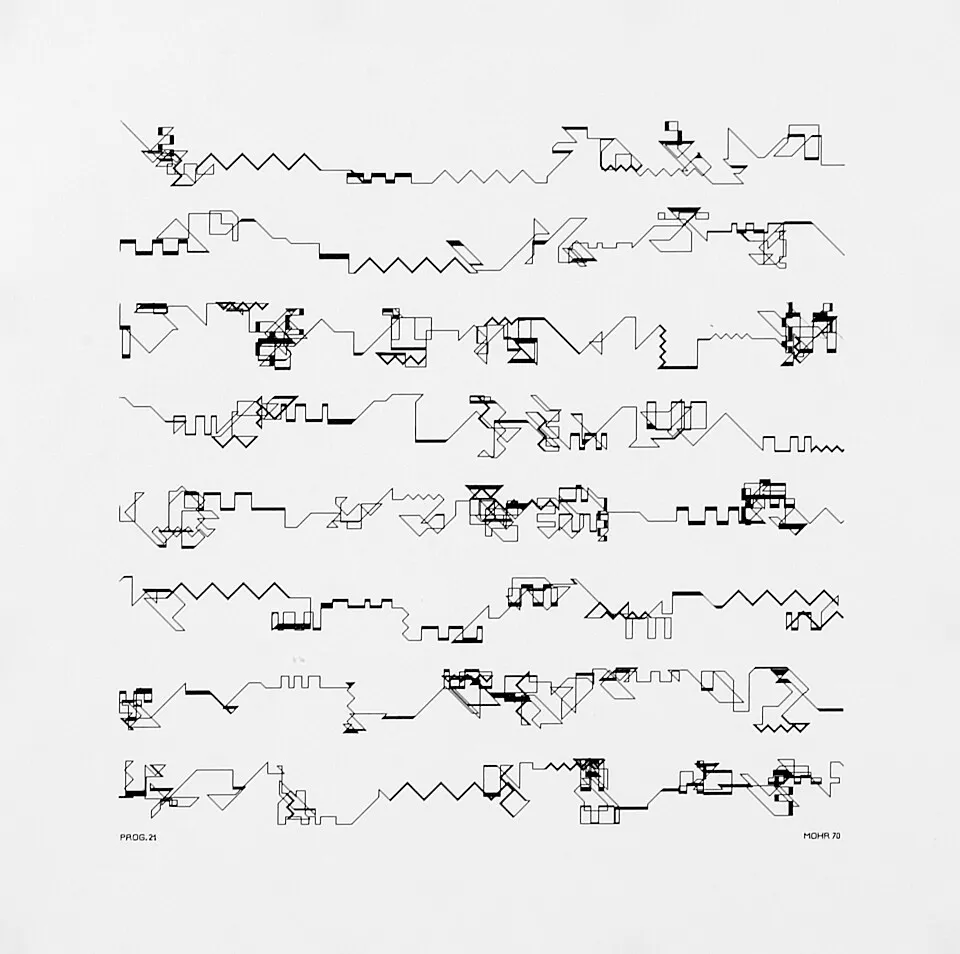
Manfred Mohr, "P021G" (1970). Computer-generated plotter drawing. Mohr's systematic investigation of the hypercube over decades produced some of the most rigorous work in early computer art. Wikimedia Commons.
The 1970s and 1980s: Pixels, Paint Programs, and New Institutions
The 1970s brought more computing power and, crucially, raster display screens. The pixel became a unit of visual construction. Harold Cohen developed AARON, a program that generated original drawings, beginning in 1973. Unlike the algorithmic drawings of the previous decade, AARON used a rule-based system of considerable complexity to produce images that no prior artist would have made. Cohen exhibited AARON's output in galleries and debated vigorously whether the program constituted an artist in its own right. The debate was never fully resolved, but the work itself was collected by major institutions.
The 1970s also saw the establishment of the first institutions dedicated to computer art. The Ars Electronica festival, founded in Linz, Austria in 1979, became the most important annual gathering for art and digital technology worldwide. It continues in 2026 and remains a significant context for new media art. The ZKM Center for Art and Media in Karlsruhe, Germany, opened in 1989 and became the world's most important museum of digital art, building a collection of interactive and generative work that documents the field's development comprehensively.
The first consumer paint programs appeared in the late 1970s and early 1980s. MacPaint, released with the original Apple Macintosh in 1984, made image-making on a personal computer available to millions of people for the first time. The earliest versions were crude by later standards, but they established the digital canvas as something ordinary people could interact with. Artists who had been working on institutional mainframes suddenly had machines they could own and use in their studios.
The 1990s: Net Art, Digital Photography, and the Cultural Explosion
The introduction of the World Wide Web in 1991 and the popularization of internet access through the mid-1990s created a new context for digital art: the browser window. Net art, also written as net.art, emerged from this context. Artists including JODI (Joan Heemskerk and Dirk Paesmans), Olia Lialina, and Heath Bunting began making work that used the protocols, aesthetics, and behaviors of the web itself as artistic material. We cover this movement in detail in the guide to net art.
Digital photography transformed the professional photography industry across the 1990s. The first commercially viable digital cameras appeared in the early 1990s and, by the end of the decade, had made film photography economically marginal for many professional applications. This disruption also opened questions about photography as art that paralleled the earlier debates about computer art: if every image could be manipulated, what distinguished a document from a fabrication?
Adobe Photoshop, released in 1990, became the defining tool of this period. Its layer system, selection tools, and compositing capabilities made possible a new kind of image that was neither photograph nor illustration but something in between: the digital composite. Artists including Andreas Gursky began using Photoshop to subtly alter their photographic images, producing works that looked documentary but were constructed. Gursky's "Rhine II" (1999), which removed figures from a riverbank photograph to produce a landscape of almost abstract severity, sold at Christie's in 2011 for $4.3 million, then the highest price ever achieved at auction for a photograph.
The 2000s and 2010s: DeviantArt to Generative Systems
The 2000s saw digital art become a mass practice. Platforms like DeviantArt (founded 2000), Flickr (2004), and Tumblr (2007) created contexts where millions of people shared digital illustrations, photo manipulations, and graphic design outside any gallery or institutional framework. This democratization made digital art ordinary in a way that the gallery world had not achieved, and it produced an enormous body of visual culture that was simultaneously ignored and influential.
Simultaneously, the art world's engagement with digital practice matured. The Whitney Museum of American Art's 2000 exhibition "BitStreams" brought net art and digital work into a major institutional context. Documenta 11 (2002) included significant digital and video work. Artists including Hito Steyerl, Ryan Trecartin, and Cory Arcangel built internationally recognized careers working with digital materials, internet culture, and software.
The generative art market developed significantly in the 2010s, with platforms like Art Blocks (founded 2020) providing a distribution infrastructure specifically for algorithmically generated visual work. The tradition Vera Molnár and Manfred Mohr had established in the 1960s and 1970s found a new commercial context and a new audience. Collectors began acquiring generative works on blockchain as a new category of digital fine art.
The 2020s: NFTs, AI Image Generation, and the New Frontier
The NFT moment of 2020-2022 brought digital ownership and the blockchain art market to global attention. Beeple's "Everydays: The First 5000 Days," a collage of digital images made over thirteen years, sold at Christie's in March 2021 for $69 million. The sale made front pages worldwide and forced the mainstream art market to reckon with digital art as a category of collectible value. The subsequent crash in NFT prices did not erase the question it had raised: how do you establish ownership, scarcity, and value for digital works that can be copied infinitely?
AI image generation tools, including DALL-E 2 (2022), Midjourney (2022), and Stable Diffusion (2022), made it possible to generate high-quality images from text descriptions without any drawing skill. This raised the question that Michael Noll had asked in 1965 in a new and urgent form: what is the role of human agency in an image made by a machine following instructions? Debates about authorship, copyright, and artistic credit that had been theoretical became practically urgent as AI tools entered professional workflows. We cover the full argument in the guide to whether AI art is still art.
What the History Tells Us
The history of digital art is a story of recurrence. The same questions appear in each decade: is this art? Who made it? What is the machine's role and what is the human's? Does the existence of this technology devalue what came before? These questions do not have stable answers because what they are really asking is what art is for, and that question is always being renegotiated.
What the history also shows is that these debates resolve in practice rather than in theory. The artists who kept making work regardless of how the debates were settled, who found ways to use the tools of their moment to produce things that other people wanted to be near, built the field. Vera Molnár, Manfred Mohr, JODI, Beeple, and Refik Anadol have almost nothing in common except that they committed to their practice and made the work. In each decade, that turned out to be sufficient.
Final Thoughts
Digital art has a history of over sixty years, and it is a history that has consistently underestimated itself and been underestimated by others. Each time it has been dismissed as novelty, temporary, or not-really-art, it has continued developing and eventually found institutional recognition. That pattern suggests considerable confidence about where the current generation of AI-assisted and generative artists will be assessed in another twenty years.
For a broader context, the guide to digital art today covers the current landscape in depth. For the specific practices that have shaped this history, the guides to generative art and creative coding provide practical entry points into the traditions that began in the 1960s.


