
In 2023, an artist in Glasgow received a commission inquiry from someone who had seen her work at a group show. They wanted a large-scale oil painting for their sitting room, a landscape in a style close to work she had already made. The brief was clear. The budget was fair. The painting took four months and cost the commissioner around three thousand pounds. They now own something made specifically for them, in dialogue with them, by someone whose practice they genuinely followed. No gallery inventory search would have found it, because it did not exist before they asked.
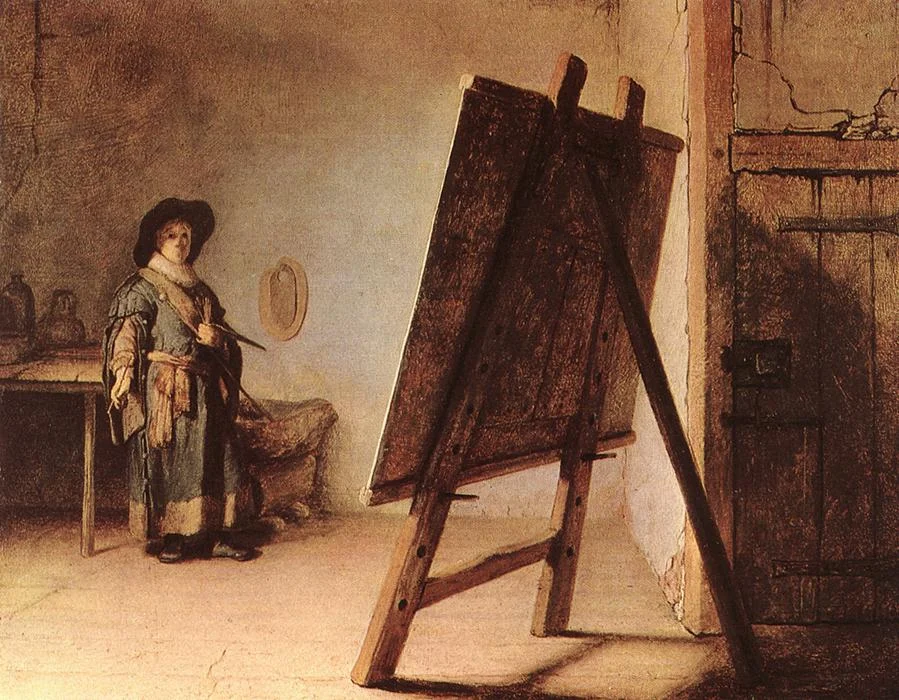
Rembrandt's The Artist in his Studio (c. 1626-1628) captures the intimate relationship between painter, easel, and canvas that still defines the commissioning process. Image: public domain, via Wikimedia Commons
Commissioning original art is one of the most underused options available to anyone who wants to own original work. Most buyers go to galleries, fairs, and online platforms and choose from what happens to be available. Artists take commissions. Many actively prefer them because commissioned work comes with a relationship and a degree of creative certainty. The process is more accessible than most people assume, and knowing how it works removes the hesitation that stops most people from trying.
This guide covers when commissioning makes sense, how to find the right artist, how pricing actually works (including the numbers), how to write a brief that produces good results, what contracts need to cover, and what to do when the outcome is not quite what you imagined.
When Does Commissioning Make Sense?
Not every art purchase is better as a commission. Commissions work best when you have a specific vision that existing work cannot satisfy: a portrait of a person, place, or animal that matters to you; a large-scale work at dimensions that are difficult to find in galleries; a piece that integrates personal references that no speculative work would include; or a site-specific painting designed for an architectural space with unusual proportions or light conditions.
If you have a more open brief and just want to own original work, buying from existing inventory is faster, less risky, and often equally satisfying. The thing a commission adds is specificity and relationship: you will end up with something made in response to you, and that is worth something that a gallery purchase cannot replicate. Whether it is worth the additional time and process (typically three to nine months from inquiry to delivery) depends on what you are trying to achieve.
Be honest with yourself about your tolerance for creative uncertainty. Even with a detailed brief, an artist will interpret your commission through their own intelligence and sensibility. The result will not be exactly what you visualized, because the artist is not executing a technical specification. If you need total predictability, a commission is the wrong tool.
Finding the Right Artist
The best commissions come from artists whose existing work you genuinely admire, not artists you think could probably do what you want if they tried hard enough. You are not commissioning an artist to work outside their practice. You are inviting them to bring their practice to your specific brief. Asking a landscape painter to make a portrait, or a printmaker to produce an oil painting, almost always produces disappointing results, because the quality of their work in unfamiliar territory will not match the quality of work in the areas where they are developed.
Before approaching anyone, look at their portfolio carefully. You want to see three to five existing works that are in the general direction of what you have in mind: similar scale, similar subject, similar mood or handling of light. If you are squinting to imagine how they might approach your brief, keep looking.
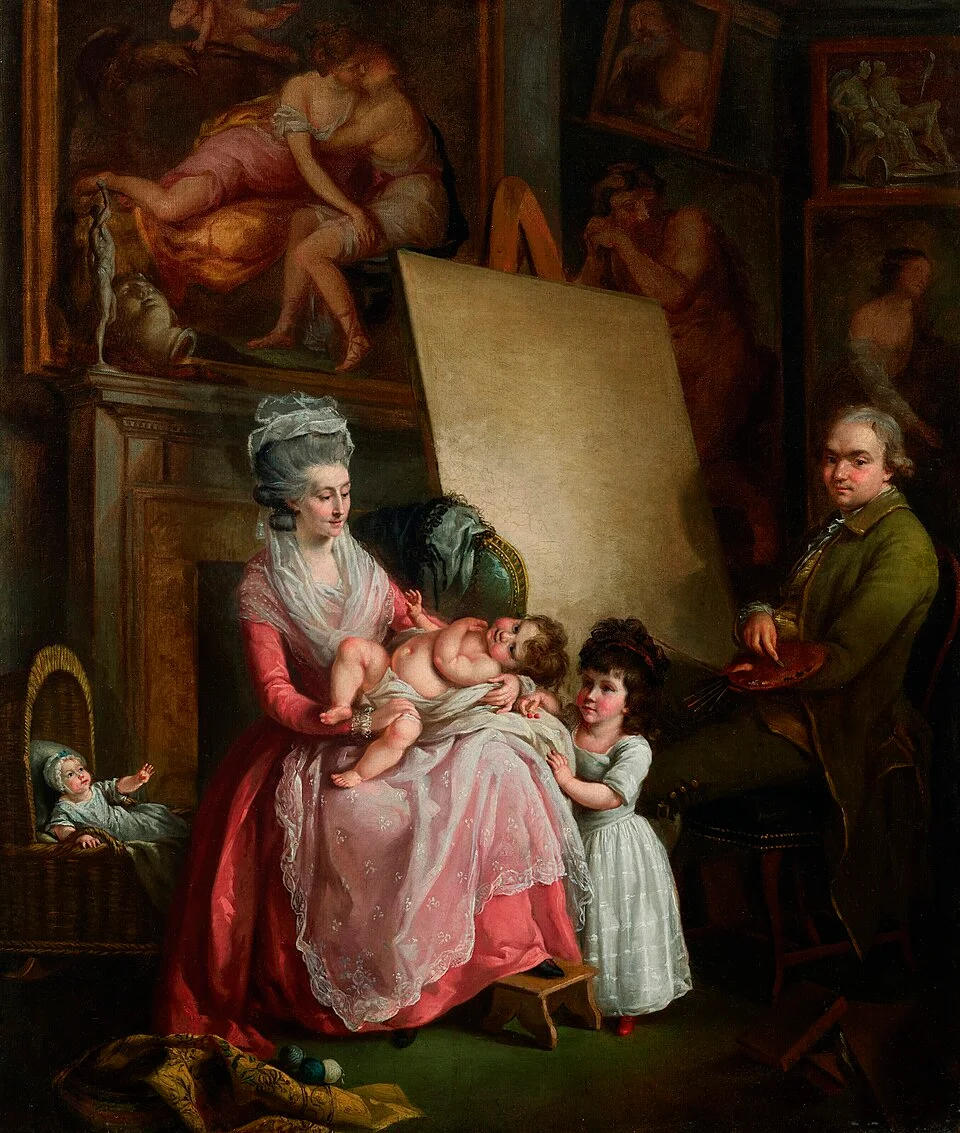
John Francis Rigaud's Portrait of the Artist with His Wife and Children in His Studio shows the painter at his easel, palette in hand, a scene that has changed remarkably little in the centuries since. Image: public domain, via Wikimedia Commons
Practical places to find commission-ready artists include galleries that represent artists open to private commissions (portrait commissions especially are common), emerging artist networks including degree show alumni and graduate shows, platforms like Artsy, The Dots, and Artwork Archive, and Instagram, where many artists explicitly state whether they are accepting commissions in their bio or story highlights. The Axis Web artist database in the UK is particularly useful for finding professional working artists by medium and region.
How Pricing Works
Artist pricing for commissioned work is based on several intersecting factors: the physical size of the work, the complexity of the subject, the medium (oil on canvas requires more time and material cost than watercolor on paper; bronze sculpture costs more than oil painting), the artist's career stage and market position, and whether the work will be exhibited publicly or published commercially after delivery.
For established gallery artists, commission prices are broadly comparable to their gallery prices for work of equivalent size and medium. Do not expect a significant discount for commissioning rather than buying from stock. Commissioned work typically requires more of the artist's time than speculative work, because of the consultation process, any revision stages, and the additional communication involved. The commission premium over equivalent gallery work is usually zero to fifteen percent, not a discount.
For emerging artists without established gallery pricing, the most transparent way to discuss money is to ask directly about their rate per square inch or square foot of canvas, their day rate, and whether they charge separately for materials. Most artists who take commissions regularly have worked this out and will answer straightforwardly. An artist who becomes evasive or uncomfortable with any direct conversation about money is worth noting before you commit.
Deposits and Payment Structure
Expect to pay a deposit of 30 to 50 percent of the agreed fee before work begins. This is standard professional practice and protects the artist if a buyer changes their mind after work has started. The balance is typically due on delivery or within a short window before it. For large commissions (over six months of work, or involving significant upfront material costs), a milestone payment structure is worth negotiating: for example, 33 percent on signing, 33 percent at an agreed intermediate stage, and 33 percent on delivery. This gives both parties checkpoints and reduces the financial risk on each side.
According to guidance from Own Art, the UK's interest-free art purchase loan scheme, the average price of a commissioned original work from an established artist in the UK as of 2024 is between £1,500 and £8,000 for a medium-scale oil on canvas, depending on artist profile and complexity. In the US, comparable figures from gallery price lists typically run from $1,500 to $12,000 for the same range.
Writing a Brief That Actually Works
The brief is the single most important factor in whether a commission succeeds. A good brief is specific enough to give the artist real direction and open enough to allow genuine creative interpretation. The two failure modes are opposite: too vague ("something peaceful, maybe with blue in it") gives the artist nothing to work with, and too prescriptive ("exactly this composition, this lighting, from this reference photograph") leaves the artist no room to do what they actually do well.
A well-structured brief includes the physical context for the work (the room it will hang in, the wall color, the natural light conditions, any adjacent furniture or other art), the desired dimensions, reference images with brief notes explaining what draws you to each one, a description of the subject matter if representational, any colors or compositional elements that are genuinely non-negotiable, and a clear budget range. "I like the hazy quality of the light in this image" is more useful to an artist than "I like this painting." Give them something to respond to creatively, not a checklist of requirements to fulfill mechanically.
Approval Stages and Revisions
For any commission above a few hundred pounds or dollars, agree in writing on how many approval stages are included in the fee. Standard practice is one compositional sketch or small-scale study at the start of the process, and optionally a view of the work at an intermediate stage before it is finished. Be clear in the contract about what constitutes a revision (a specific adjustment within the agreed brief) versus a fundamental change of direction (a new brief, likely out of scope and subject to additional fees).
Do not approach the revision process the way you would with a graphic designer. Artists are not executing a specification. They are bringing creative intelligence to your brief. The more you micromanage the process, the less likely you are to get work of genuine quality at the end. The revision stage is for catching genuine misalignments, not for course-correcting the artist's every aesthetic decision.
Contracts: What Must Be in Writing
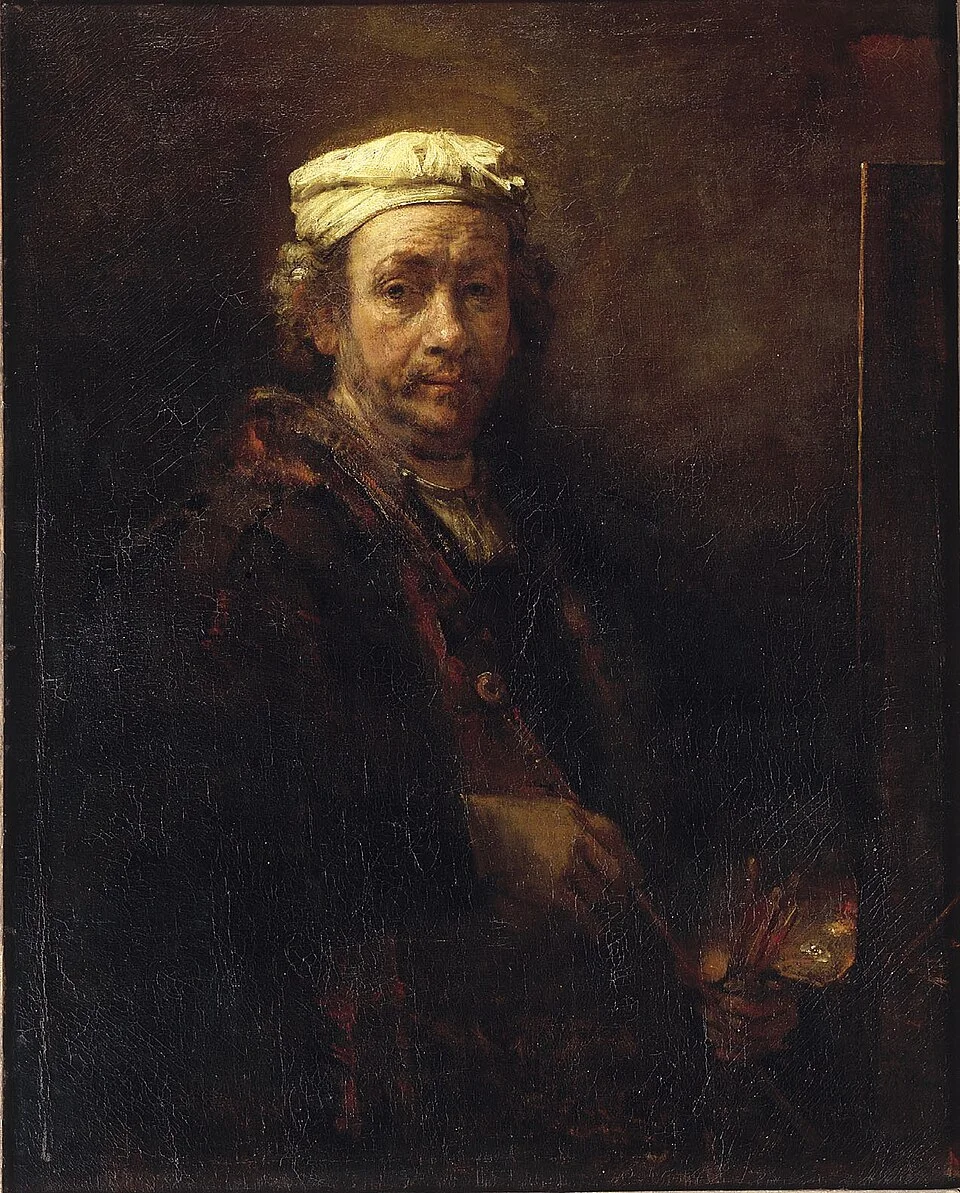
Rembrandt's Self Portrait at the Easel (1660), Louvre. The artist at work, depicting themselves depicting themselves, a tradition that continues in commissioned portraiture today. Image: public domain, via Wikimedia Commons
For any commission of significant value, a written agreement is not optional. It protects both parties and prevents the misunderstandings that cause most commission failures. A basic contract should cover: the agreed fee and payment schedule, the agreed dimensions, medium, and subject matter description, the delivery timeline, the cancellation terms (including what happens to the deposit if either party withdraws), and a statement of copyright ownership.
The copyright question is the one most frequently overlooked by first-time commissioners and the one most likely to cause problems later. When you commission a work of art, you own the physical object. Under most national copyright laws, including the US Copyright Act and the UK Copyright, Designs and Patents Act 1988, the artist retains copyright in the image of that object by default unless you explicitly agree otherwise in writing. The artist can reproduce the work in their portfolio, exhibit it in future shows as a commissioned example, and publish images of it online.
For most personal commissions, this is not a problem in practice. For any work with commercial potential, or where privacy is a genuine concern (a portrait you do not want reproduced), negotiate exclusive copyright separately and expect it to increase the fee, because you are purchasing an additional right that has real value to the artist.
When the Result Is Not What You Imagined
Even with a clear brief and a well-chosen artist, commissions sometimes arrive looking different from what you pictured. This is not failure. It is what happens when you ask a creative person to interpret rather than replicate. The artist has brought their own judgment to your brief, and the result carries their intelligence alongside your requirements.
Before reacting, look carefully and give it time. Many commissioned works that seem wrong on first viewing become exactly right after a week of living with them. You adapt to the work, and the work reveals things you had not anticipated. If, after considered reflection, you have specific concerns, raise them in precise terms: "the figure reads larger than I expected relative to the background" is something an artist can work with. "It's not really what I wanted" is not.
If the work is still in progress, targeted adjustments are usually possible. If it is finished, the scope for changes is limited and should already be defined in the contract. The best way to prevent this situation is a good brief and a clear conversation upfront, not detailed revision management during the process.
Once the work is in your home, how you care for it matters as much as how you chose it. The guide on how to store and preserve artwork at home covers the basics for oil, works on paper, and other media. And for protecting the work's visual impact over the long term, the guide to framing art properly covers the decisions around glass, matting, and mounting that most people underestimate. Have you commissioned original work before? Share what worked and what you would do differently in the comments.


