Elizabeth Greenshields Foundation: Funding Representational Art Since 1955
Most arts funders today explicitly seek "innovative," "experimental," and "interdisciplinary" work. The Elizabeth Greenshields Foundation does the opposite. It funds painting, drawing, sculpture, and printmaking that depicts recognizable subjects from the observable world. Abstract art, non-objective art, photography, video, digital art, installation, performance, and conceptual work are all explicitly excluded. If your work does not depict something you can see and recognize, this funder is not for you.
This narrow focus is the foundation's strength. Since 1955, it has been one of the few major grant programs worldwide dedicated exclusively to representational and figurative art. For painters working in classical realism, sculptors working from the figure, printmakers committed to observational subjects, and draftspersons drawing from life, the Greenshields grant is one of the most relevant and accessible funding sources available.
What the Grant Provides
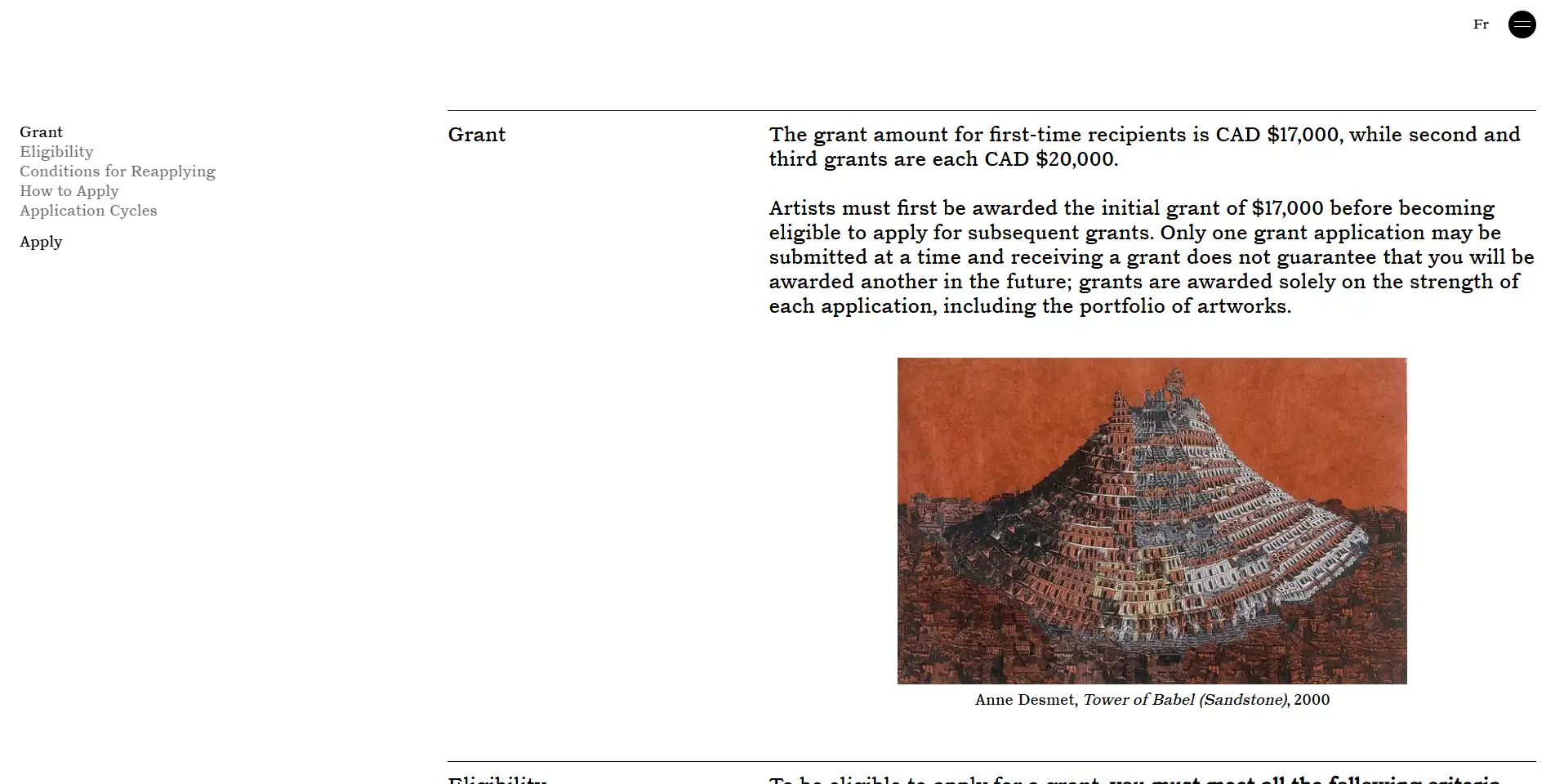
The grant amounts have been updated from older listings that cite $15,000:
- First grant: CAD $17,000
- Second grant: CAD $20,000
- Third grant: CAD $20,000
An artist can receive the grant up to three times in their lifetime. Each application is evaluated independently, and subsequent grants are not guaranteed. You must reapply and be evaluated again for each grant.
The grant is unrestricted. You can use it for materials, studio rent, living expenses during a period of focused work, travel for study, or any other cost that supports your artistic development. The foundation does not line-item your expenses or require receipts for specific purchases.
There is no application fee. Applications are accepted on a rolling basis with no fixed deadline, meaning you can apply whenever your portfolio is strongest.
Who Is Eligible
The foundation supports early-career artists who are:
- Pursuing their studies or in the early/developmental stage of their career
- Working in a representational style of painting, drawing, sculpture, or printmaking
- Demonstrating the determination and talent to pursue a lifetime career in their art practice
"Early-career" does not mean "student only." The foundation funds artists who have completed formal training and are establishing their practice, as well as self-taught artists who can demonstrate serious commitment. The key criterion is that you are not yet an established, mid-career artist with a long track record of exhibitions and sales.
The grant is international. Artists from any country can apply. This global accessibility is one of the foundation's most distinctive features. Artists in regions where arts funding is scarce or nonexistent can access the same grant amounts as artists in Canada, the US, or Europe.
What Is Excluded
The foundation is explicit about what it does not fund:
- Abstract or non-objective art
- Commercial art, graphic design, illustration, photography, animation, and video art
- Installation, performance, and conceptual art
- Digital-only art forms
If your practice involves any of these, do not apply. The foundation evaluates portfolios carefully, and applications that include non-representational work will be rejected. The eligibility page on their website is blunt about this: the foundation exists to support artists who "show clearly a disposition to use the purely traditional methods."
The Application Process
The application requires:
- A portfolio of recent representational work
- An artist statement describing your practice and commitment to representational art
- A project proposal for how the grant funds would be used
- Two references from people who can speak to your practice and commitment
- Proof of eligibility (early-career status)
The application is submitted through the foundation's website. There is no online portal system to navigate, no matching funds to secure, no budget to itemize. The foundation's process is simpler than most government arts grants, which is partly why it is so accessible to international applicants who may not have experience with complex grant application systems.
The board reviews applications and notifies successful applicants. The timeline is not published with specific dates, but applicants typically hear back within several months.
How Greenshields Compares to Other Grants for Representational Artists
Dedicated funding for representational art is rare. Here is how Greenshields stacks up:
- Canada Council for the Arts: Funds all disciplines including representational art, but you compete against abstract, conceptual, and interdisciplinary work in the same pool. Greenshields is representational-only, meaning less competition from unrelated disciplines.
- Creative Capital Award: Explicitly seeks "innovative" and "risk-taking" work, which often means conceptual or experimental approaches. Greenshields values traditional practice and technical skill.
- Joan Mitchell Foundation: $25,000 grants for painters and sculptors, but includes both abstract and representational work. Open to US-based artists only.
- Pollock-Krasner Foundation: Grants for visual artists in financial need, all styles including representational, but requires documented exhibition history.
Greenshields is unique in three ways: it is international (most grants are country-restricted), it is representational-only (most grants are open to all styles), and it targets early-career artists specifically (most grants are open to all career stages). The combination creates a niche that no other major grant program fills.
The Renewable Structure
The ability to receive up to three grants is not a minor feature. It means the foundation can provide CAD $57,000 in total support over the course of an artist's early career. This is more than most single grants provide, and the multi-grant structure acknowledges that artistic development takes years, not months.
To receive a second or third grant, you must demonstrate significant progress since your previous grant. This means showing new work, exhibitions, residencies, or other evidence that the previous grant advanced your practice. The foundation is not handing out repeat grants automatically. Each application is evaluated on its own merits.
Insider Tips for Applicants
- Your portfolio must be 100% representational: Do not include abstract work, even if you consider it your strongest. The foundation will reject applications that include non-representational pieces. If you work in both representational and abstract modes, only submit the representational work.
- Emphasize your commitment to a lifetime career in art: The foundation wants to fund artists who are in this for the long haul, not hobbyists. Your artist statement should articulate a clear, sustained commitment to representational practice.
- The project proposal should be specific and practical: "I will use the grant to continue my practice" is not a proposal. "I will complete a series of 12 oil paintings exploring [specific subject], using the funds for studio rent, materials, and a six-month period of focused work" is.
- Self-taught artists are welcome: The foundation evaluates artistic merit, not academic credentials. If you learned to paint through apprenticeship, workshops, or independent study, you are eligible as long as your work is representational and you are early-career.
- Apply when your portfolio is strongest: The rolling deadline means you choose when to apply. Take the time to build a strong portfolio before submitting. There is no advantage to applying early with weak work.
- International applicants: translate your materials: All application materials should be in English or French. If your references are in another language, have them translated before submitting.
Who This Is For (and Who It Is Not For)
This is for: Early-career painters, sculptors, printmakers, and draftspersons working in representational or figurative traditions, from any country. If you depict recognizable subjects from the observable world and you are in the early stage of your career, this is one of the most accessible grants available to you.
This is not for: Abstract or non-objective artists, photographers, digital artists, video artists, illustrators, graphic designers, animators, commercial artists, or artists working in installation, performance, or conceptual modes. It is also not for established mid-career or late-career artists. If you have a long exhibition history and established gallery representation, you are past the "early-career" stage the foundation targets.
Final Verdict: Who Is This Actually For?
The Elizabeth Greenshields Foundation fills a gap that no other major grant program addresses: substantial, unrestricted, international funding for early-career representational artists. The CAD $17,000 first grant is real money that can fund months of focused studio time. The renewable structure (up to $57,000 total) provides long-term support that most one-time grants cannot match. The rolling deadline and lack of application fee remove barriers that prevent many artists from applying to competitive grants. If you are a representational painter, sculptor, printmaker, or draftsperson in the early stage of your career, this should be one of the first grants you apply to.
Visit the Elizabeth Greenshields Foundation application page to start your application.