Drawabox: The Free Drawing Course That Filters Out the Lazy
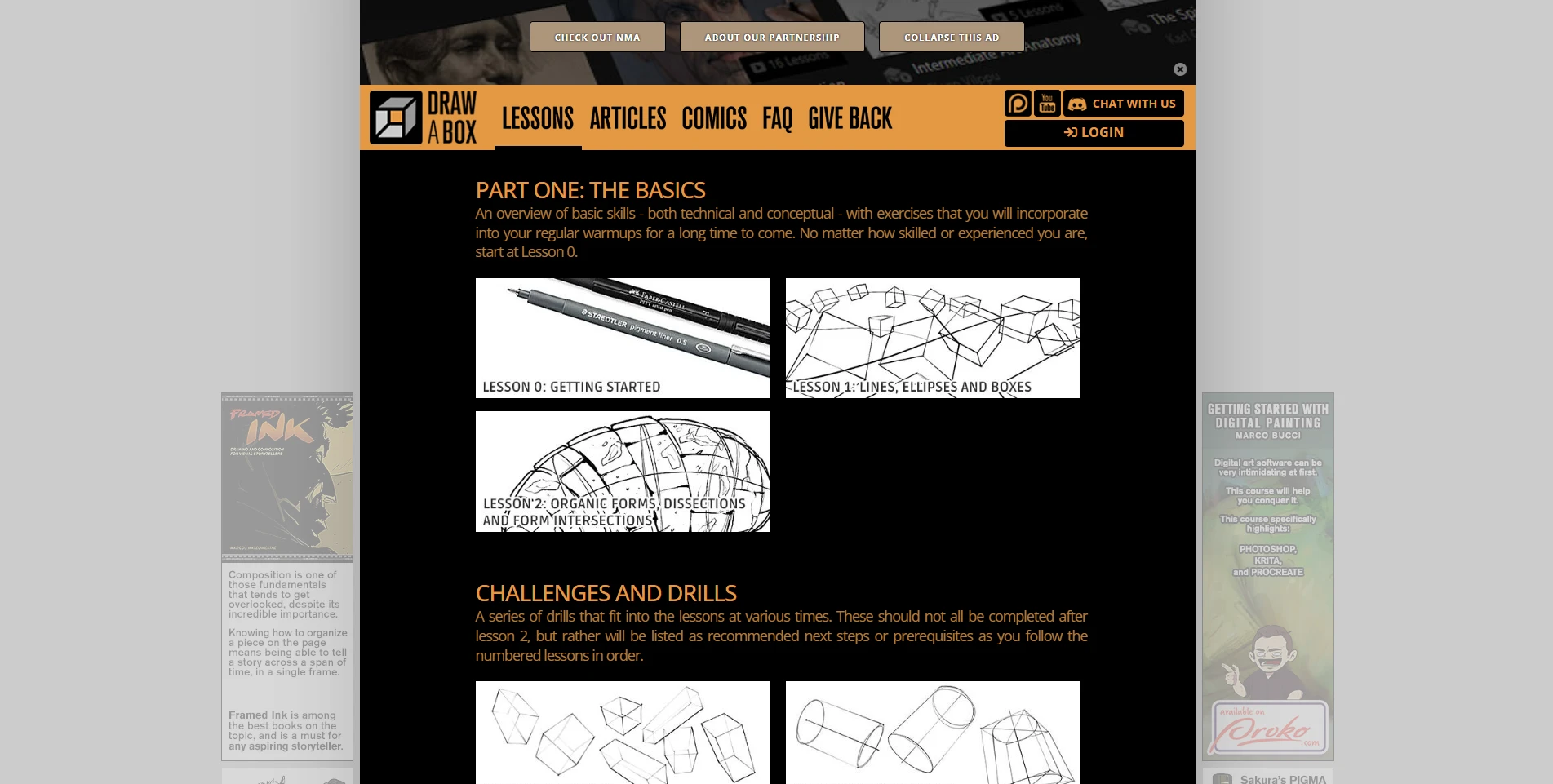
Most free art resources hand you a feel-good pep talk and a loose collection of tips. Drawabox hands you 250 boxes to draw in three-point perspective and tells you to come back when you are done. That contrast tells you everything you need to know about why this course, created by Irshad Karim (known online as "Uncomfortable"), has built a cult following among serious beginners while quietly alienating anyone looking for a quick win.
The entire curriculum is free. Every lesson, every exercise, every demonstration sits on the Drawabox website without a paywall. You do not even need to create an account. The only paid element is optional official critique, and even that costs roughly $5 to $10 per lesson through a credit-based Patreon system that subsidizes the free content for everyone else.
What Makes Drawabox Different from Every Other Free Course
Compare Drawabox to Proko's free YouTube lessons or the free tier on New Masters Academy. Those platforms give you professional-quality video instruction from named experts, polished and edited. Drawabox gives you written lessons with embedded video supplements, a Discord server with thousands of students, and homework assignments that take hours to complete. The production value is lower. The demands are higher. The results, for those who finish, speak for themselves.
The course teaches a specific skill that most online resources skip entirely: construction drawing from imagination. Instead of copying reference photos, you learn to build three-dimensional forms from the inside out using simple geometric volumes. A plant is not a flat shape on paper. It is a cylinder with branching organic forms attached. An animal is a series of interlocking boxes and spheres. A vehicle is a precise arrangement of boxes in perspective with subtractive carving.
This is the same spatial reasoning that concept artists, industrial designers, and animation layout artists use daily. If your goal is to draw from reference and produce pretty pictures, Drawabox is overkill. If your goal is to draw anything from any angle without relying on photos, there is no better free starting point.
The 250 Box Challenge and the 50% Rule
The 250 Box Challenge is the course's signature exercise. You draw 250 boxes in three-point perspective, freehand, rotating each one in space. Most students need several weeks. Many quit. Those who finish report a tangible shift in how they perceive three-dimensional space on a flat surface.
But the more important innovation is the 50% rule. Karim requires students to split their drawing time evenly: half on structured Drawabox exercises, half on drawing whatever they want with zero concern for quality. This is not a suggestion. It is a course requirement. The logic is sound: pure drill work burns people out, while pure recreational drawing produces stagnation. Forcing both creates a sustainable practice loop that keeps students engaged for months rather than weeks.
The Credit System: How the Free Model Actually Works
Drawabox operates on a credit-based system through Patreon. Subscribers receive credits that can be redeemed for official critique from teaching assistants. Credits expire two months after receipt, and the money from expired credits subsidizes the critique program for students with tighter budgets. This is an unusual model, and Karim is transparent about its fragility: if too many students spend their credits and too few let them expire, the program loses money.
The result is that official critique costs roughly half of what it actually costs Drawabox to provide. Students who want feedback can subscribe, redeem credits for homework critiques, and cancel between submissions. Students who want to support the platform can maintain a subscription and let credits expire, knowing their money funds free access for others.
For students who cannot afford Patreon at all, the Drawabox Discord community provides free peer feedback. The subreddit also hosts informal critique threads. The quality of peer feedback varies widely, but the community is active and genuinely supportive.
Partnerships and Perks
Drawabox has secured two notable partnerships that add value for students. The first is with New Masters Academy, where the coupon code DRAWABOX gives 25% off the first billing cycle. NMA hosts Charles Hu's Dynamic Sketching course, which Karim recommends as a video companion to Drawabox's written lessons. The second is with Clip Studio Paint, which offers all Drawabox students a free 30-day DEBUT license with no credit card required.
Drawabox also runs seasonal Promptathon events: week-long community drawing challenges with unique avatar rewards. These events double as a structured way to practice the 50% rule's creative half, and they give the community a shared activity that breaks the isolation of self-paced study.
The Lesson Progression: What You Actually Do
Lessons 1 and 2 develop line confidence and shoulder-driven mark-making. You learn to draw from the shoulder rather than the wrist, producing smooth, confident lines instead of sketchy, hesitant ones. Organic forms exercises introduce three-dimensional volume through curved surfaces.
Lessons 3 through 5 apply construction to plants, insects, and animals. You analyze real subjects, identify their underlying geometric structure, and rebuild them on paper through additive construction. Each category introduces new challenges: branching structures in plants, segmented forms in insects, complex organic curves in animals.
Lessons 6 and 7 tackle everyday objects and vehicles. These are the hardest lessons. You draw manufactured forms with precise perspective, symmetry, and proportion. The skills here transfer directly to industrial design, prop design, and vehicle concept art. Most students hit a wall at this stage, and the dropout rate reflects it.
How Drawabox Compares
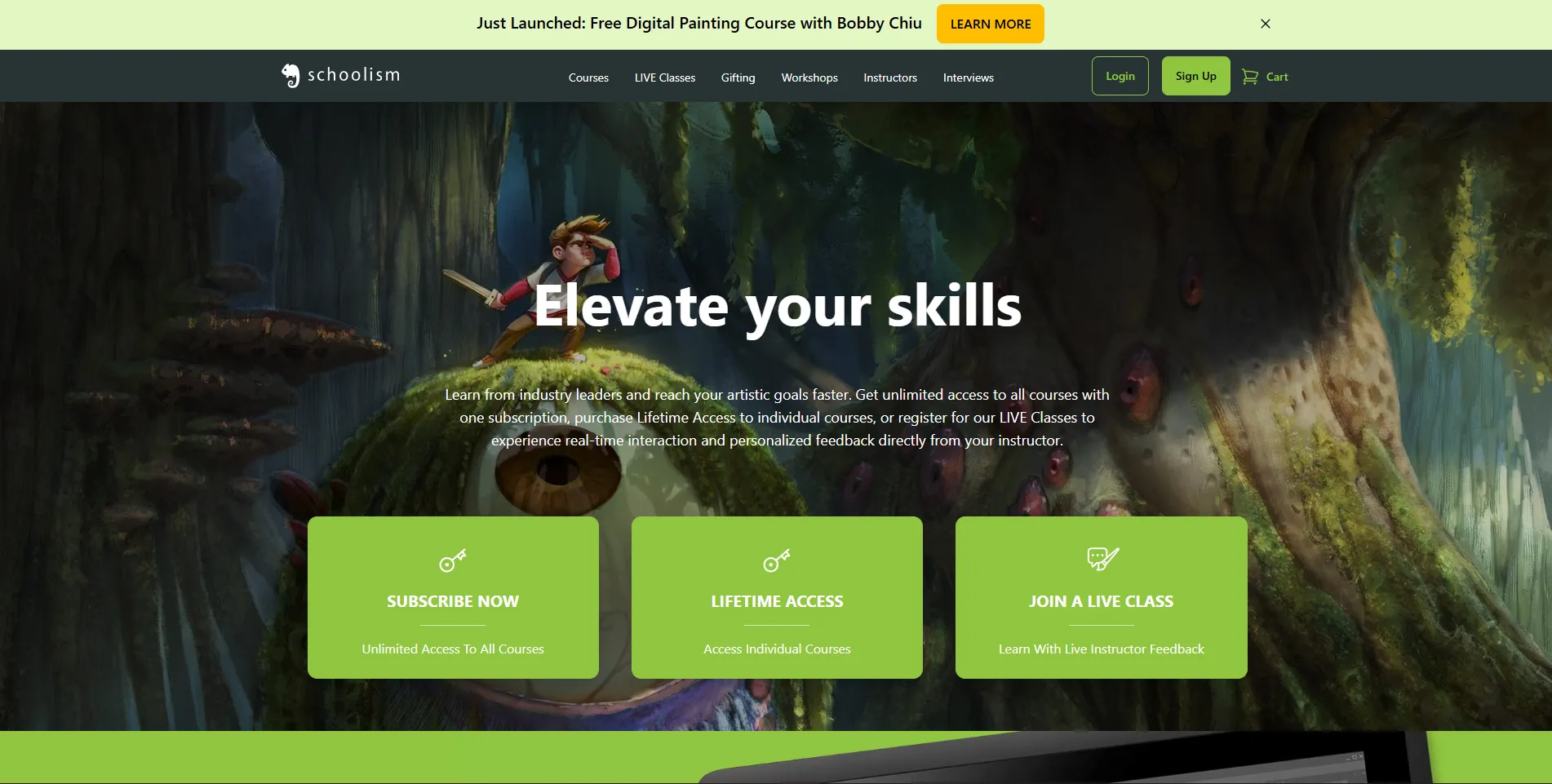
Against Ctrl+Paint, which focuses on digital painting techniques and software workflows, Drawabox is purely traditional and purely fundamental. Ctrl+Paint teaches you how to use tools. Drawabox teaches you how to see. Against Watts Atelier Online, which offers a more comprehensive classical training at a subscription price, Drawabox is narrower in scope but free and self-paced. Against Schoolism, which features named industry instructors teaching specific subjects, Drawabox is anonymous, methodical, and obsessed with fundamentals to the exclusion of everything else.
Final Verdict: Who Is This Actually For?
Drawabox is for complete beginners who want a structured, no-nonsense path from zero to competent construction drawing. It is for self-taught artists whose work looks flat because they lack spatial reasoning skills. It is for aspiring concept artists and industrial designers who need to draw from imagination and cannot yet do so reliably.
It is not for hobbyists who want to draw portraits from reference photos. It is not for experienced artists who already understand construction. And it is absolutely not for anyone who thinks they can skip the 250 Box Challenge.
Start at drawabox.com. Read Lesson 0. Draw your first 250 boxes. Then decide if you have the patience for what comes next.