
Motion Graphics as Art: When Design Starts to Move
Motion graphics have moved from TV titles to gallery walls. Discover the history of moving image design, key artists, and tools shaping visual art in motion.
Your cart is empty
Browse the store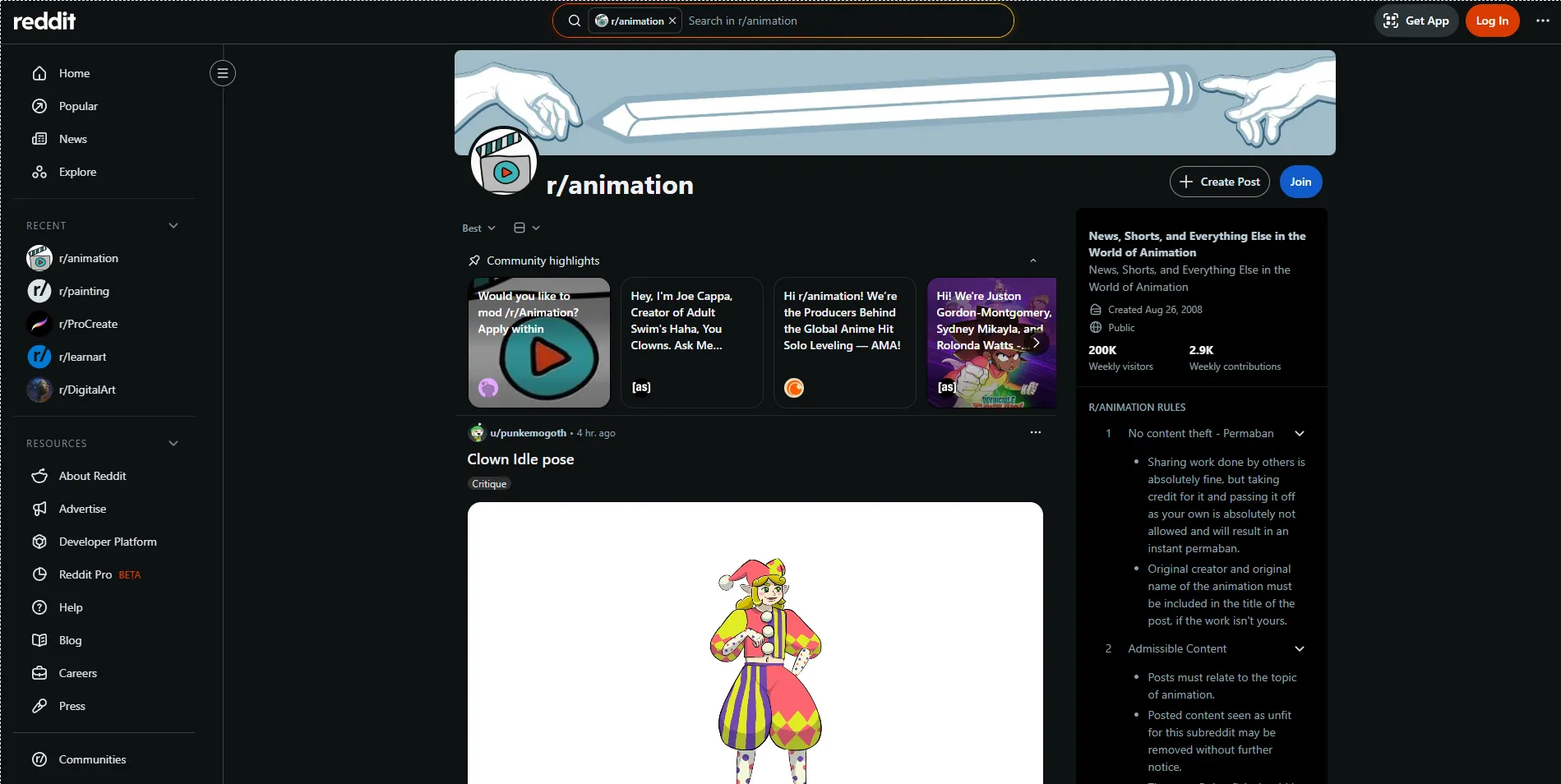
Reddit's largest animation community with 2 million members spanning 2D, 3D, stop motion, and motion graphics, sharing work, career advice, and software discussion.
Discover other art communities you might be interested in
Instagram in 2026 punishes artists who post still images. The algorithm demands Reels, censors artistic nudity, and compresses images. Is it still worth your time?
View details
Home of The Artist's Magazine and Watercolor Artist, offering 1,000+ hours of video instruction, art competitions, and a searchable magazine archive for traditional media painters.
View detailsExplore definitions from our glossary that connect to this community
Motion graphics is graphic design set in motion. Learn its history from Saul Bass and John Whitney to After Effects, key artists, and how animation became design.
Storyboarding is sequential drawing for film and animation pre-production. Learn its history from Disney to the AI storyboarding controversy of 2026.
Read more about this topic on our blog
Motion graphics have moved from TV titles to gallery walls. Discover the history of moving image design, key artists, and tools shaping visual art in motion.

Explore the best Reddit art communities to grow your skills, find inspiration, and get feedback from fellow creative artists.
With approximately 2 million members, r/animation is the largest animation community on Reddit and one of the few places on the internet where a stop-motion claymation artist, a Blender 3D animator, a Toon Boom 2D animator, and an After Effects motion designer all share the same feed. That cross-discipline mixing is both the community's greatest strength and its primary limitation: you get exposure to everything, but deep, specialized technical discussion is often diluted by the sheer breadth of content.
Founded in 2009, the subreddit has grown steadily as animation tools have become more accessible. The explosion of Blender as a free, capable 3D animation tool has brought a wave of independent creators into the community, and the rise of motion graphics as a career path has expanded the motion design contingent. The result is a community that reflects the current state of animation: more disciplines, more tools, more independent creators, and fewer clear boundaries between categories.
The feed is a mix of original work sharing, industry news, software questions, career advice, and festival announcements. Unlike r/art, which is dominated by finished pieces, r/animation has a healthier balance of process content: works in progress, technical questions, and career discussions sit alongside completed animations.
2D animation content covers hand-drawn frame-by-frame work, digital 2D in Toon Boom and TVPaint, vector animation in Adobe Animate, and hybrid approaches. The 2D community within r/animation is particularly vocal about preserving traditional animation skills in an industry dominated by 3D.
3D animation discussions cover character animation, rigging, motion capture, procedural animation, and rendering across Blender, Maya, Cinema 4D, and Houdini. The Blender contingent has grown significantly as the software has improved, and many posts now come from independent creators using free tools rather than studio pipelines.
Stop motion and experimental animation generate enthusiastic engagement because they showcase the handmade, tactile qualities that distinguish physical animation from digital approaches. These posts often punch above their weight in terms of community response relative to their frequency.
Motion graphics content applies animation principles to typography, infographics, UI elements, and brand content. The overlap between animation and motion design creates productive cross-pollination, though some animators feel motion graphics dominates the feed at the expense of character animation.
Some of the most valuable content on r/animation is the career guidance from members working at major studios. Animators from Disney, Pixar, DreamWorks, Sony, Netflix, and Cartoon Network occasionally share insights about hiring processes, portfolio expectations, and the daily realities of production work. This is information that recruitment marketing and school brochures will never tell you.
Discussions about animation education help prospective students evaluate schools, online courses, and self-study resources. Members who have attended specific animation programs share honest assessments of education quality, job placement rates, and whether the investment was worth it. With animation education costing tens of thousands of dollars at many institutions, this kind of peer-sourced evaluation is genuinely useful.
The community also discusses working conditions, salary expectations, and studio cultures with a transparency that the animation industry often lacks. The wave of industry unionization efforts in recent years has made these discussions more frequent and more politically charged, which some members welcome and others find distracting from the art itself.
The community provides extensive software recommendations across every animation discipline. The most common comparisons:
These discussions help animators choose tools for their specific needs and budgets. The Blender vs. Maya debate is particularly active, with Blender advocates pointing to its rapid improvement and zero cost, while Maya defenders note its dominance in studio pipelines and superior rigging tools.
r/animation actively promotes animation festivals, short film screenings, and independent animation projects. Festival announcements, submission deadline reminders, and discussions of award-winning shorts expose members to the breadth of animation as an art form: experimental work, artistic shorts, documentary animation, and personal expression that differs dramatically from commercial animation.
This festival culture helps maintain the artistic identity of animation within a community that could easily become dominated by commercial production discussion. By celebrating independent and experimental work alongside studio animation, r/animation reinforces the idea that animation is both an art form and an industry.
r/animation's advantage is its size and cross-discipline scope. Its disadvantage is that specialized questions about, say, Maya rigging or TVPaint brush settings may get better answers in smaller, more focused communities.
This is for you if: You are an animator or animation student who wants broad exposure to multiple disciplines. You are looking for career guidance from people working in the industry. You want to share work and receive feedback from a large, active community. You are interested in independent and festival animation alongside commercial work.
This is not for you if: You need deep, specialized technical discussion on a single software or discipline (use a dedicated subreddit or Discord). You are looking for structured education (use an online school or course). You want professional networking with industry recruiters (use LinkedIn or ArtStation).
r/animation is the broadest, most active animation community on Reddit. Its cross-discipline scope is both its strength and its weakness: you get exposure to everything animation-related, but specialized technical depth requires supplementing with smaller communities. For animators who want a general hub for inspiration, career guidance, community feedback, and industry news, it is the default choice.
Next steps: Visit r/animation and sort by "Hot" to see current content, then try filtering by flair to find critique requests or career discussions. For more animation resources, check our YouTube channels directory for animation educators and our art courses directory for structured animation training. You can also explore our art software directory for animation tools like Blender, Toon Boom, and TVPaint.
Quiet Canvas is a space for artists and art lovers: essays, glossary terms, tools, and curated directories to support your creative practice.
Learn more →


