
Morehshin Allahyari did not have access to the original artifacts. The Islamic State had already destroyed them. So she did the only thing left: she spent months modeling the figures that once stood in the ancient Assyrian city of Nimrud, reconstructing them in ZBrush from photographs and archival records, then 3D-printed each one in translucent resin with a USB drive and a memory card embedded inside. The drives contain digital records. The resin holds them like amber holds an insect. The result is not a replica and not a monument. It is something new, a class of object that only exists because digital sculpture tools exist.
That series, "Material Speculation: ISIS" (2015-16), is a useful starting point for understanding what 3D art is and what it is for. The tools involved, ZBrush for sculpting, desktop resin printing for fabrication, are the same ones that game studios use to build character models and that product designers use to prototype hardware. The difference is entirely in what you decide to make with them and why.
Right now, in mid-2026, those tools are more capable and more affordable than they have ever been. Blender 4.5 LTS, released in July 2025, introduced full Vulkan graphics support, faster EEVEE shader compilation, and a new manifold boolean solver in Sculpt Mode that makes complex subtraction operations significantly more reliable. Desktop FDM printers from Bambu Lab and Prusa cost between $200 and $600 and produce quality suitable for editions and exhibition. The pipeline from concept to physical sculptural object has never been shorter for an independent artist working without institutional support.
Why 3D Art Is a Fine Art Medium
The question of whether 3D art qualifies as fine art rather than commercial craft was largely settled over the past decade by a combination of institutional acceptance and market activity. Works created in 3D software are collected by major institutions, exhibited at venues including documenta and the Venice Biennale, and sold through major auction houses. Artists like Hito Steyerl, whose practice incorporates 3D rendering and simulation, received the Hugo Boss Prize from the Guggenheim Museum. The Museum of Modern Art and the Serpentine Gallery in London both hold significant works by artists associated with the post-internet generation who worked substantially in 3D.
The more interesting development of the last few years is the growth of a serious independent 3D art practice that exists entirely outside the gallery system. Artists building audiences through social platforms, selling rendered prints and physical editions directly to collectors, and exhibiting through digital-native venues have created a parallel ecosystem where the work is judged on its own terms rather than by its relationship to the fine art market. The entry costs are low enough that a committed self-taught artist working with free software and a consumer printer can develop a technically serious practice. That was not true fifteen years ago.
Blender: What It Is and What It Does
Blender is a free, open-source 3D creation suite maintained by the Blender Foundation and a large international contributor community. A single installation handles modeling, sculpting, rigging, animation, fluid and particle simulation, rendering, compositing, and video editing. Its rendering engine Cycles produces photorealistic output that competes with professional commercial renderers. Its real-time engine EEVEE handles fast previews and stylized rendering at a quality level suitable for final output in many contexts.
For artists coming from traditional sculpture or painting, Blender's sculpt mode is the most accessible entry point. The brush set behaves analogously to clay tools: you can push and pull geometry with the Grab brush, smooth transitions with the Smooth brush, create hard creases with the Crease brush, and build up surface mass with the Clay Strips brush in ways that translate directly from physical clay intuitions. The Blender 4.4 update added a new Plane brush that generalizes the older Flatten, Fill, and Scrape tools with adjustable height and depth control, useful for flattening reference planes on portraits and figures.
Blender's learning curve is real. The keyboard shortcuts, once internalized, make the workflow fast, but the early weeks feel laborious in a way that traditional media rarely do. The standard starting resource is Blender Guru's Donut Tutorial, a free YouTube series that has been watched over 100 million times. It takes a complete beginner from opening the application to producing a fully rendered image. Follow it through to completion before attempting original work, because it gives you the vocabulary of the interface without requiring you to make creative decisions simultaneously.
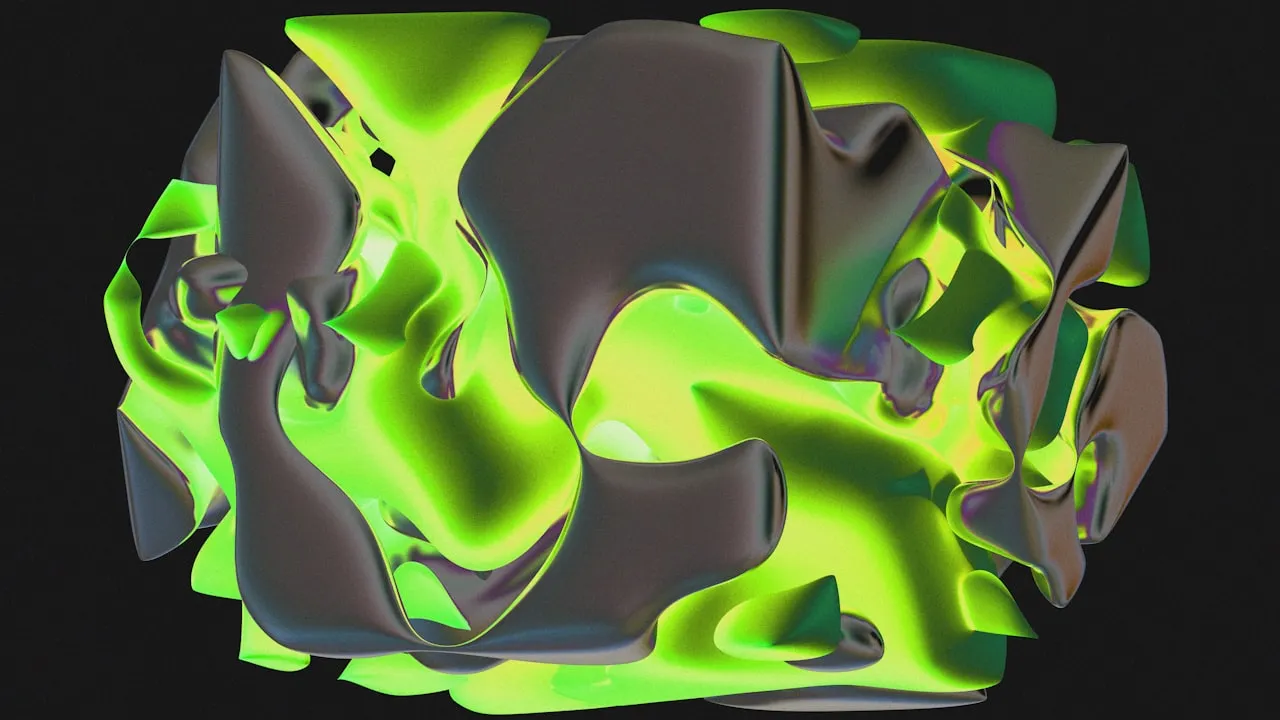
3D rendered digital sculpture. Software like Blender can produce imagery that exists purely as rendered output or serves as the basis for physical fabrication through 3D printing. Photo: Unsplash.
ZBrush: The Industry Standard for Organic Sculpting
ZBrush, made by Pixologic and now owned by Maxon, has been the default tool for digital sculpting in film, games, and visual effects since the early 2000s. Its proprietary Pixol technology handles meshes with tens of millions of polygons without the performance collapse that standard polygon-based software would experience at those polygon counts. That means you can sculpt pores in skin, individual hair follicles, fabric weave, and fine jewelry detail without switching tools or decimating the mesh.
For figurative sculpture, character design, and any work where fine organic surface detail is central, ZBrush is still the more capable tool. Weta Workshop, Industrial Light and Magic, and most major games development studios use it as a standard part of their pipeline. When you see a photorealistic creature or character in a contemporary film, ZBrush was almost certainly involved at the high-resolution sculpting stage, with the finished model then retopologized and rendered through other software.
ZBrush requires a subscription through Maxon One or a standalone purchase, placing it at a meaningfully higher cost than Blender. Its interface is unusual and takes real time to become comfortable with: menus are contextual in ways that differ from standard software conventions, and the navigation model has its own logic. For artists committed specifically to high-resolution digital sculpture of figures or organic forms, the investment pays off. For those whose work is more architectural, hard-surface, or mixed-media, Blender's sculpting tools now offer a compelling free alternative for most applications.
3D Printing: From Digital File to Physical Object
Once a 3D model exists in software, it can be fabricated into a physical object through additive manufacturing, commonly called 3D printing. The technology builds objects by adding material layer by layer rather than carving it away. For artists, three fabrication pathways are relevant depending on scale, surface quality, and budget.
FDM (Fused Deposition Modeling) prints by melting plastic filament and depositing it in layers. Entry-level FDM printers from Bambu Lab and Prusa cost between $200 and $600 in 2026 and produce output suitable for sculptural prototypes, larger-scale editions, and display-quality pieces with finishing work. Layer lines are visible without sanding and priming, but for work where texture is acceptable or intentional, FDM is the fastest and cheapest path from file to object.
Resin printing (SLA and MSLA) produces much finer surface detail, approaching the smoothness of cast resin or ceramic. Resin printers from Elegoo and Anycubic are available for under $300. The tradeoff is that liquid resin requires UV curing post-processing and involves handling chemicals that require gloves and ventilation. For small-scale figurative sculpture where surface quality matters, resin printing is the appropriate technology.
For metal printing, large-scale fabrication, and professional surface finishes beyond what desktop equipment can achieve, services including Shapeways and Materialise accept 3D model files and return finished objects in stainless steel, titanium, bronze, and ceramic. The cost per piece is significantly higher, but so is the quality ceiling, and there is no equipment to maintain or calibrate.
Artists Doing Significant Work in 3D
Morehshin Allahyari uses 3D printing as a tool of cultural documentation and political resistance. Her "Material Speculation: ISIS" series (2015-16) reconstructed ancient Mesopotamian artifacts destroyed by the Islamic State, embedding archival data drives within the printed resin forms. The works treat digital fabrication as a form of preservation that is simultaneously artwork and archive.
Neri Oxman, whose practice at MIT Media Lab combined computational design with biological systems, produced "Silk Pavilion" (2013) by using a CNC-wound silk frame as a scaffold for silkworm activity, then documented and modeled the resulting structure. Her work consistently used 3D modeling and printing to explore the boundary between what machines make and what living systems grow.
Joris Laarman designs furniture and sculpture using robotic metal printing, producing lattice structures that conventional casting cannot achieve. His "Bone Chair" series applies algorithmic structural optimization derived from the same principles that govern how biological bone distributes load, generating forms that look organic because they solve structural problems the way organisms do.
Stephanie Dinkins pairs 3D-printed portrait busts with AI systems in her project "Not the Only One," which trains a conversational AI on recorded family histories. The 3D-printed forms provide a physical anchor for a work that is fundamentally about memory, race, and the transmission of stories across generations. The combination of fabricated sculpture and artificial intelligence is characteristic of where 3D art is going: the tools are becoming elements in larger systems rather than ends in themselves.
How to Start a 3D Practice
The most practical starting point in 2026 is Blender, because it is free and because its community has produced an extensive library of tutorials covering every level of skill and every kind of work. Download it from blender.org. Open Blender Guru's Donut Tutorial and work through it completely before attempting original projects. This gives you the fundamental vocabulary of the interface and the rendering pipeline without requiring you to make creative decisions simultaneously with learning the tool.
After completing a structured tutorial, the direction of your practice should follow what you want to make. For artists coming from traditional sculpture who want to translate clay intuitions into digital form, start directly in Sculpt Mode. Enable dynamic topology, select the Grab brush, and begin pushing and pulling a sphere. The first session will feel disorienting. By the third or fourth session, the spatial reasoning becomes more natural, and the tool starts to feel like an extension of your hands rather than an obstacle to get past.
If physical output is your goal, start planning your 3D printing workflow before you finish your first model. The file formats, mesh requirements, and surface preparation needed for printing differ from what you need for a rendered image. Learning those constraints early prevents the frustration of finishing a model only to discover it cannot be fabricated as designed.
For a broader picture of where 3D art sits within contemporary digital practice, the guide to digital art covers the full field. The guide to sculpture materials provides the historical context from clay and bronze through to the contemporary expanded definition of sculpture that makes digital fabrication possible.
Where This Goes Next
The most significant current development in 3D art is the integration of AI-generated geometry and texture with traditional sculpting workflows. Tools for generating 3D models from text prompts or photographic references already exist in early form, and they are improving rapidly. The question for artists is how to use these tools as a starting point rather than an endpoint, the same question that photographers asked about cameras and that digital painters asked about Photoshop. The tools do not make the decisions. They expand the range of decisions available.
Three-dimensional digital art is not a replacement for physical sculpture, painting, or drawing. It is an expansion of what is possible. The combination of accessible software, capable desktop printers, and a global community of artists and educators has made this one of the most open fields in contemporary art practice. What aspect of 3D art are you most interested in exploring? Share in the comments below.


