NEA Grants for Arts Projects: Federal Funding for the Arts Across America
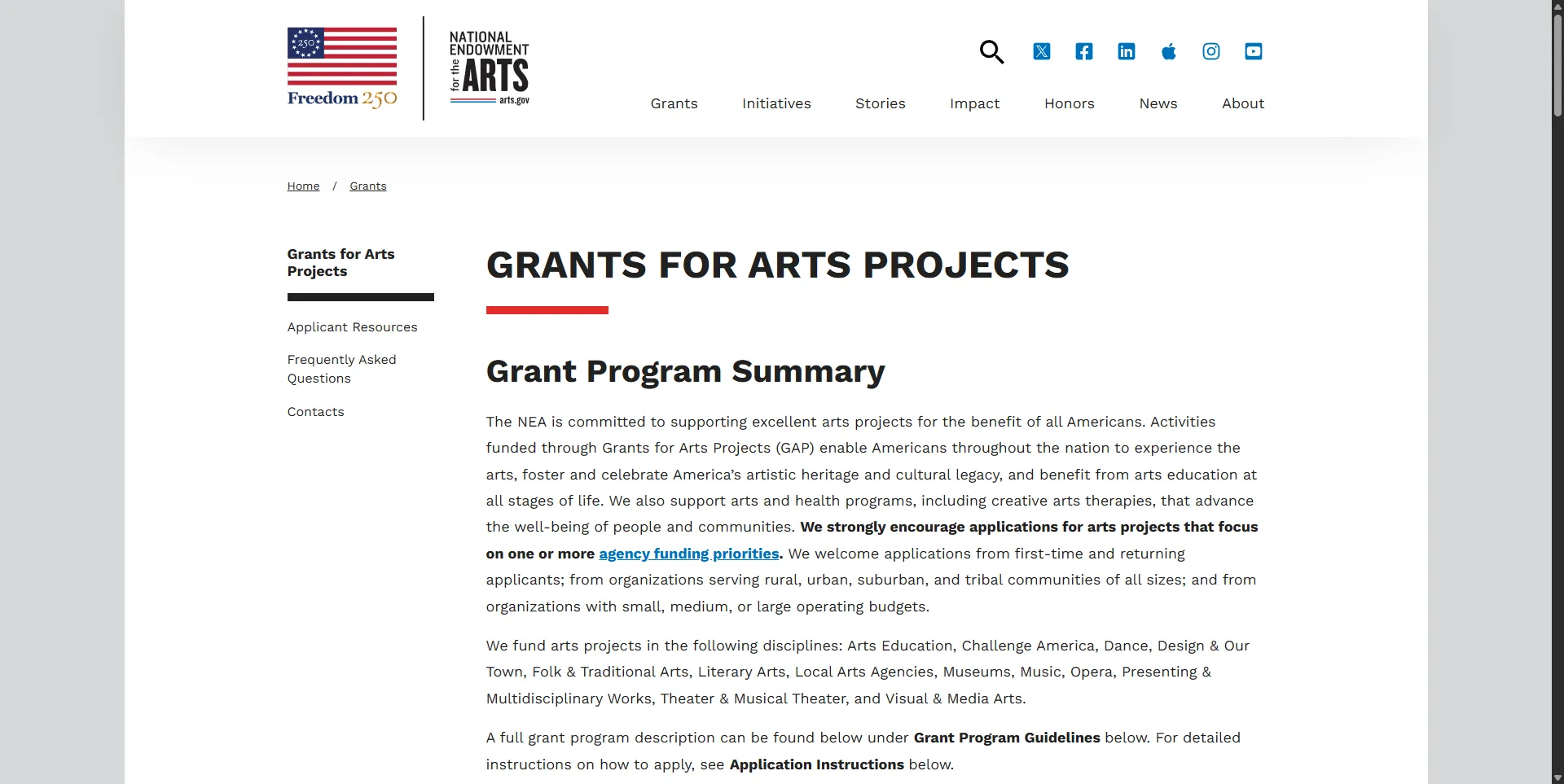
Grants for Arts Projects (GAP) is the National Endowment for the Arts' principal grants category and the largest source of federal arts funding in the United States. The program provides project-based funding to arts organisations, government bodies, and tribal communities across all 50 states, the District of Columbia, and US territories, supporting arts projects of all sizes in every artistic discipline. For visual artists working through or with eligible organisations, NEA grants represent one of the most significant sources of public funding available in the country.
The National Endowment for the Arts was established by Congress in 1965 as an independent federal agency with the mission of supporting excellence in the arts and making the arts accessible to all Americans. Since its founding, the NEA has awarded more than $5 billion to arts organisations and projects across the country, funding work that ranges from community arts education programs in rural towns to major museum exhibitions in metropolitan centres. The agency is, as it describes itself, the only arts funder in the United States that provides access to the arts in all 50 states, the District of Columbia, and US jurisdictions.
The FY2026 Grant Cycle
For fiscal year 2026, the NEA revised its Grants for Arts Projects guidelines, with updated information made available on arts.gov in February 2025. The FY2026 cycle has two application deadlines: one in March 2025 and one on April 24, 2025, for projects taking place beginning in 2026. The NEA hosted guidelines webinars in February 2025 to help applicants understand the requirements and prepare strong applications.
It is important to note that NEA grants fund organisations, not individual artists directly. Visual artists who want to access NEA funding typically do so through partnerships with eligible nonprofit organisations, arts centres, museums, or community organisations that can serve as the fiscal sponsor or lead applicant for a project involving the artist's work. This structure means that individual artists need to build relationships with eligible organisations and develop projects that align with those organisations' missions and the NEA's funding priorities.
What Gets Funded
Grants for Arts Projects supports an extraordinarily wide range of arts activities. In the visual arts, funded projects have included major museum exhibitions, public art commissions, community mural programs, artist residencies, arts education initiatives, craft and folk art preservation projects, and interdisciplinary projects that combine visual art with other disciplines.
The NEA's funding priorities emphasise geographic diversity, ensuring that arts funding reaches communities across the country rather than concentrating in major metropolitan areas. Projects in rural communities, underserved urban neighbourhoods, and regions with limited arts infrastructure are viewed favourably, as are projects that make the arts accessible to audiences who might not otherwise have access to them.
Public art is a particularly strong area for NEA funding. Projects that bring visual art into public spaces, engage communities in the creation of public works, or use art to address community needs and concerns align well with the NEA's mission of making the arts accessible to all Americans. Many of the most significant public art projects in American cities over the past several decades have received NEA support.
Arts education projects that use visual art to engage students, communities, or underserved populations are also well-aligned with NEA priorities. Projects that combine professional artistic practice with educational programming, community engagement, or social impact are viewed favourably by review panels.
Award Amounts and Cost Sharing
NEA Grants for Arts Projects awards range from $10,000 to $100,000, with most awards falling in the $10,000 to $50,000 range. The program requires a cost-sharing match: applicants must demonstrate that they will match the federal award with non-federal funds at a ratio of at least 1:1. This means that an organisation receiving a $25,000 NEA grant must raise at least $25,000 from other sources to support the project.
The cost-sharing requirement serves multiple purposes. It ensures that NEA funding is leveraged to support projects that have demonstrated community and philanthropic support, it encourages organisations to build diverse funding bases rather than relying solely on federal support, and it ensures that the total investment in funded projects exceeds the federal contribution.
For organisations with strong fundraising capacity, the NEA grant can serve as a powerful catalyst, providing the federal endorsement that makes it easier to attract matching funds from foundations, corporations, and individual donors. Many funders view NEA support as a mark of quality and are more likely to fund projects that have received federal recognition.
The Peer Review Process
NEA grant applications are reviewed by panels of arts professionals with expertise in the relevant discipline and knowledge of the communities being served. Panels typically include artists, curators, educators, administrators, and community leaders who bring diverse perspectives to the evaluation of applications.
The review process evaluates applications on the basis of artistic excellence and artistic merit, the quality of the organisation's management and track record, the project's potential impact on the communities it will serve, and the feasibility of the project plan and budget. Applications that demonstrate both high artistic quality and meaningful community engagement tend to be most competitive.
The NEA publishes detailed guidelines for each grant cycle that explain the review criteria, the application requirements, and the characteristics of competitive applications. Organisations preparing applications are strongly encouraged to read these guidelines carefully and to attend the NEA's guidelines webinars, which provide detailed guidance on how to present projects effectively.
The NEA's Broader Impact
Beyond the direct funding it provides, the NEA has a multiplier effect on arts funding in the United States. The agency's State Arts Agencies program distributes a portion of NEA appropriations to state arts councils, which in turn fund arts organisations and projects in their states. This network of state arts agencies extends the reach of federal arts funding to every corner of the country and provides an additional source of funding for organisations that may not be competitive for direct NEA grants.
The NEA's endorsement also carries significant weight in the broader funding landscape. An NEA grant signals to private foundations, corporations, and individual donors that a project or organisation has been evaluated and found worthy of federal support. This endorsement can be a powerful tool in fundraising, helping organisations attract the matching funds required by the NEA's cost-sharing requirement and building the broader funding base that sustains long-term artistic work.
How Visual Artists Can Access NEA Funding
Individual visual artists who want to access NEA funding should focus on building relationships with eligible organisations whose missions align with their work. This might mean approaching a local arts centre, museum, community organisation, or university about co-developing a project that would be eligible for NEA support. It might mean working with a fiscal sponsor, an organisation that agrees to receive and administer grant funds on behalf of an individual artist or unincorporated project.
Artists should also be aware of the NEA's Research Grants in the Arts program, which supports research on the value and impact of the arts. This program has different eligibility requirements and may be accessible to academic researchers and research organisations studying visual art and its effects on communities and individuals.
The Bottom Line
NEA Grants for Arts Projects represents the most significant source of federal arts funding in the United States, supporting visual art projects of all sizes in communities across the country. For organisations working with visual artists, the program offers substantial project funding, federal endorsement, and the leverage to attract matching funds from other sources. For individual artists, the path to NEA funding runs through partnerships with eligible organisations, but the rewards of that partnership, both financial and reputational, make it well worth pursuing.