Arts Council of Ireland: Visual Arts Bursary Up to €20,000 for Irish Artists
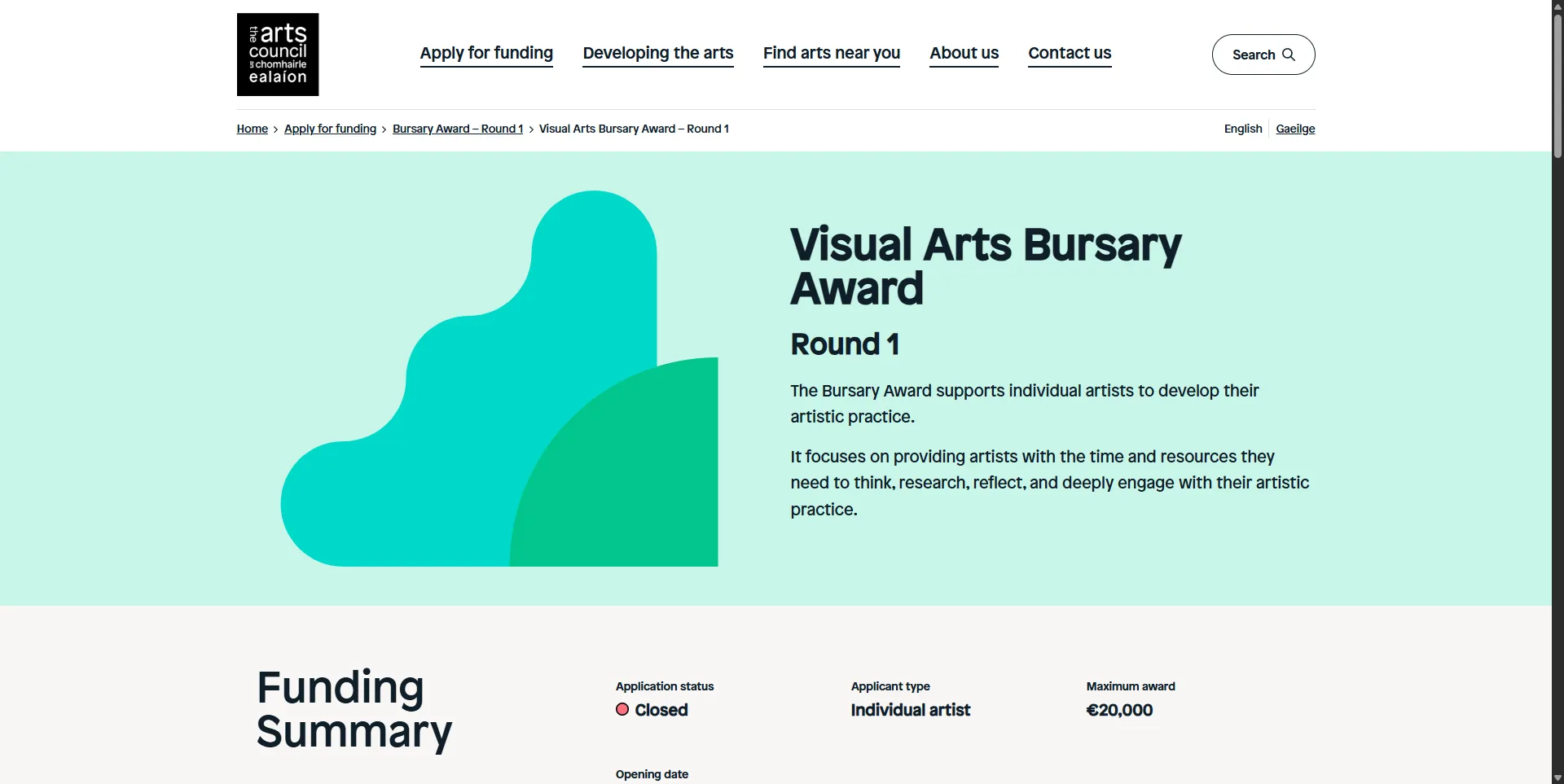
The Arts Council of Ireland (An Chomhairle Ealaíon) is the primary public funder for visual artists in the Republic of Ireland. Established by the Arts Act of 1951, it distributes government funding through several grant programs. The Visual Arts Bursary is the most substantial of these, offering up to €20,000 to individual professional artists and curators to develop their practice.
For 2026, the bursary has been restructured into three distinct strands, including a new pilot strand for emerging artists. This is a meaningful change. Previously, emerging artists competed directly against established practitioners for the same funding pool. Now, there is a dedicated pathway with a lower maximum but a better chance of success.
The Three Bursary Strands
Strand 1: Emerging Artists (€10,000)
This is a pilot strand for early-career artists who have not previously received an Arts Council Bursary Award, Next Generation Award, or Markievicz Award. The maximum award is €10,000, and the Arts Council will support up to five artists under this strand in 2026.
The emerging strand is designed to give early-career artists access to a competitive award as a professional development tool. You can use the bursary to spend time developing your artistic practice, exploring and resolving a specific body of work, or re-engaging with your practice after a break. You can also use it for studio or workspace costs, research facilities, residencies, training, and work with mentors, producers, or collaborators.
If you are an emerging artist, you can choose to apply for Strand 1 (€10,000) or Strand 2 (€15,000 or €20,000). The trade-off is straightforward: Strand 1 has a lower maximum but less competition from established artists. Strand 2 has a higher maximum but you are competing against artists with longer track records.
Strand 2: Visual Artists (€15,000 or €20,000)
This is the standard bursary strand for professional visual artists who do not qualify as emerging. You can apply for either €15,000 or €20,000. There are no amounts between these bands. If you request an amount that is not one of the fixed bands, the Arts Council will round any offer down to the next lowest band. For example, if you request €19,500, the maximum possible offer is €15,000.
Strand 3: Curators (€10,000 to €20,000)
Curators can apply for €10,000, €15,000, or €20,000 under this strand. The bursary supports curatorial research, development, and practice.
Key Dates for 2026
Round 1
- Applications open: Tuesday, January 6, 2026
- Deadline: Thursday, February 12, 2026 at 5:30pm (Ireland time)
- Shortlist notification: by May 8, 2026
- Final decisions: by May 29, 2026
Round 2
- Applications open: Tuesday, May 19, 2026
- Deadline: Thursday, June 18, 2026 at 5:30pm (Ireland time)
You can only apply for one round per year. If you apply in Round 1 and are unsuccessful, you cannot apply again in Round 2 for the same year.
Important Rule: Bursary or Agility, Not Both
In 2026, you can only apply for a Bursary Award or an Agility Award, not both. The Agility Award is a separate Arts Council program for early-career artists that supports shorter-term professional development. If you are considering both, you need to decide which one is more appropriate for your needs before applying. The Bursary is for sustained practice development. The Agility Award is for shorter, more targeted development activities.
What the Bursary Supports
The Visual Arts Bursary is designed to give artists the time and financial security to develop ambitious new work or undertake a significant period of research and experimentation. Supported activities include:
- Studio time to develop a specific body of work
- Research and experimentation with new materials, techniques, or approaches
- Residencies that provide time and space for focused creative development
- Training and mentoring to extend your technical or conceptual range
- Re-engagement with your practice after a break
- Studio or workspace costs during the bursary period
The bursary is not designed to fund the production of finished work for a specific exhibition or commission. It is about giving you the time and resources to think, research, reflect, and deeply engage with your practice. This is similar to the Arts Council England DYCP program, which also focuses on development rather than production.
The Application Process
Applications are submitted through the Arts Council of Ireland's online grants management system. You will need:
- A comprehensive portfolio of recent work
- A detailed artist statement
- A clear description of the proposed activity during the bursary period
- Evidence of professional practice
- A budget if applicable
The assessment is conducted by a panel of arts professionals who evaluate applications based on artistic quality, the ambition and clarity of the proposed activity, and the potential impact of the funding on your practice.
The Arts Council encourages artists to contact them before submitting an application to discuss their proposal and ensure it meets the program's criteria. This pre-application support is particularly valuable for first-time applicants.
How the Irish Arts Council Compares to Other Funders
- vs. Arts Council England DYCP: DYCP offers up to £12,000 (roughly €14,000) for individual development in England. The Irish bursary offers up to €20,000, which is more generous, but the Irish arts funding ecosystem is smaller overall.
- vs. Arts Council of Northern Ireland: ACNI's SIAP offers £3,000 to £10,000 (roughly €3,500 to €11,500) for individual artists in Northern Ireland. The Irish bursary offers significantly more money but is also more competitive.
- vs. Arts Council of Wales: ACW's Creative Practice program offers £500 to £10,000 (roughly €600 to €11,500) for individual artists in Wales. Again, the Irish bursary is more generous.
- vs. Creative Scotland Open Fund: Creative Scotland offers up to £100,000 for creative projects in Scotland, but that program is project-based rather than bursary-based.
The Irish Arts Context
Ireland has a distinctive artistic tradition with strong roots in painting, printmaking, and craft, alongside a growing contemporary art sector. The Arts Council's support reflects the specific challenges facing artists in Ireland: a relatively small domestic art market, the importance of international engagement for career development, and the specific cultural and historical context that shapes Irish artistic practice.
The Irish language is another dimension of the Arts Council's work, with specific programs supporting artists who work in Irish or engage with Irish language culture. The Arts Council's commitment to Irish language arts reflects the understanding that the vitality of the Irish language is tied to the vitality of Irish culture more broadly.
Insider Tips for Applicants
- Choose your strand carefully. If you are an emerging artist, seriously consider Strand 1. The €10,000 cap is lower, but the competition pool is smaller and the Arts Council is specifically looking to support early-career artists.
- Apply for a fixed band amount. Do not request €17,000. You can only apply for €10,000, €15,000, or €20,000 (depending on your strand). Any other amount will be rounded down.
- Do not apply for both Bursary and Agility. You must choose one. The Bursary is for sustained development. The Agility Award is for shorter activities.
- Contact the Arts Council before applying. They encourage pre-application conversations and can help you determine whether your proposal fits the criteria.
- Check the deadline time. The Round 1 deadline is 5:30pm Ireland time on February 12, 2026. Not midnight. Not end of day. 5:30pm.
Final Verdict: Who Is This Actually For?
The Arts Council of Ireland Visual Arts Bursary is for professional visual artists and curators based in the Republic of Ireland who need sustained time and financial support to develop their practice. The €20,000 maximum for established artists and €10,000 for emerging artists makes this one of the more generous individual artist bursaries in Europe.
If you are an Irish-based artist at a turning point in your practice, this is your primary public funding route. The two-round structure gives you flexibility on when to apply, but remember you can only apply once per year. Choose the round that gives you the most time to prepare a strong application.
Visit artscouncil.ie for the full guidelines and application portal. Read the 2026 guidelines document carefully, as the three-strand structure is new and the rules differ from previous years.