
Every technology fails in its own way. A scratched vinyl record skips. A damaged VHS tape produces rainbow noise and frozen frames. A corrupted image file produces something that no photographer intended: color bands across a face, blocks of color where detail should be, the entire image fractured into geometric noise. For most people, these are errors to be fixed or discarded. For glitch artists, they are materials to be worked with, methods to be cultivated, and windows onto something that correctly functioning technology deliberately conceals.
Glitch art is the practice of intentionally introducing or exploiting digital or electronic errors for aesthetic purposes. It is a relatively young field as a named practice, emerging explicitly in the late 1990s and early 2000s, but it has roots in the longer traditions of noise music, video synthesis, and the conceptual art of the 1960s and 1970s. Understanding it requires understanding what a glitch is philosophically, not just technically.
What Is a Glitch?
In everyday usage, a glitch is a small and usually temporary technical problem. In glitch art, the word carries additional meaning. A glitch is a moment when a technology's underlying structure becomes visible. When an image file is corrupted, what you see is no longer the image the photographer intended. What you see is the image as data: the raw information that the file contains, interpreted incorrectly. The glitch reveals that the image was never a transparent window onto the world. It was always an encoded file, a set of instructions that the viewing software has been following faithfully until now.
This philosophical dimension, the glitch as revelation of the constructed nature of digital representation, is what distinguishes serious glitch art from casual visual effects. When Rosa Menkman, one of the field's most important theorists and practitioners, writes about glitch aesthetics in her "Glitch Studies Manifesto" (2010), she describes the glitch as "a wonderful interruption that shifts an object away from its ordinary form and discourse." The error is not a failure. It is a different kind of information.
Key Techniques
Databending is the practice of opening a digital file in a program that was not designed to read that file type, editing its underlying data, and saving the result. Opening a JPEG image file in a text editor and adding random characters to its code will produce visual distortions when the file is reopened in an image viewer. Opening it in an audio editor and applying effects designed for sound will produce different, often more structured distortions. The results are unpredictable and depend on the internal structure of the specific file format: different image formats produce different kinds of glitch because their compression schemes work differently.
Datamoshing is a video-specific technique that exploits the way video compression works. Modern video codecs compress footage by only recording changes between frames rather than storing every frame as a complete image. A "keyframe" is a complete image; "interframes" only record what has changed since the last keyframe. Datamoshing removes keyframes and replaces them with interframes from a different piece of footage, causing the motion data from one scene to be applied to the colors of another. The result is the characteristic smearing and bleeding of video datamoshing: the face from one video moving across the background of another, forms dissolving and reforming in ways that belong to neither source clip.
Circuit bending is an analog predecessor to databending that involves modifying the circuitry of electronic devices, particularly cheap keyboards, game consoles, and toys, to create unintended and often unstable behaviors. Sound-producing devices circuit-bent to add switches that route signals in unintended ways, short-circuit certain components, or feed output back into input produce sounds that no factory engineer planned. Visual circuit bending applies similar logic to video hardware, introducing noise, feedback, and instability into the signal path to produce visual distortion.
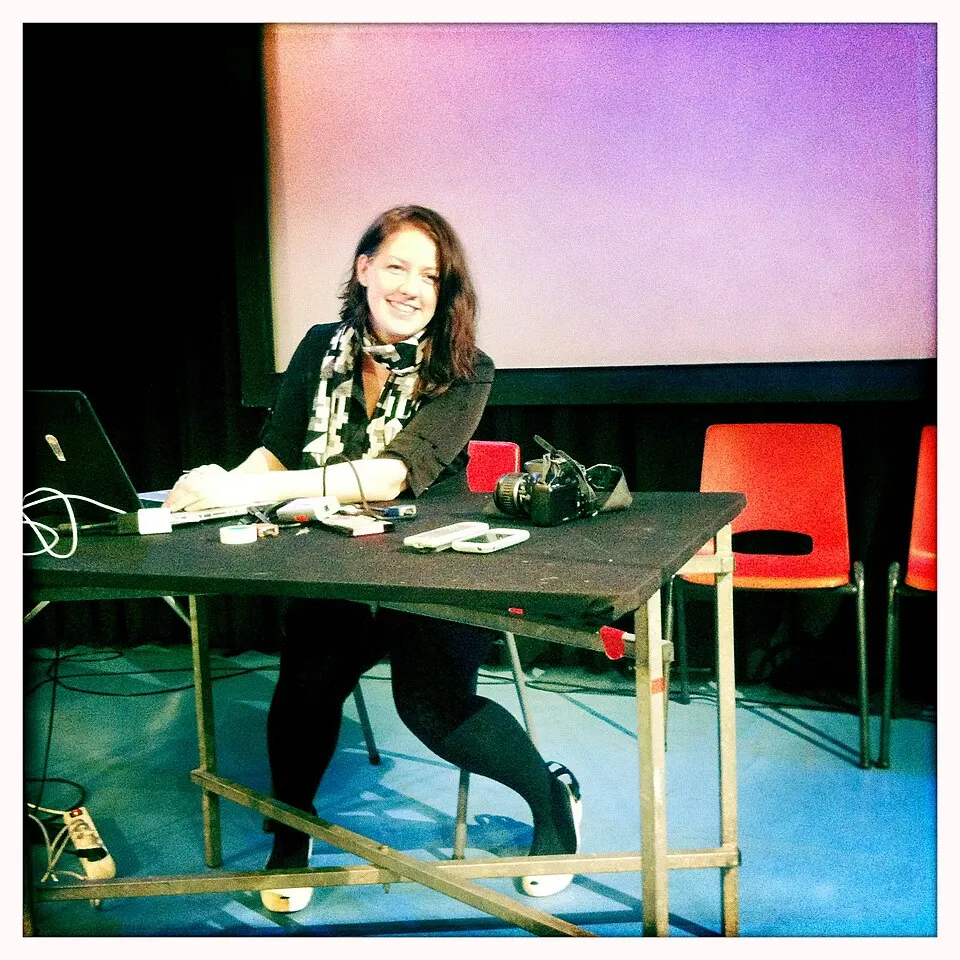
Rosa Menkman performing "Glitch Moment(um)" at STEIM, Amsterdam, 2011. Menkman's live performances combine audio and video glitch techniques in real time. Wikimedia Commons.
Notable Glitch Artists
Rosa Menkman is both a practitioner and a theorist who has done more than anyone to establish glitch art as a field with its own vocabulary, history, and institutions. Her "Glitch Studies Manifesto" (2010) outlined a framework for thinking about glitch aesthetics that has been widely cited. Her performances, which combine live glitch processing of audio and video, are demanding and formally rigorous: she treats the unpredictability of the glitch not as a limitation but as a feature, building performances around systems she can influence but not fully control. She co-organized the GLI.TC/H festival, which ran in Chicago, Amsterdam, and Birmingham between 2010 and 2012 and remains the most significant institutional gathering the field has produced.
Jon Satrom is a Chicago-based artist whose work uses glitch techniques in performance, video, and interactive software. His "Purer Than Pure" series explores how compression artifacts, resolution degradation, and format conversion accumulate across successive copying operations, treating the loss of image quality as a record of the image's transmission history. His live performances, which often involve live-coding and real-time video processing, are chaotic in a disciplined way.
Takeshi Murata is an American video artist whose work uses datamoshing techniques to create video that feels simultaneously documentary and hallucinated. His "Monster Movie" (2005) and "Untitled (Pink Dot)" (2007) were among the earliest works to use datamoshing as an intentional aesthetic method and were exhibited at galleries including the Foxy Production Gallery in New York. His work showed that datamoshing could produce results with genuine pictorial beauty alongside the expected strangeness.
Phillip Stearns makes textiles and photographs using data corruption as material. His "Glitch Textiles" series takes digital image files, corrupts them, and then uses the corrupted data as the pattern for custom-woven fabric. The resulting textiles are objects that contain their own broken data as a physical form. The translation from digital error to woven fiber is one of the more formally original moves in the field.
Glitch Aesthetics in Visual Culture
Glitch aesthetics have spread far beyond the work of artists who use them intentionally. The visual vocabulary of databending and datamoshing, including color banding, pixelation, motion smearing, and the horizontal-scan interference pattern, has been adopted in music video production, fashion photography, game design, and graphic design. The aesthetic signals disruption, digital authenticity, and a knowing relationship with technology's fallibility. It reads as cool in contexts from streetwear to tech company branding.
This popularization is a source of tension in discussions of glitch art. When the aesthetic is used decoratively, without the conceptual framework that gives serious glitch art its meaning, it becomes what some practitioners call "glitch lite": the surface appearance of error without the philosophical inquiry into what errors reveal. The same tension exists in most movements that have been absorbed into popular aesthetics, from abstract expressionism to punk to lo-fi. The original practice continues, and the mainstream adoption, whatever its limitations, introduces the visual language to a wider audience.
How to Make Glitch Art
The most accessible entry point is databending a JPEG image. Open a JPEG file in a plain text editor (not a word processor, as these will add formatting that corrupts the file differently). You will see mostly unintelligible characters. Navigate past the first 200 characters or so (which contain header information needed for the file to open at all), then add, delete, or modify characters in the middle of the file. Save it with the original extension. Open it in an image viewer. The result will depend on what you changed and where.
For more controlled results, free tools including Audacity (set to open files as raw audio data) and Hexinator (a hex editor that shows the raw numerical data in files) give you more direct access to the underlying data. The learning curve is not steep, but the results are genuinely unpredictable, which is the point. Each file format has its own internal structure that glitches in its own characteristic way. Learning those structures, understanding why a JPEG glitches differently from a PNG or a GIF, is the deeper craft of the field.
Final Thoughts
Glitch art matters not because errors are beautiful, though sometimes they are, but because the error reveals something that the functioning technology conceals. Every digital image is a file. Every file is data. Every rendering of that data into visible form involves interpretive decisions that we never see when things work correctly. The glitch breaks the illusion that the image was ever a transparent record of the world. That is both a technical observation and a philosophical one, and the best glitch art keeps both dimensions in view at the same time.
For context on the broader field that glitch art sits within, the guides to the history of digital art and net art cover the traditions this work builds on and sometimes reacts against. For the generative practices at the other end of the digital art spectrum, where order is imposed rather than broken, the guide to generative art provides a useful counterpoint.


