FCA Emergency Grants: When the Opportunity Is Great but the Timeline Is Terrible
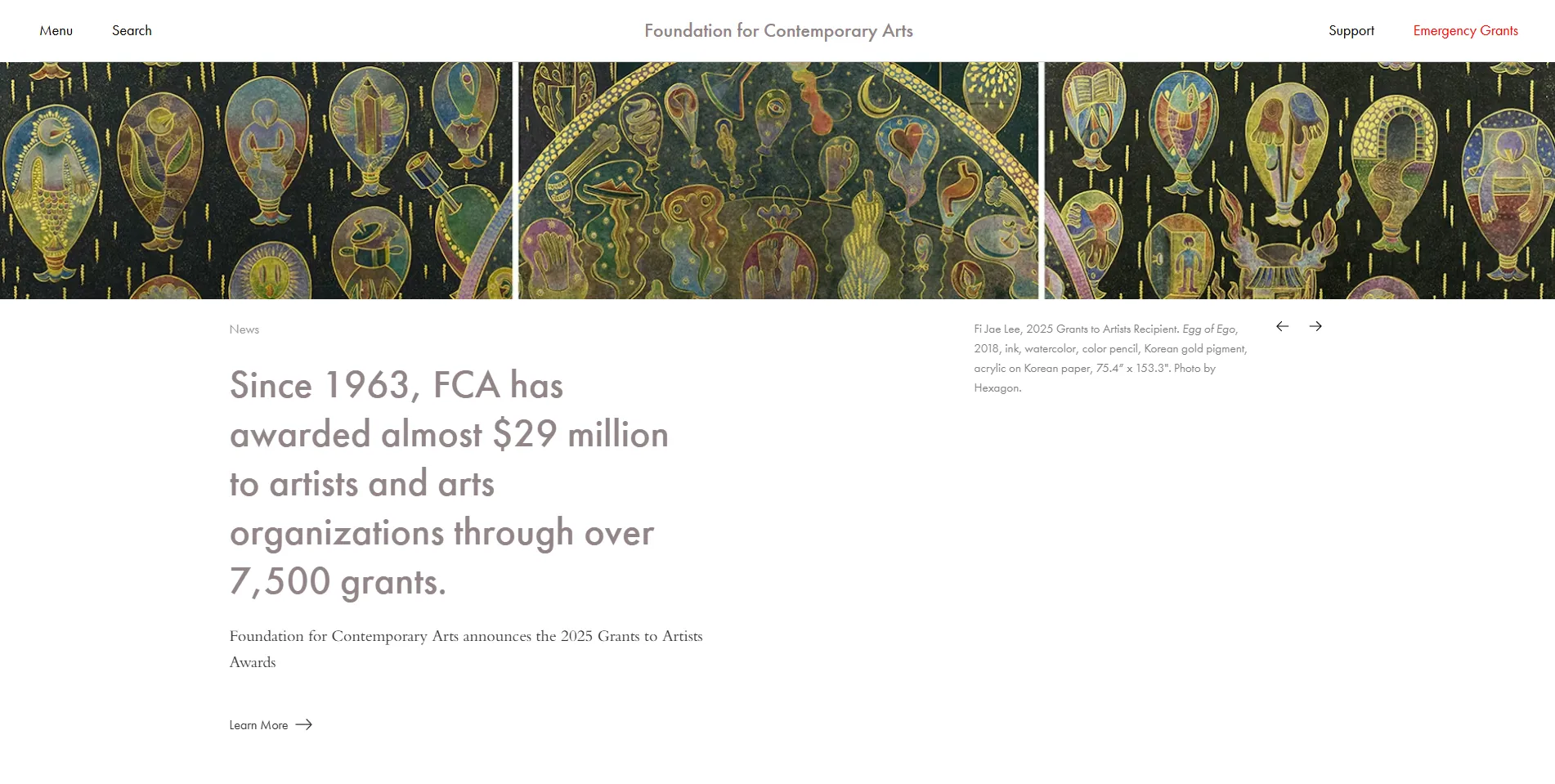
A curator emails you on a Tuesday. They want your work in a show opening in six weeks. The opportunity is real, confirmed, and could change your career. There is one problem: you cannot afford to ship the pieces, book the flights, or fabricate the installation. You have maybe $400 in your checking account. This is the exact gap the Foundation for Contemporary Arts (FCA) Emergency Grants program was built to fill.
Most grants in the art world operate on timelines that make no sense for actual emergencies. You apply in October, hear back in April, and by then the opportunity is long gone. FCA flips that model. They review applications monthly, respond fast, and disburse funds within roughly a week of approval. The catch? The grants are small ($500 to $3,000, averaging about $2,200), and the word "emergency" means something very specific here.
What Actually Counts as an Emergency
FCA does not fund medical bills, rent, or general financial hardship. If you are facing a personal crisis, look at the Gottlieb Foundation Emergency Grant or the Joan Mitchell Foundation instead. FCA defines emergency purely in terms of opportunity and timing: you have a confirmed, public presentation of your work happening in less than 10 weeks, and you cannot secure other funding fast enough to cover the costs.
Qualifying situations include a nonprofit gallery exhibition where you need to ship work, a festival that accepted your performance but cannot cover your travel, or a screening where you need to finish production on a piece that is close to completion. The opportunity must have specific, confirmed dates at the time you apply. You cannot apply speculatively.
There are hard exclusions. Commercial gallery shows and art fairs do not qualify. Work-in-progress showings, workshop readings, and residency-related open studios are out. Educational programming, conferences, and competitions are ineligible. Publishing books, albums, or music videos is not supported. And you cannot apply for expenses you already paid before submitting the application.
The Experimental Requirement
This is where many applicants get rejected. FCA was founded in 1963 by Jasper Johns, John Cage, and Robert Rauschenberg to support contemporary, experimental work. The program is not for traditional landscape painters, commercial photographers, or artists whose practice sits comfortably within established conventions. The guidelines state that FCA considers "all elements of an application in context to determine if an artist's work aligns with our mission to support experimental practices."
If your work is not genuinely experimental in nature, you will likely be declined. The program supports artists working in dance, music/sound, performance art/theater, poetry, and visual art, but only work that pushes boundaries within those disciplines. This is not subjective taste on the part of reviewers; it is the foundation's founding mandate.
How the Process Works
Applications are submitted through Submittable and reviewed by a multidisciplinary panel of artists that meets monthly. FCA advises applying 8 to 10 weeks before your presentation date. If you apply with less than 6 weeks remaining, you may not hear back until your project is already underway.
You need: documentation of the confirmed opportunity (invitation letters, contracts, emails with dates), a detailed itemized budget showing both expenses and income sources (each marked confirmed or pending), work samples, and a resume. FCA provides budget templates on their website. Use them. Applications with vague or incomplete budgets get declined.
Once approved, FCA pays out electronically within about a week of notification. That speed is the program's single greatest advantage over every other funding source available to artists.
The Numbers: What Your Odds Look Like
FCA receives an average of 100 applications per month and makes approximately 15 to 20 grants. That is a 15-20% approval rate, which is significantly better than most competitive grants. However, a large portion of applications are rejected because they do not meet eligibility criteria rather than because the work is not good enough. If you carefully read the guidelines and confirm your situation qualifies before applying, your real odds are considerably higher than the raw numbers suggest.
One important restriction: if you have received an FCA Emergency Grant or Grants to Artists award within the past three years (36 months), you must wait before applying again. Relief grants (COVID-19 funds, LA Fire Relief, Cancellation Funds) do not count toward this waiting period.
How It Compares
The FCA Emergency Grant is the fastest source of presentation funding for experimental artists in the US. The Gottlieb Foundation Emergency Grant covers personal catastrophes (medical, disaster) but not opportunity-based needs. The Joan Mitchell Foundation is now nomination-only and operates on a multi-year timeline. The Harpo Foundation offers larger awards ($10,000) but on an annual cycle with no emergency mechanism. FCA fills the gap between these programs: small money, delivered fast, for a specific type of need.
FCA also runs a separate Creative Research Grant program offering $10,000 for longer-term creative exploration. That program is not rolling and has its own application process. If your need is not time-sensitive, the Creative Research Grant may be a better fit.
Insider Tips for Applicants
- Be specific about what FCA money will cover. Do not request contingency funds. List exact line items: $450 for shipping via FedEx Ground, $320 for round-trip Amtrak to New York, $200 for framing materials. Vague budgets get declined.
- Mark every income line as confirmed or pending. If a venue is providing $500 in support, list it. If you are contributing your own money, include that in the income section. The FCA request should equal your total expenses minus your confirmed and pending income.
- Apply as early as possible within the 10-week window. Applications received 8-10 weeks out get full review. Applications received with 4 weeks left may not get a decision in time.
- Do not apply if your work is not experimental. Read the FCA mission statement and past grant recipients. If your practice does not align, you are wasting your time and theirs.
- Project-related childcare is eligible. If you need childcare during tech rehearsals or installation, include it in your budget. General childcare is not eligible, but project-specific childcare is.
Who Should Apply
Any individual artist living and working in the United States (or US territories) who has a confirmed public presentation of experimental work happening within 10 weeks, and who cannot cover the costs through other funding sources in time. You need a US Tax ID (SSN, EIN, or ITIN). You cannot be enrolled in any degree-granting program. Curators, producers, and organizations are not eligible; FCA funds artists directly.
The program is especially valuable for emerging and mid-career experimental artists who lack the financial cushion to absorb unexpected professional costs. A $2,000 grant that lets you participate in a respected nonprofit exhibition can generate connections and visibility worth far more than the dollar amount.
Final Verdict: Who Is This Actually For?
FCA Emergency Grants are for experimental artists who have a real, confirmed opportunity and no money to seize it. If you are a traditional painter invited to a commercial gallery show, this is not your program. If you are an experimental performance artist invited to present at a nonprofit venue in seven weeks and you cannot afford the bus ticket, this is exactly your program. Bookmark the FCA Emergency Grants page and familiarize yourself with the budget template before you need it. When the email arrives, you will not have time to figure out the process from scratch.