Canada Council for the Arts: What Actually Gets Funded in 2026
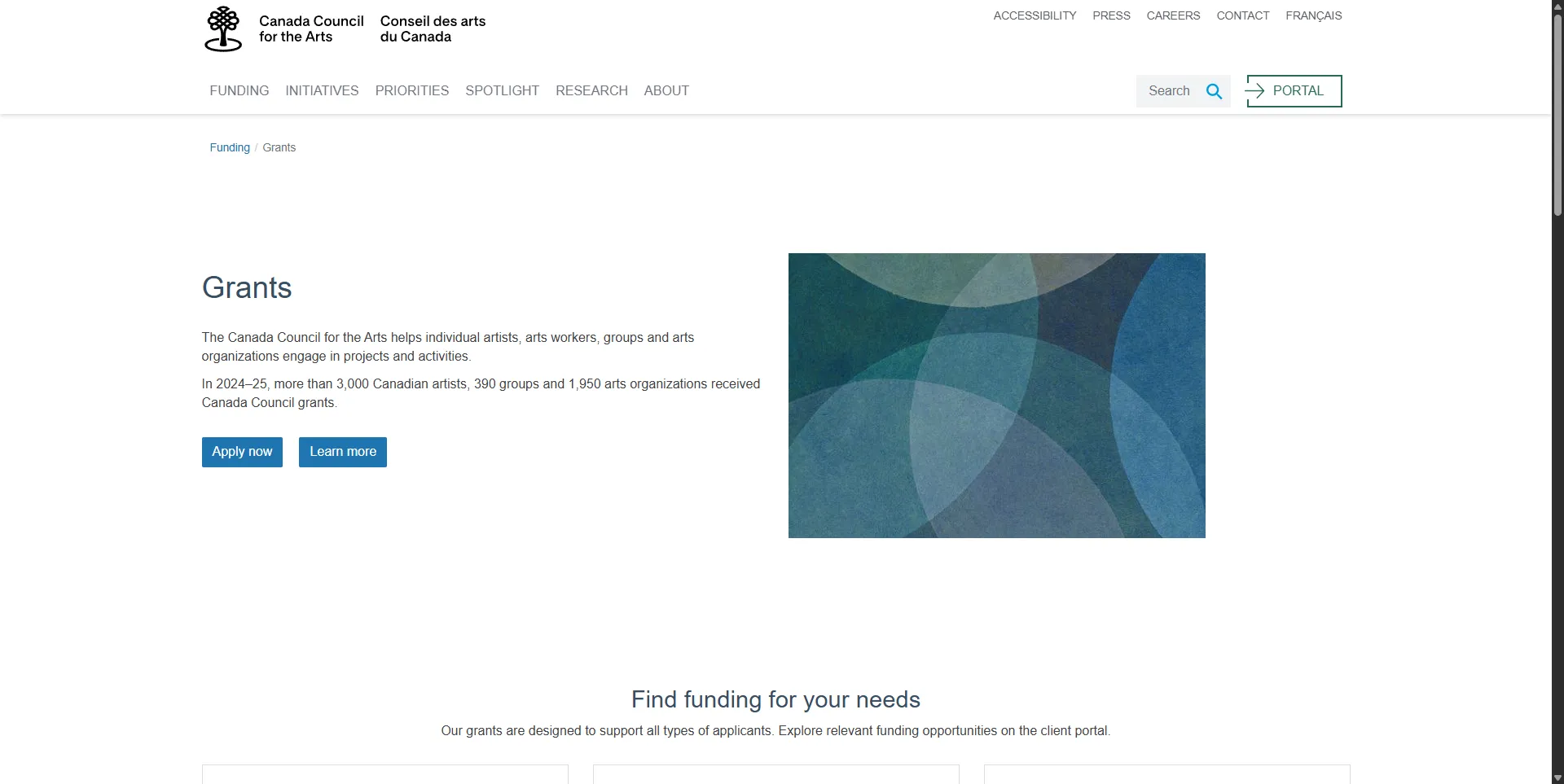
The Canada Council for the Arts has been around since 1957, making it one of the older national arts funding bodies in the world. In its most recent published competition results (2024-25), the Council assessed 7,370 applications through its Explore and Create program, approved 1,735 of them, and distributed $52 million. That is a 23.5% success rate, which sounds low until you realize that 35% of successful applicants were first-time grantees. The Council is not a closed shop. New applicants get funded.
But here is the catch: the Council restructured its funding programs a few years ago, consolidating dozens of separate grants into six main programs. If you are reading older guides that reference "Research and Creation" or "Concept to Realization" as separate grants, those have been merged into a single opportunity called Artistic Creation. The old names still appear in some documentation, but the current application portal is where you will find what is actually available.
Explore and Create: The Main Program for Individual Artists
Explore and Create is the program most individual visual artists will apply to. It supports research, development, creation, production, and sharing of work, plus professional development. The program encourages artists to investigate creative processes and take risks.
There are two funding opportunities within Explore and Create:
Artistic Creation
This is the primary individual artist grant. It supports the creation of artistic work from initial idea through to public presentation. You can apply at any stage of the creative process: research, development, production, or presentation.
- Deadline: Rolling. You can submit any time before the start date of your project or activity.
- Amount: Varies. Typical first-time awards run $5,000 to $25,000 for research/creation and $15,000 to $100,000 for concept-to-realization projects.
- Notification: Typically within 5 months of submission.
- Payment: Advance payment upon approval, disbursed within 30 days.
The rolling deadline is a significant advantage. Unlike programs with fixed annual deadlines, you can apply when your project is ready, not when the calendar says so. But do not treat "rolling" as "no urgency." Assessment still takes 4-6 months, so submit well before your project start date.
Artist-driven Organizations
This is for incorporated not-for-profit arts organizations that create, produce, present, or exhibit artistic activities. Multi-year funding is available, with a fixed annual deadline (April 2, 2025 was the most recent cycle). Notification takes about 8 months.
Funding is capped at 60% of your organization's average annual revenues over the last three completed fiscal years. This means smaller organizations face lower caps, regardless of project scope. If your organization averages $200,000 in annual revenue, your maximum request is $120,000, even if your project costs $300,000.
The Other Five Programs
Beyond Explore and Create, the Canada Council runs five other granting programs:
- Engage and Sustain: Multi-year funding for arts organizations and their community engagement.
- Creating, Knowing and Sharing: The Arts and Cultures of First Nations, Inuit, and Metis Peoples. Dedicated funding for Indigenous artists and organizations.
- Supporting Artistic Practice: Professional development and career advancement for artists and arts workers.
- Arts Across Canada: Projects that connect artists and communities across Canada.
- Arts Abroad: International presentation, exhibition, and professional development for Canadian artists abroad.
For individual visual artists, Explore and Create is almost always the right starting point. The other programs serve specific niches or organizational applicants.
The Peer Assessment Process
The Canada Council uses peer assessment panels, similar to Creative Australia and Creative New Zealand. In 2024-25, 316 peer assessors evaluated the 7,370 Explore and Create applications. Assessors are practising artists and arts professionals selected for expertise in relevant disciplines.
The Council publishes detailed competition results broken down by applicant type, province, field of practice, and designated priority group. This transparency is unusual among arts funders and gives you a concrete sense of your odds before you apply.
Key stats from 2024-25:
- Individual artists had a 22.7% success rate (1,449 of 6,388 applications)
- Groups had a 27.2% success rate (145 of 533)
- Organizations had a 31.4% success rate (141 of 449)
- 80.1% of funding ($41.7M) went to individual artists
- 35% of recipients were first-time Council grantees
How the Canada Council Compares to Other National Funders
The Canada Council shares its peer assessment model with other Commonwealth arts councils, but the rolling deadline for Artistic Creation sets it apart. Creative Australia uses fixed deadlines, which means you compete against everyone who applies in the same cycle. The Canada Council's rolling intake means your application is assessed against whatever else is in the queue at that moment, which can work for or against you depending on timing.
Compared to the NEA in the United States, the Canada Council offers more money to individual artists directly. The NEA primarily funds organizations, with individual artist grants limited to specific fellowships and lifetime honors. The Canada Council's $52 million for individual artists through a single program dwarfs what the NEA offers individuals.
The bilingual requirement (English and French) is a structural feature unique to Canada. All programs and materials are available in both languages, and you can apply in either. Peer assessment panels include assessors who can evaluate applications in both languages.
Insider Tips for Applicants
- Validate your portal profile 30+ days before submitting: The Canada Council's client portal requires profile validation, which takes time. Do not leave this until the last minute.
- Almost all successful applicants receive the full eligible amount requested: The Council's approach is to fully fund strong applications rather than partially funding a larger number. This means you should request what you genuinely need, not a inflated amount hoping to get a fraction.
- Do not over-itemize your budget: One of the most common rejection reasons is over-itemized budgets with $50 line items. Provide realistic, high-level budget categories.
- No matching funds required: Unlike many grant programs, the Canada Council does not require you to show other revenue sources. Your budget must be realistic, but you do not need co-funding to be competitive.
- First-time applicants have a real chance: 35% of successful applicants in 2024-25 were first-time grantees. The Council actively works to improve access for new applicants, youth, official language minority communities, and historically underserved populations.
Who This Is For (and Who It Is Not For)
This is for: Canadian citizens and permanent residents who are professional artists. The Council defines "professional" as someone who has completed training in their discipline, is recognized by peers as a professional, and is committed to their practice as a primary activity. You do not need to earn your full income from art.
This is not for: Students, non-Canadian residents, or artists who have not yet established a professional practice. If you are early in your career without a track record of public presentation or peer recognition, you may need to build your profile before applying. The Supporting Artistic Practice program may be a better entry point for early-career artists seeking professional development funding.
Final Verdict: Who Is This Actually For?
The Canada Council for the Arts is the most accessible major national arts funder for individual artists in North America. The rolling deadline for Artistic Creation means you can apply when your project is ready, the success rate for individuals (22.7%) is reasonable for a national competition, and first-time applicants have a genuine chance. The $52 million distributed through Explore and Create alone makes it one of the largest individual artist grant programs in the world. If you are a Canadian visual artist with a strong project and a professional track record, this is your primary funding source.
Visit the Canada Council Explore and Create page to start your application.